
Scales of Justice
Lesson Creator: The New Jersey Center for Civic Education, Rutgers University, Piscataway, NJ.
Grade Level: Elementary
Objectives: Students will be able to:
- Identify the structure of New Jersey’s court system
- Analyze how procedural due process protects fairness
- Explain why judges must be impartial
- Explain why judicial independence is important
Time Required: Three-four class periods
New Jersey Student Learning Standards for Social Studies (2020):
6.1.5.CivicsPI.2: Investigate different ways individuals participate in government (e.g., voters, jurors, taxpayers)
6.1.5.Civic.DP.1: Using evidence, explain how the core civic virtues and democratic principles impact the decisions made at the local, state, and national government (e.g., fairness, equality, common good).
6.1.5.CivicsDP.2: Compare and contrast responses of individuals and groups, past and present, to violations of fundamental rights (e.g., fairness, civil rights, human rights).
6.1.5.CivicsPR.1: Compare procedures for making decisions in a variety of settings including classroom, school, government, and /or society.
Essential Questions:
- What is the structure of the state court system in New Jersey?
- What is procedural due process and why is it important?
- What is the role of a judge?
- What is the role of a juror?
- Why is judicial independence important in a democracy?
Vocabulary
- Procedural Justice
- Trial
- Jury
- Juror
- Judge
- Impartial
Day One: Background Vocabulary discussion
What is a trial?
A trial is a formal examination of evidence before a judge, and typically before a jury, in order to decide guilt in a case of criminal or responsibility in civil proceedings. The trial must follow due process rules that ensure that it is conducted impartially.
What is the role of a judge?
Judges, who are appointed in New Jersey but elected in most states, preside over court proceedings, including civil and criminal cases. The judge must conduct the trial impartially. The judge gives instructions to the jury and in cases with no juries, decides on the facts and the rulings.
What does “impartial” mean and why is it important?
Impartial means fair, objective unbiased. Court decisions should be based on objective criteria, rather than on the basis of bias, prejudice, or preferring the benefit to one person over another for improper reasons.
Why is it important for judges to be impartial? The Framers and the ratifiers considered that a fair and impartial judiciary — one that followed the law and was not biased, partisan, intimidated or seeking preferment — was central to a republican form of government. They believed that judicial independence was critical to fairness and impartiality. This was important so that the public would have faith in the decisions of the courts.
What is the role of a juror?
A jury is a body of people from the community who are summoned to a trial to consider the evidence introduced and decide the facts in accordance with the principles of law laid down by the judge’s charge to the jury. Juries developed in England during the Middle Ages, and are a hallmark of the British common law legal system.
Day One: The structure of New Jersey’s state court system
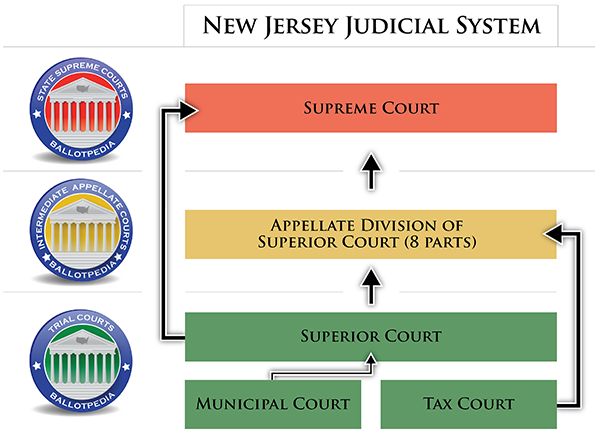
Share Handout 1 with your students. Ask: How many kinds of courts are there in New Jersey? There are several levels are courts in New Jersey: Municipal courts, Trial Courts, Appellate Courts and the New Jersey State Supreme Court. Discuss the scope and function of the various state courts.
Municipal courts
A municipal court is a local court in a city or town. Some smaller towns or townships might share a municipal court. Municipal courts have limited jurisdiction. That means that they only handle certain kinds of court cases. Municipal courts primarily handle parking and traffic tickets, minor criminal offenses and violations of local ordinances. Municipal court cases are decided by judges, not juries.
Trial Courts
A trial helps people who disagree resolve their disagreement without fighting. A trial helps the court find out if someone broke the law or caused harm to someone. Trials are a much better way to deal with a disagreement than fighting. For this reason, trials play an important role in a peaceful society. Trials only work if everyone involved in them agrees that they are fair and just. Otherwise, they might not agree to live with the outcome of the trial. Every trial has a plaintiff, the person or business that brought a complaint to court—an announcement that a person, group or entity has harmed the plaintiff. In criminal cases, the plaintiff is the State of New Jersey representing the people of the state. It is the government's job to make sure people who break the law are caught and punished.
Criminal trials always require a jury. A judge may decide a case alone in certain civil cases such as (1) family matters, such as divorce, adoption, or custody hearings, (2) Tenant/landlord disputes, (3) collections issues, (4) Drinking while driving or other municipal court cases where no injuries took place, (5) juvenile court issues, (6) workers compensation cases, (7) probate or chancery cases.
Appellate courts
The Superior Courts of New Jersey include a Trial Division and an Appellate Division. The judges on the Appellate Division review the cases sent to them from the trial division.
New Jersey State Supreme Court
The state supreme court in New Jersey includes seven justices appointed by the governor. The New Jersey State Supreme Court only hears certain cases:
1. A case about a new law;
2. Where the two or three Appellate Division judges do not agree with each other on how a case should be decided;
3. An inconsistency in decisions;
4. A case that has been appealed and the Supreme Court believes that it is so important that it could affect many of New Jersey’s citizens for years to come.
United States Courts
The U.S. Constitution is the supreme law of the land in the United States. It creates a federal system of government in which power is shared between the federal government and the state governments. Due to federalism, both the federal government and each of the state governments have their own court systems. State courts make the final decisions involve state law and constitution. Federal courts interpret federal laws and the U.S. Constitution. When state courts decisions involve the interpretation of federal law or the U.S. Constitution, they may be appealed to the U.S. appellate courts.
Day Two: Procedural Justice
Procedural justice refers to the fairness of the procedure used to gather information and make decisions. Police often need information about people they think have broken the law. How they get this information is important. Courts have procedures for gathering information and making decisions that include:
- the right to tell your side of the story
- the right to have a friend or lawyer help tell your side of the story
- the right to have witnesses who support you
- the right to question witnesses who testify against you
- the right to an impartial judge and jury
Local school boards, city councils, the president of the United States and Congress all need to gather information and make decisions, using fair procedures.
Procedural justice is important because it:
- increases the chances of getting the information needed to make wise and fair decisions.
- ensures the wise and fair use of the information in making decisions.
- Protects important individual rights, such as freedom, liberty and dignity.
Critical Thinking Activity: Have students identify the procedural justice issue in each of these situations:
1. Rosie thought someone in the class had taken her radio. During recess while everybody was on the playground, Rosie went back into the classroom and searched every desk.
This is not procedural justice. Student desks cannot be secretly searched. And Rosie is not an appropriate authority to search desks.
2. The police arrested Jed for kidnapping. Jed’s lawyer asked for a trial by jury. Twelve juror had e to be chosen from a group of 100 people. Jed’s lawyer had the right to questions each person. She could refuse to accept people she thought might be prejudiced against Jed.
This is part of procedural justice. The lawyer for a defendant in a criminal case has the right to question the potential jurors to eliminate people who might be prejudiced against the defendant.
From Foundations of Democracy: Justice, for elementary grades (4th ed)(Center for Civic Education, 2020)
Assessment:
Ask students to explain orally or in writing one of the following:
- Why is procedural due process important for fairness
- What the role of a jury is
- Why is it important for the judiciary to be independent of the other branches of government.
Extension:
- Have students participate in the New Jersey State Bar Foundations’ annual mock trial law fair for grades 3-6. For information, go to https://njsbf.org/school-based-programs/mock-trial/law-fair-competition-for-grades-3-to-6/
- Engage students in the New Jersey State Bar Foundation’s activities for elementary students at https://njsbf.org/school-based-programs/mock-trial-civics-online-content/
Handout 1
New_Jersey_State_Court_Flow_Chart.png (600 × 464 pixels, file size: 113 KB, MIME type: image/png)