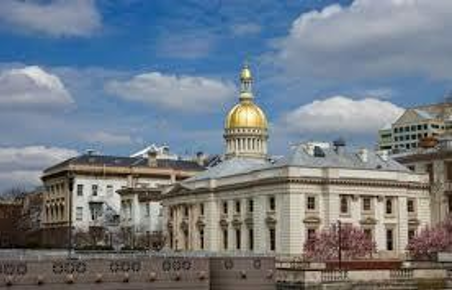
New Jersey State House, Trenton, NJ
Lesson Creator: NJ Center for Civic Education, Rutgers University, Piscataway Lesson Length: Four-Five 40-minute periods
Grade Level: Elementary
New Jersey Student Learning Standards for Social Studies (2020):
6.1.5.CivicsPI.3: Explain how the United States functions as a representative democracy and describe the roles of elected representatives and how they interact with citizens at local, state, and national levels
6.1.5.CivicsPI.4: Describe the services our government provides the people in the community, state and across the United States.
6.1.5.CivicsPI.5: Explain how government functions at the local, county, and state level. 6.1.5.CivicsPI.6: Distinguish the roles and responsibilities of the three branches of the national government.
6.1.5.CivicsPI.7: Explain how national and state governments share power in the federal system of government.
6.1.5.CivicsPI.8: Describe how the United States Constitution defines and limits the power of government.
6.1.5.Civic.DP.1: Using evidence, explain how the core civic virtues and democratic principles impact the decisions made at the local, state, and national government (e.g., fairness, equality, common good).
Common Core ELA Standards
RI.5.1 Quote accurately from a text when explaining what a text says explicitly and when drawing inferences from the text.
RI.5.4 Determine the meaning of general academic and domain-specific words and phrases in a text
W.5.2 Write informative/explanatory texts in which they introduce a topic. Use facts and definition to develop points and provide a concluding statement
W.5.7 Participate in shared research and writing projects
W.5.8 Gather information from provided sources to answer a questionSL.5.1 Engage effectively in a range of collaborative discussions, building on others’ ideas and expressing their own clearly
SL5.2 Summarize a written text read aloud or information presented in diverse media
Objectives: Student will be able to:
- Identify the concept of federalism as one of the major principles of the United States Constitution.
- Explain the reason for the inclusion of this concept in the United States Constitution.
- Compare and explain the different powers held by the federal government and those held by the states.
- Analyze whether certain issues should be addressed by the federal government, by state government, or concurrently.
Focus questions:
- Why do we need government?
- What is democracy?
- What is a republic?
- What is a constitution?
- How does our Constitution limit what the government can do?
- What are the problems with a dictatorial government?
- What is federalism?
- What powers does the national government have? What are reserved to the states? What powers are held by both?
- What other ways are power limits? What is separation of powers?
- How are New Jersey’s state and local government organized?
Why do we need government?
Day One, Activity 1 - Why do we need rules and laws?: Begin the activity by asking students to look at Handout 1 and respond to the following questions:
- What is happening in the picture? (Potential answer: Students may respond that the bigger kids are bullying or hurting the smaller boy - literally shaking him down for money).
- How could this be prevented? (Potential answer: With rules or laws and someone in authority to enforce them)
Continue activity 1 by asking students, why do we need rules or laws?
(Potential answers)
- To protect the weak from the strong
- To protect individual rights
- To keep us safe
- To help us keep order
- To settle arguments
- To help us share things in a fair way
Teachers may want to supplement this activity with the following video developed by iCivics and Nickelodeon 'Rules & Laws' Full Song ⚖️ Well Versed Episode 2 | Nickelodeon
Day one, Activity 2 - The Difference Between Power and Authority -
Help students understand the difference between power and authority. Power refers to the ability to use force. Authority is the power to use force combined with the right to use that power. Refer back to handout, Ask students the following questions:
- Does the bully in the picture have power?
- Does the bully have authority?
- Why or why not?
Then ask students to identify who has the authority to enforce rules or laws? Potential answers may include:
- Teachers
- Principals
- Crossing Guards
- Policemen and women
- Parents
- Governmental officials
Complete the activity 2 by asking students to identify whether power or authority in described in the following examples (Teachers are encouraged to add to or alter the list of examples in ways that are identifiable and relatable to their students::
- A thief robs you at gunpoint
- A parent tells her children to brush their teeth
- A teacher assigns homework to his students
- Jimmy forces Susie to leave the playground
- The legislature bans smoking in restaurants
More examples and activities can be found in Who has Authority Over Me, a comprehensive lesson developed by the Center for Civic education CIFD L2 Authority Lesson Plan
Day One, Activity 3: Now that students have been introduced to the need for rules and law and the difference between power and authority, engage them is a discussion about different kinds of government that can make and enforce rules and laws with authority.
What is a democracy?
- Democracy is a system of governance where the power is vested in the people.
- The United States is a democracy, as is Canada, France, Germany and Britain. Britain may have a queen but the power resides with the people who elect representatives to make decisions for them.
- In a direct democracy, everybody is involved in making decisions.
- In most democracies, decisions are made by elected representatives (see republic)
For more information and a deeper understanding of democracy see: Democracy - A short introduction and 'Our Voices' Full Song 🗣 Well Versed Episode 7 | Nickelodeon
What is a republic?
- A republic is a form of government in which representatives are elected to make governmental decisions for the general public and are responsible to the electorate.
- The United States has a republic because in most cases decisions about government are made by representatives serving in governmental institutions rather than by direct vote of the people.
For more information and for the difference between a democracy and a republic see: Democracy Vs Republic | What's the difference between a Democracy and Republic? Democracy Explained
What is a constitution and what does it do?
- Constitutions are the means used to state the powers that the government shall have. By defining these powers, constitutions limit the powers of government both in what it does and how it acts (due process).
- The United States has a constitutional government because the U.S. Constitution is the supreme law that everyone must obey including those serving the government.
- Government is limited to acting within the law and subject to judicial review as to whether its actions are within the Constitution.
- In a dictatorial government there are no limits on those who run the government. When the United States Constitution was created in 1787 most governments were run by hereditary monarchs who had absolute power to do whatever they wanted.
For additional information and a more complete understanding, see The Constitution Explained - YouTube, developed by iCivics and the Center for Civic Education. Each video is very student friendly and approximately two minutes long. Teacher can review the entire series and select those best suited for their students’ understanding
Day Two: Federalism
Background class discussion: What is Federalism?
- A federal system is one in which the national and state government share power.
- The Constitution established a federal system of government with power shared between the state and federal government.
- The Constitution lists specific roles of the federal government, including declaring war and printing money.
- The Tenth Amendment to the Constitution specifically states that “The powers not delegated to the United States by the Constitution, nor prohibited by it to the States, are reserved for the States respectively, or to the people.”
- Some powers not listed and therefore reserved to the states include the power to regulate intrastate trade and issue licenses. Students will explore this topic in Activity 4.
For additional information and a more complete understanding of federalism, see Foundations of the Constitution - Teaching Federalism, Separation of Powers, and Checks and Balances and States' Rights - Teaching the Tenth and Eleventh Amendments
Day Two, Activity 4: How Does Federalism Work?
Prepare cards (see Handout 2) with government activities, such as:
- Establish post offices
- Raise an army
- Conduct elections
- Establish local governments
- Take measures for public safety
- Collect taxes
- Build roads
- Coin money
- Establish courts
- Regulate commerce with foreign nations
- Make and enforce laws
- Declare war
- Regulate commerce within the state
Put students in groups of three: National Government, States and the People. Share Handout 3 (a simplified version of the U.S. Constitution, Art. 1, Sec. 8) with your students. Have students determine which of the following powers have been given to Congress, which have been reserved to the states (by not being delegated to Congress), and which powers the state and national governments share. Have them give the cards to the entity that has the authority (See Handout 2).
- What are the “States”, “the People” and “the National Government” doing?
- Who is holding most of the “power” cards? The people.
- So where does the power come from in our federal system of government? The people.
- To whom is power delegated: To the federal and state governments.
- Why do you think the Framers chose a federal system of government? They wanted to limit the power of the federal government and keep issues which did not have to be decided nationally at a more local level of decision-making.
- What are some of the advantages of a federal system of government? State and national governments each have limited powers.
- What are some of the disadvantages? Sometimes the authority of the two governments overlaps, for example environmental issues and this can be confusing.
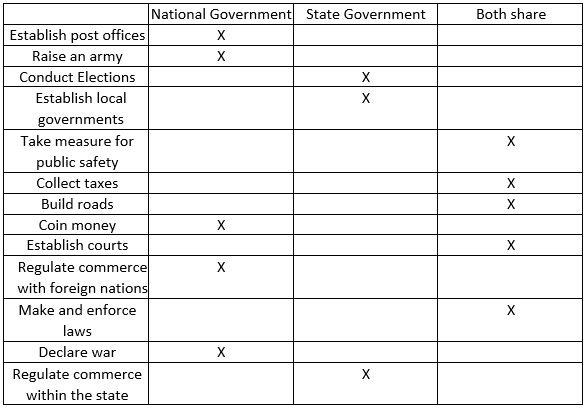
Day Two, Activity 5: Who Has the Power? As a formative assessment, have students complete the chart in Handout 4: Who Has the Power? Which Government has the Power to:
- Establish post offices
- Raise an army
- Conduct elections
- Establish local governments
- Take measures for public safety
- Collect taxes
- Build roads
- Coin money
- Establish courts
- Regulate commerce with foreign nations
- Make and enforce laws
- Declare war
- Regulate commerce within the state
A completed chart Who has the Power?:
Day Three: Separation of powers
Background: The concept of separation of powers was developed by baron de Montesquieu, an 18th century French social and political philosopher. Under his model, the political authority of the government is divided into legislative, executive and judicial powers. He asserted that, to most effectively promote liberty, these three powers must be separated and act independently.
Separation of powers, therefore, refers to the division of government responsibilities into distinct branches to limit any one branch from exercising the core functions of another. The intent is to prevent the concentration of power and provide for checks and balances.
- The legislative branch is responsible for enacting the laws of the state and appropriating the money necessary to operate the government.
- The executive branch is responsible for implementing and administering the public policy enacted and funded by the legislative branch.
- The judicial branch is responsible for interpreting the constitution and laws and applying their interpretations to controversies brought before it.
Most state constitutions, including New Jersey’s, specify that government be divided into three branches: legislative, executive and judicial.
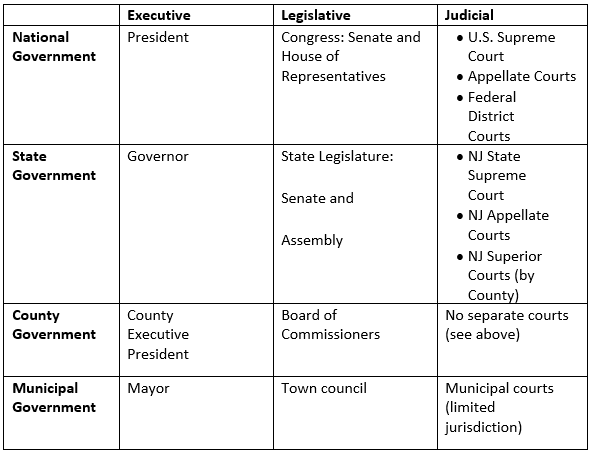
Day Three, Activity 5: Divide your class into small groups of students. Have the small groups of students complete the chart (Handout 5: Separation of Powers at National, State and Local Levels) to identify how executive, legislative and judicial powers are separated at the national, state and local levels.
- The Governor holds the executive position in the state, similar to the president of the country.
- The State Legislature, which consists of a State Senate and State Assembly hold the legislative positions, much like the U.S. Senate and House of Representatives.
- The County Freeholders are empowered with a broad scope of authority, some of which is designated to them by the State of New Jersey, including, but are not limited to, law enforcement, welfare, education, roads, and economic development. They share these functions with local (municipal) governments, which are also empowered by the state.
- At the local government level, the executive and legislative functions are not as clearly defined, although some counties have moved to having a county executive with clear executive functions.
- States also have three levels of judicial review (NJ Superior Courts, Appellate Courts and a State Supreme Court) much like the national government (federal District Courts, federal Appellate Courts and the U.S. Supreme Court). Municipal courts are courts of limited jurisdiction, having responsibility only for motor vehicle and parking tickets, minor criminal-type offenses (for example, simple assault and bad checks), municipal ordinance offenses (such as dog barking or building code violations) and other offenses,
A completed chart: Separation of Powers
Day Four: Local Government: How and when was your town and county organized?
Historical Background: As a colony, New Jersey was governed by two groups of proprietors as two distinct provinces, East Jersey and West Jersey, between 1674 and 1702. New Jersey's first counties were created as administrative districts within each province, with East Jersey split in 1675 into Bergen, Essex, Middlesex and Monmouth counties, while West Jersey's initial counties of Burlington and Salem date to 1681. New Jersey's county names derive from several sources, although most of its counties are named after place names in England and prominent leaders in the colonial and revolutionary periods. These original counties then broke into additional units as their populations grew. See the lesson, “New Jersey’s Counties”.
New Jersey’s Municipalities
Background: New Jersey has 564 municipalities—a lot for a small state. There have been over 600—the state has been encouraging regionalizing towns and school districts.
Traditional forms of local government developed over centuries include:
- Borough (mayor and council elected at large)
- City (strong mayor)
- Township (mayor (weak) selected by the committee each year)
- Town (mayor elected at large, council by wards)
- Village (weak mayor, strong council--village form of local government was ended by legislation in 1989—now township but can still say “Village of…”)
What is the basis of these differences? History. Some have strong mayor; others stronger committee members. So executive and legislative functions depend on the form of local government.
Day Four: Local Government: How and when was your town organized?
The New Jersey State League of Municipalities is a voluntary association created by a New Jersey statute in 1915 to serve municipalities and local officials and has a lot of information about NJ municipalities.
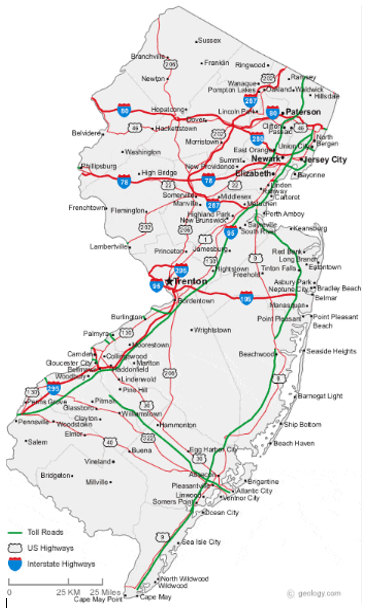
Day Four, Activity 6: Identify your town on a map of New Jersey (Handout 6) and conduct a short research project to discover when they were incorporated and what type of local government (borough, town, township, city) you have.
Day Four: School Districts
Local Boards of Education are made up of members of the community who are elected by their neighbors. The role of the school board is to set policies for the district—it is essentially the “legislative branch”. School Superintendents are the executive branch and carry out the policies set by the board. Challenges to school district policies are brought to Superior Court.
Unlike many other states where educational policy (start and end dates for the school year, school curriculum, etc.) is almost totally set by the state, there is a great deal of local control by local school boards in NJ.
Day Five: Critical thinking activity: Have students consider why we should know about our local government? Have them think about a normal day in their life. Water, roads, schools are all locally controlled. Local government probably has the most influence over our lives. And we have the most control over our local government and school boards because it is run by our neighbors, ourselves. And New Jersey is a very local control state.
Assessment
- Students find three articles (in newspaper, magazines, online, etc.) that represent federalism in the United States today. They should summarize the articles and explain why the issue is controlled by the federal or state government.
- Students conduct a short research project to identify a problem that they think needs to be addressed in your community. Since numerous problems will be identified, have them distinguish which level of government would address each of the problems/issues raised.
Handout 1
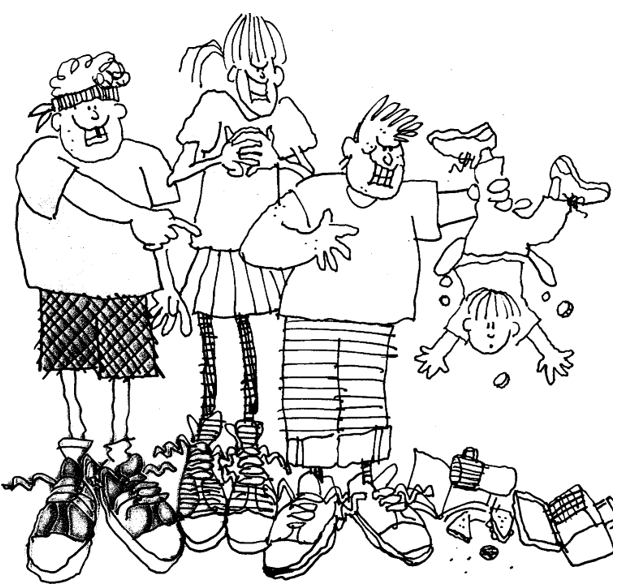
From We the People: The Citizen and the Constitution (Center for Civic Education)
Handout 2
Who has the power? The federal or state government?
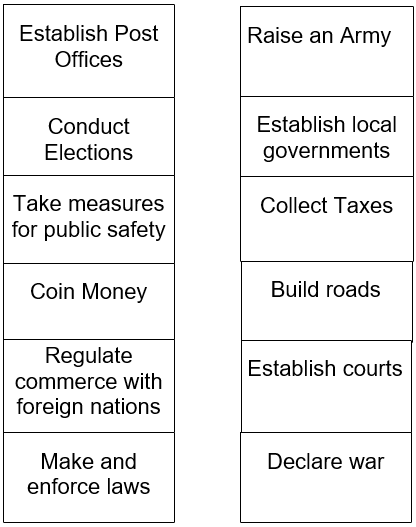
From We the People: The Citizen and the Constitution (Center for Civic Education)
Handout 3
Excerpt from the U.S. Constitution
Article I Section. 8.
The Congress shall have Power
To lay and collect Taxes, Duties, Imposts and Excises, to pay the Debts and provide for the common Defence and general Welfare of the United States; but all Duties, Imposts and Excises shall be uniform throughout the United States;
To borrow Money on the credit of the United States;
To regulate Commerce with foreign Nations, and among the several States, and with the Indian Tribes;
To establish a uniform Rule of Naturalization, and uniform Laws on the subject of Bankruptcies throughout the United States;
To coin Money, regulate the Value thereof, and of foreign Coin, and fix the Standard of Weights and Measures;
To establish Post Offices and post Roads;
To constitute Tribunals inferior to the supreme Court;
To define and punish Piracies and Felonies committed on the high Seas, and Offences against the Law of Nations;
To declare War, grant Letters of Marque and Reprisal, and make Rules concerning Captures on Land and Water;
To provide and maintain a Navy;--And
To make all Laws which shall be necessary and proper for carrying into Execution the foregoing Powers, and all other Powers vested by this Constitution in the Government of the United States, or in any Department or Officer thereof.
Amendment X
The powers not delegated to the United States by the Constitution, nor prohibited by it to the States, are reserved to the States respectively, or to the people.
Handout 4: Who has the Power?
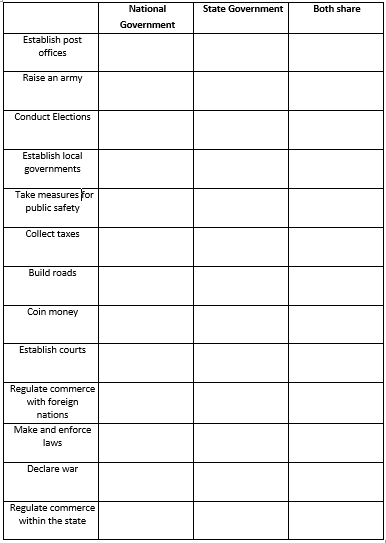
Handout 5:
Separation of Powers at National, State and Local levels
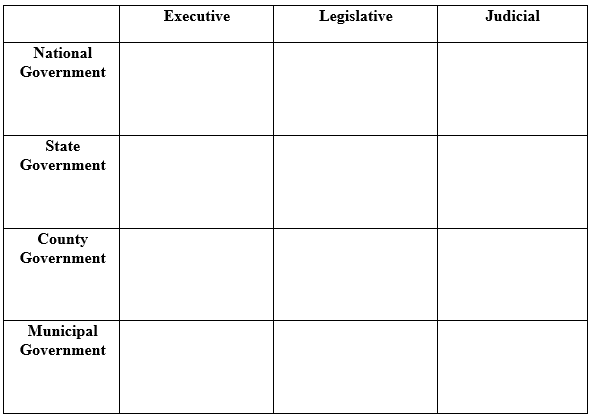
Handout 6: Map of New Jersey: Find your town