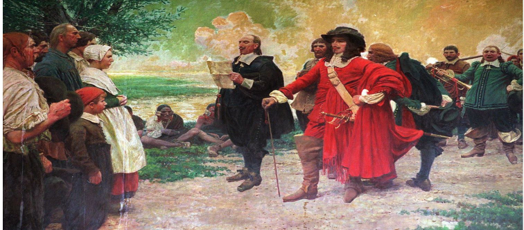
The Landing of Carteret in New Jersey, by Howard Pyle
Lesson Creator: The New Jersey Center for Civic Education
Grade Level: Elementary
Time: Three days
Objectives: Students will be able to explain
- Why immigrants decided to leave their homelands and settle in New Jersey
- What was colonial life like in the North American colonies
- How did life in the North American colonies differ from life in Europe?
New Jersey Student Learning Standards for Social Studies (2020):
6.1.5.GeoPP.6: Compare and contrast the voluntary and involuntary migratory experiences of different groups of people and explain why their experiences differed.
6.1.5.GeoGI.1: Use multiple sources to evaluate the impact of the movement of people from place to
place on individuals, communities, and regions.
6.1.5.GeoGI.3: Use geographic tools to determine factors that impacted emigration, settlement patterns, and regional identities of the U.S. colonies.
6.1.5.GeoGI.4: Explain how cultural and environmental characteristics affect the distribution and movement of people, goods, and ideas.
6.1.5.EconET.1: Identify positive and negative incentives that influence the decisions people make.
6.1.5.EconET.2: Use quantitative data to engage in cost benefit analyses of decisions that impact the individual and/or community.
6.1.5.EconET.3: Explain how scarcity and choice influence decisions made by individuals, communities, and nations.
6.1.4.D.15: Explain how various cultural groups have dealt with the conflict between maintaining traditional beliefs and practices and adopting new beliefs and practices
6.1.5.HistoryUP.1: Describe reasons various groups immigrated to New Jersey and America, and cite evidence from multiple perspectives to describe the challenges they encountered.
Common Core ELA Standards:
RI.4.1 Refer to details and examples in a text when explaining what the text says explicitly and when drawing inferences from the text.
RI.4.3 Explain events, procedures, ideas, or concepts in a historical…text, including what happened and why, based on specific information in the text.
RI.4.7 Interpret information presented visually, orally, or quantitatively (e.g., in charts, graphs, diagrams, time lines, animations, or interactive elements on Web pages) and explain how the information contributes to an understanding of the text in which it appears
W.4.2 Write informative/explanatory texts to examine a topic and convey ideas and information clearly.
W.4.3 Write narratives to develop real or imagined experiences or events using effective technique, descriptive details, and clear event sequences.
W.4.7 Conduct short research projects that build knowledge through investigation of different aspects of a topic.
W.4.8 Recall relevant information from experiences or gather relevant information from print and digital sources; take notes and categorize information, and provide a list of sources.
W.4.9 Draw evidence from literary or informational texts to support analysis, reflection, and research.
SL.4.1 Engage effectively in a range of collaborative discussions (one-on-one, in groups, and teacher-led) with diverse partners on grade 4 topics and texts, building on others' ideas and expressing their own
SL.4.2 Paraphrase portions of a text read aloud or information presented in diverse media and formats, including visually, quantitatively, and orally.
SL.4.4 Report on a topic or text, tell a story, or recount an experience in an organized manner, using appropriate facts and relevant, descriptive details to support main ideas or themes
Focus Questions:
- What pushed people to leave their homelands?
- What pulled immigrants to come to New Jersey?
- Would you immigrate to another country as an indentured servant?
- Where did people from different countries settle in New Jersey during the colonial period?
- What were the British colonies in America like in the 1770s?
- Compare the lives of colonists, women, indentured servants, and slaves in colonial New Jersey
Activities/Procedures:
1. Vocabulary
- Immigrate: to move to another country as a permanent resident.
- Self-sufficient: to provide for one’s self or family without external assistance.
- Religious Freedom: the ability of an individual or community to express and act upon religious beliefs in teaching, practice, worship, and observance free from government interference or requirements.
- Economic Freedom: the right to control one’s own labor and property.
- Indentured servant: a person who agrees to work without a salary for a certain period of time to repay the price of passage. Indenture is a form of labor where an individual is under contract to work without a salary to repay an indenture or loan within a certain timeframe. Indentured servitude was popular in the United States in the 1600 and 1700s as many European immigrants worked in exchange for the price of passage to America.
- Slave: one whose person and services are under the control of another as owner or master.
- Huguenots— French Protestants, many of whom, due to religious persecution, were forced to flee France to other countries in the sixteenth and seventeenth centuries.
- Immigrant—have students brainstorm what an “immigrant” is and conclude that it is a person who comes to live permanently in a foreign country.
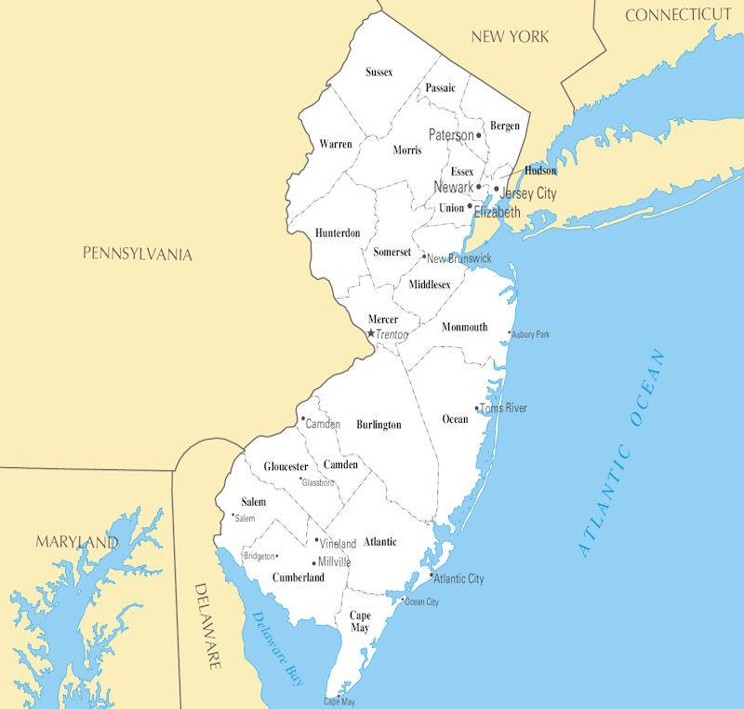
Day One, Map Activity: Where did early immigrants come from and where did they settle and why?
- In this activity, students will locate where groups of early immigrants settled in New Jersey. (Note that in some areas of New Jersey immigrants from several countries settled.)
- Historical Background (for teacher use or students, depending on their readiness):
- By the 1690s, as many as 900 Swedes and Finns had crossed the Delaware River to settle in Cape May, Gloucester, and Salem counties, in West Jersey.
- Bergen County was the first to be permanently settled by the Dutch because of its close proximity to New Amsterdam (New York). The Dutch continued to spread into Bergen County and the Raritan Valley and then into Somerset and northern Monmouth in the 1680s and 1690s.
- The area between the Raritan and Passaic rivers was granted to a group of English Puritans that led to the establishment of settlements at Elizabethtown (now Elizabeth) in 1665, Milford (now Newark, Woodbridge in 1666 and Piscataway in 1669.
- English Quakers and New Englanders settled the east bank of Cape May, and along New Jersey's southern coast, by 1690.
- Scottish settlers came to Monmouth, Middlesex, Somerset, and Mercer counties between 1683 and 1685 and established New Perth at Amboy Point (now Perth Amboy), Plainfield, Freehold, and wilderness areas of the Watchung Mountains. A second and third migration 1715 through 1750 brought Scots to Middlesex, Essex, Somerset, Hunterdon, and northern Burlington Morris, Sussex, and Salem counties.
- In the early 1700s, Dutch-speaking French Huguenots settled in the Hackensack Valley of Bergen County and some in Monmouth County.
- Germans started to settle in Bergen County in 1710. Later, German Lutherans followed the Raritan River through Monmouth and Somerset counties into northeastern Hunterdon County. A few Germans crossed over to New Jersey from Philadelphia and went to southern Hunterdon, Morris, and Sussex counties.
- Distribute a map of the 21 counties of New Jersey (Handout 1) as well as color crayons or pencils (red, blue, green, orange, purple, yellow and pink).
- Color key to where early immigrants settled:
- Swedish and Finnish settled in Cape May, Gloucester and Salem Counties. Stripe or color these counties RED.
- The Dutch settled in Bergen, Somerset and Northern Monmouth County. Stripe or color these areas BLUE.
- English Puritans settled in Union, Middlesex and Hunterdon Counties. Color or stripe these counties GREEN.
- English Quakers settled in Cape May County. Color or stripe this county ORANGE.
- The Scottish settled in Essex, Union, Monmouth, Middlesex, Somerset, Hunterdon, Morris, Sussex, Mercer, Salem and northern Burlington Counties. Color or stripe these areas PURPLE.
- French Huguenots settled in Bergen and Monmouth Counties. Color these counties YELLOW.
- Germans settled in Bergen, Monmouth, Somerset and northeastern Hunterdon County Color or stripe these areas PINK.
- Note: Students may get frustrated because the map will have lots of areas with many colors, indicating that people from many different countries lived close together in New Jersey even in colonial times!
- After completing the map, ask students to use the map to discuss and draw conclusions about early settlers in New Jersey. (Potential answers in italics)
- Early immigrants settled primarily along the New Jersey coast and the Delaware River to have the water resources to farm, fish, catch beaver and to travel.
- New Jersey was highly diverse even in colonial times.
- Some immigrant groups were small; others were large. Not everybody spoke English
- By the time of the first census in 1790, just under 70% of the people living in New Jersey were of English background (including Irish, Scotch and Welsh).
- Another 20 percent were of Dutch ancestry and 10 percent came from German states and surrounding countries like France, Austrian and Italian states).
- Only 1 percent were of Swedish descent.
- Not all immigration was voluntary
- The first U.S. Census in 1790 showed that of a total population of 184,139, there were 11,423 enslaved people in New Jersey brought from Africa against their will.
- This was approximately 6% of the state’s population.
Day Two, Critical Thinking Activity: Why did immigrants come to NJ and the U.S.?
Discuss: What does it mean to “immigrate”? What is religious freedom? What is economic freedom?
Activity: Why did people immigrate to New Jersey and America in the 1600-1700s?
Have students divide into groups and use graphic charts (Handout 2) to explain the economic, religious, or other reasons for Europeans immigrating to New Jersey and America in the 1600-1700s, and describe the challenges they encountered.
- Many early colonists came to America primarily to earn money by trading with the Native Americans for their furs. Later, when word spread of the bounty of the wide expanse and natural resources in America, many came to earn their living by farming. Land in Europe was limited and owned only by wealthy people. America was a very large place compared to most countries in Europe.
- Economic reasons. There was space in America for people to settle and own land. In Europe only the rich could afford to buy land. Land in America was cheap.
- Other European colonists settled in America because they were not allowed to practice their religious beliefs in France, Britain or other European countries.
Day Two: Critical Thinking Activity: Would you come to America as an indentured servant?
- Review Vocabulary and Background:
- Costs—weaknesses of alternative actions that can be taken
- Benefits—strengths of alternative actions that can be taken
- Opportunity Cost-- value of the best alternative forgone (what you give up), in a situation in which a choice needs to be made between several mutually exclusive alternatives given limited resources
- Indenture Servitude - a legal, written contract binding one party into the service of another for a specified term—usually five to seven years-- in exchange for transportation and the prospects of a job and a new life in the American colonies. The system of indenture and indentured servants was introduced in Colonial America (started by the Virginia Company in 1619) to meet the growing demand for cheap, plentiful labor in the colonies. Although the majority of indentured servants ended up in the tobacco fields of Virginia, some also came to New England and the Middle States, including New Jersey. Indentured servants were provided with basic necessities such as food, clothing and lodging during their term of Indenture but they were not paid any wages. Unlike slaves, the Indentured servants from Europe could look forward to a release from bondage.
- With an understanding of the vocabulary, have students consider four case studies and identify the costs and benefits of each leaving their home country and moving to the colonies.
Cut Handout 3 into four strips and give a strip to each student representing a person who is thinking about immigrating to America as an indentured servant. Have students consider the opportunity cost they would be giving up in order to immigrate to America and if you think the person described in the strip should immigrate as an indentured servant.
1. Patrick MacDonald believed there was little for him to do in Dundee, Scotland. He had lost his farm. His only work was intermittent farm work lasting a few weeks at one time. He had no money. His parents were aged and poor. One market day in the village, he heard men talking about opportunities to work on a farm in New Jersey. The work was difficult — clearing land. The indenture would last for four years.
2. William Schmidt felt he had been cheated out of his share of the family estate. His father had been a merchant of moderate means living in Dutch Bremen, Germany. William’s father had died. His mother, who remarried a man of less wealth, moved to Hamburg. Having little money left, William’s mother gave him some money but he soon spent nearly all of it. While in town, he was approached by a man who offered to buy him a mug of beer while they discussed signing a contract to go to work outside Philadelphia in New Jersey. The agent thought that a man of William’s background should be able to sign on with an artisan — perhaps a watchmaker.
3. Mary Dubois lived in a small village outside of Rheims, France, a town northeast of Paris. Not much is known about her. She was an orphan. Her uncle, a farmer, took care of her until she reached age 14. She knew she had always been a burden for the family of eight children. There were few young men in the village, and she had no prospects for marriage. One day, while walking in Rheims’s town center, she was told by an agent of a shipowner about a Protestant family in New Jersey that wanted an indentured servant to sew, spin, knit and do other household chores. Room and board were to be provided for five years, at which point she would be released from the contract.
4. Tom Holyfield was a thief. His life began well enough. He grew up on a farm outside Blackpool, England. As the youngest male in the family, Tom stood no chance to inherit the farm. He was apprenticed at age 13 to a cooper — a maker of barrels. He worked for room and board on the promise that he would be trained as a cooper. But Tom grew impatient and fell in with a gang of thieves. It wasn’t long before he and his friends were caught. Found guilty of a felony, Tom could be hanged — or he could accept a contract to work as an indentured servant.
Adapted from Focus: Understanding Economics in U.S. History (Council for Economic Education)
- Assessment: What influenced the decisions of individuals to become indentured servants?
Immigrants came to New Jersey as indentured servants because:- They wanted to start a life in the colonies and agreed to sign contracts
- They needed to escape religious persecution or were forced to go for other reasons
- They were unemployed or had no job prospects or were in debt or convicted of a crime and chose to emigrate rather than be in prison or without a job.
Day Three: What was colonial life like in New Jersey?
Have students research life in colonial New Jersey for children, Native Americans, women, slaves, indentured servants and complete Handout 4: comparing the level of freedom, and the ability to earn income, travel, and to own property of each group. You may want to consider using the National Geographic Series: “Voices from Colonial America: New Jersey 1609-1776”.
- Most settlers were self-sufficient farmers. This meant that they grew and made everything that they needed: food, clothing, tools, household goods. They were able to earn money and keep what they earned and were able to move to a new location.
- Married women and children were “dependents,” and unable to legally own their own property or money even if they were able to have a job.
- Some people were indentured servants who were obligated to work without pay and could not leave until their period of “indenture” had ended. An indentured servant was a colonist who didn’t have the money to pay for his voyage to America had someone else pay those costs and then he had to work for that person for a period of years, usually 5-7, and then was free to do as he pleased. Indentured servants ultimately attained their freedom once they completed their contract.
- A slave was a colonist who was brought here against his or her will to work on a plantation, small farm or in a city, without wages but with room and board. Enslaved people were permanently denied their freedom unless they could obtain the means to purchase themselves or successfully escape. Sometimes those who held enslaved workers allowed them to work for others in their spare time and keep their earnings.
Extension Activity:
- Visit a colonial home or farm in New Jersey, such as:
- The Robinson Plantation House, built around 1690 in Clark, Union County - Dr. William Robinson Plantation Museum | VisitNJ.org
- The Dutch-style Steuben House, built in 1695, in River Edge, Bergen County - Bergen County Historical Society
- The British-style Hancock House, built in 1735, in Lower Alloways Creek, Salem County - Hancock House - State Parks, Forests & Historic Sites
- The Cornelius Low House, a Georgian mansion built by a wealthy Dutch merchant in 1741, in Piscataway, Middlesex County - Cornelius Low House Museum | Middlesex County NJ
- The Vanderveer House, a Federal style home in 1779 in Bedminster Township, Somerset County - Jacobus Vanderveer House & Museum | Visit Somerset County NJ
Handout 1
Handout 2: Why did people come to the North American colonies in the 1600and 1700s?

Handout 3
Would you go to America as an Indentured Servant?
1. Patrick MacDonald believed there was little for him to do in Dundee, Scotland. He had lost his farm. His only work was intermittent farm work lasting a few weeks at one time. He had no money. His parents were aged and poor. One market day in the village, he heard men talking about opportunities to work on a farm in New Jersey. The work was difficult — clearing land. The indenture would last for four years.
2. William Schmidt felt he had been cheated out of his share of the family estate. His father had been a merchant of moderate means living in Dutch Bremen, Germany. William’s father had died. His mother, who remarried a man of less wealth, moved to Hamburg. Having little money left, William’s mother gave him some money but he soon spent nearly all of it. While in town, he was approached by a man who offered to buy him a mug of beer while they discussed signing a contract to go to work outside Philadelphia in New Jersey. The agent thought that a man of William’s background should be able to sign on with an artisan — perhaps a watchmaker.
3. Mary Dubois lived in a small village outside of Rheims, France, a town northeast of Paris. Not much is known about her. She was an orphan. Her uncle, a farmer, took care of her until she reached age 14. She knew she had always been a burden for the family of eight children. There were few young men in the village, and she had no prospects for marriage. One day, while walking in Rheims’s town center, she was told by an agent of a shipowner about a Protestant family in New Jersey that wanted an indentured servant to sew, spin, knit and do other household chores. Room and board were to be provided for five years, at which point she would be released from the contract.
4. Tom Holyfield was a thief. His life began well enough. He grew up on a farm outside Blackpool, England. As the youngest male in the family, Tom stood no chance to inherit the farm. He was apprenticed at age 13 to a cooper — a maker of barrels. He worked for room and board on the promise that he would be trained as a cooper. But Tom grew impatient and fell in with a gang of thieves. It wasn’t long before he and his friends were caught. Found guilty of a felony, Tom could be hanged — or he could accept a contract to work as an indentured servant.
Handout 4
Comparing freedoms