Map of New Jersey
Creator: New Jersey Center for Civic Education, Rutgers University, Piscataway, NJ
Grade Level: Elementary
Objectives: Students will be able to:
- locate the 21 counties in New Jersey
- identify which county and town that they live in
- the structure of their county and local government
New Jersey Student Learning Standards for Social Studies (2020):
6.1.5.CivicsPI.3: Explain how the United States functions as a representative democracy and describe the roles of elected representatives and how they interact with citizens at local, state, and national levels
6.1.5.CivicsPI.4: Describe the services our government provides the people in the community, state and across the United States.
6.1.5.CivicsPI.5: Explain how government functions at the local, county, and state level
New Jersey’s Counties
Background:
As a colony, New Jersey was governed by two groups of proprietors as two distinct provinces, East Jersey and West Jersey, between 1674 and 1702. New Jersey's first counties were created as administrative districts within each province, with East Jersey split in 1675 into Bergen, Essex, Middlesex and Monmouth counties, while West Jersey's initial counties of Burlington and Salem date to 1681.
New Jersey's county names derive from several sources, although most of its counties are named after place names in England and prominent leaders in the colonial and revolutionary periods.
The State of New Jersey entered the union as the 3rd state on December 18, 1787 with a total of 13 counties. Eight more counties were added in New Jersey between 1824 to 1857 bringing the total to 21 counties, where it has remained to this day.
Activity One: Identify the counties
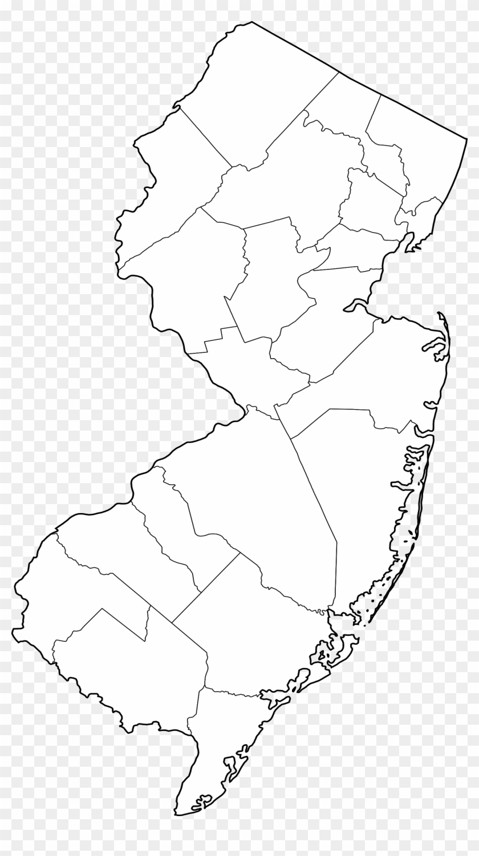
- Divide students into groups and give them Handout One: Map of New Jersey with county lines (but no names) and Handout Two: List of names of New Jersey counties (you can cut them into slips that your students can paste, tape or otherwise match to their appropriate locations on the map)
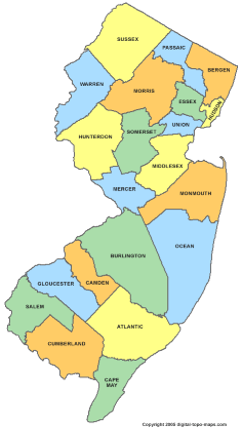
- Share Handout Three: Map of New Jersey with counties identified with the class
- Have students listen to or sing along with the students singing the NJ County Song at https://www.youtube.com/watch?v=HTZGsKpr-FQ
Activity Two: Why do we have counties? What services do county governments in New Jersey provide?
Have students work in groups to research what their county does by going online, looking at local news sources or contacting the clerk of the county office directly, and prepare a short written or oral presentation.
The presentations should include the following:
- NJ counties maintain significant powers since they have existed in some form since colonial times.
- Counties were created as administrative district courts within each province. Now there are 15 vicinages for Superior (trial) courts in the state, organized primarily by county (Bergen, Essex, Passaic, Hudson, Union, Middlesex, Monmouth, Mercer, Camden, Burlington and Ocean Counties; with Atlantic and Cape May Counties together; Morris and Sussex Counties together; Somerset, Hunterdon and Warren Counties together; and Gloucester, Cumberland and Salem Counties together as one court vicinage.
- Counties also provide services for older citizens, parks, public safety, road construction and repair, corrections (jails), help with elections, and maintain important property, health and other records.
Activity Three: How does your county government make decisions?
Background
- New Jersey counties are run by an elected board of commissioners.
- The county board of commissioners serves as both the legislative and executive body (for counties with supervisors or administrators, that person serves as the executive).
- Depending on the county, the executive and legislative functions may be performed by the Board of County Commissioners or split into separate branches of government.
- In counties without an Executive, a County Administrator (or County Manager) may be hired to perform day-to-day administration of county functions.
Have students research and determine the type of county government they have in their county.
- In 16 counties, the County Commissioners perform both legislative and executive functions on a commission basis, with each commissioner assigned responsibility for a department or group of departments.
- In the other five counties (Atlantic, Bergen, Essex, Hudson and Mercer), there is a directly elected County Executive who performs the executive functions while the commissioners retain a legislative and oversight role.
New Jersey’s Municipalities
Background: New Jersey has 564 municipalities—a lot for a small state. There have been over 600—the state has been encouraging regionalizing towns and school districts.
Traditional forms of local government developed over centuries include:
- Borough (mayor and council elected at large)
- City (strong mayor)
- Township (mayor (weak) selected by the committee each year)
- Town (mayor elected at large, council by wards)
- Village (weak mayor, strong council--village form of local government was ended by legislation in 1989—now township but can still say “Village of…”)
What is the basis of these differences? History. Some have a strong mayor; others have stronger committee members. So executive and legislative functions depend on the form of local government.
Local Government: How and when was your town organized?
The New Jersey State League of Municipalities (https://www.njlm.org/) is a voluntary association created by a New Jersey statute in 1915 to serve municipalities and local officials and has a lot of information about NJ municipalities.
Activity : Contact your local government to find out when your town was first incorporated and what type of local government (borough, town, township, city) you have.
New Jersey’s School Districts
Local Boards of Education are made up of members of the community who are elected by their neighbors. The role of the school board is to set policies for the district—it is essentially the “legislative branch”. School Superintendents are the executive branch and carry out the policies set by the board. Challenges to school district policies are brought to Superior Court.
Unlike many other states where educational policy (start and end dates for the school year, school curriculum, etc.) is almost totally set by the state, there is a great deal of local control by local school boards in NJ.
The New Jersey School Boards Association (https://www.njsba.org/) is a state-created federation of boards of education established in 1914. It provides training opportunities for school board members and lobbies for the interests of school boards.
Activity: Research and identify your current school superintendent and school board members.
Separation of Powers
Background: The concept of separation of powers was developed by baron de Montesquieu, an 18th century French social and political philosopher. Under his model, the political authority of the government is divided into legislative, executive and judicial powers. He asserted that, to most effectively promote liberty, these three powers must be separated and act independently.
Separation of powers, therefore, refers to the division of government responsibilities into distinct branches to limit any one branch from exercising the core functions of another. The intent is to prevent the concentration of power and provide for checks and balances.
- The legislative branch is responsible for enacting the laws of the state and appropriating the money necessary to operate the government.
- The executive branch is responsible for implementing and administering the public policy enacted and funded by the legislative branch.
- The judicial branch is responsible for interpreting the constitution and laws and applying their interpretations to controversies brought before it.
Most state constitutions, including New Jersey’s, specify that government be divided into three branches: legislative, executive and judicial. Local and county governments are also separated to include executive, legislative and judicial functions.
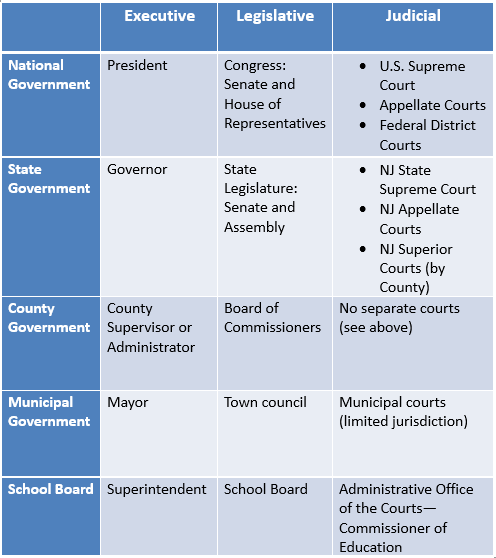
Activity: Divide your class into small groups of students. Have the small groups of students complete the chart (Handout Four: Separation of Powers at National, State and Local Levels) to identify how executive, legislative and judicial powers are separated at the national, state and local levels. Share and Discuss Handout Six: Completed Chart.
- The Governor holds the executive position in the state, similar to the president of the country.
- The State Legislature, which consists of a State Senate and State Assembly hold the legislative positions, much like the U.S. Senate and House of Representatives.
- The County Commissioners are empowered with a broad scope of authority, some of which is designated to them by the State of New Jersey, including, but are not limited to, law enforcement, welfare, education, roads, and economic development. They share these functions with local (municipal) governments, which are also empowered by the state.
- At the local government level, the executive and legislative functions are not as clearly defined, although some counties have moved to having a county executive with clear executive functions.
- The school board members act as the legislative branch determining school policies, while the superintendent is the executive, running the school district and carrying out the policies. The superintendent is hired by and accountable to the school board. School board issues and disputes involving state education laws (Title 18A) are first decided by the New Jersey Commissioner of Education rather than a traditional courtroom. Many of these cases are initially reviewed by a judge at the Office of Administrative Law (OAL) before the Commissioner issues a final decision.
- The States also have three levels of judicial review (NJ Superior Courts, Appellate Courts and a State Supreme Court) much like the national government (federal District Courts, federal Appellate Courts and the U.S. Supreme Court). Municipal courts are courts of limited jurisdiction, having responsibility only for motor vehicle and parking tickets, minor criminal-type offenses (for example, simple assault and bad checks), municipal ordinance offenses (such as dog barking or building code violations) and other offenses.
Critical thinking activity: Have students consider why we should know about our local government? Have them think about a normal day in their life. Water, roads, schools are all locally controlled. Local government probably has the most influence over our lives. And we have the most control over our local government and school boards because it is run by our neighbors, ourselves. And New Jersey is a very local control state.
Handout One: Map of New Jersey with county lines
Handout Two: Names of New Jersey’s Counties
- Sussex
- Passaic
- Bergen
- Hudson
- Essex
- Morris
- Warren
- Hunterdon
- Somerset
- Union
- Middlesex
- Monmouth
- Mercer
- Burlington
- Ocean
- Atlantic
- Camden
- Gloucester
- Salem
- Cumberland
- Cape May
Handout Three: New Jersey’s Counties
Handout Four: Separation of Powers at National, State and Local levels
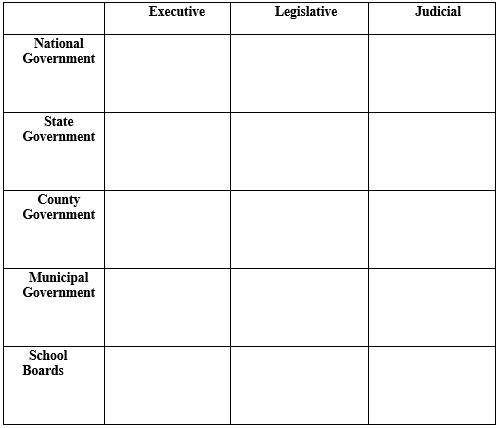
Handout Six: Separation of Powers at National, State and Local levels