New Jersey State Assembly Chamber, Trenton, NJ
Lesson Creator: New Jersey Center for Civic Education, Rutgers University, Piscataway, NJ
Grade Level: Elementary
New Jersey Core Content Social Studies Standards
6.1.5.CivicsPI.1: Describe ways in which people benefit from and are challenged by working together, including through government, workplaces, voluntary organizations, and families.
6.1.5.CivicsPI.3: Explain how the United States functions as a representative democracy and describe the roles of elected representatives and how they interact with citizens at local, state, and national levels.
6.1.5.CivicsPI.4: Describe the services our government provides the people in the community, state and across the United States.
6.1.5.CivicsPI.5: Explain how government functions at the local, county, and state level.
6.1.5.CivicsPD.1: Describe the roles of elected representatives and explain how individuals at local, state, and national levels can interact with them.
6.1.5.CivicsPD.2: Explain how individuals can initiate and/or influence local, state, or national public policymaking (e.g., petitions, proposing laws, contacting elected officials).
6.1.5.CivicsPR.1: Compare procedures for making decisions in a variety of settings including classroom, school, government, and /or society.
6.1.5.CivicsPR.4: Explain how policies are developed to address public problems.
6.1.5.EconET.1: Identify positive and negative incentives that influence the decisions people make.
Common Core ELA Standards
RI.5.1 Quote accurately from a text when explaining what a text says explicitly and when drawing inferences from the text.
RI.5.4 Determine the meaning of general academic and domain-specific words and phrases in a text
W.5.2 Write informative/explanatory texts in which they introduce a topic. Use facts and definition to develop points and provide a concluding statement
W.5.7 Participate in shared research and writing projects
W.5.8 Gather information from provided sources to answer a question.
SL.5.1 Engage effectively in a range of collaborative discussions, building on others’ ideas and expressing their own clearly
SL5.2 Summarize a written text read aloud or information presented in diverse media
Objectives: Student will be able to
- Explain what legislatures do
- Compare and contrast legislative and executive functions
- Explain how a bill becomes a law
- Identify the requirements for being a member of the New Jersey State legislature
- Identify their State Legislative District and their representatives in the State Legislature
- Describe how individuals can influence public policy and develop an action plan to have a piece of legislation become law
Essential Questions/Focus Questions
- What does the New Jersey State Legislatures do?
- How does a bill become a law?
- How can individuals influence public policy?
What does the Legislature do?
The legislature is the branch of government that makes new laws and changes old ones. The New Jersey State Legislature consists of two Houses: a 40-member Senate and an 80-member General Assembly. The Senate and Assembly chambers are located in the State House in Trenton.
The New Jersey Legislature has the power to enact laws by a majority vote of both houses, subject to a veto by the governor. A veto may be overridden by the Legislature if there is a two-thirds majority vote in each House to override the governor’s veto.
The New Jersey State Legislature makes laws only for the state of New Jersey, while the U.S. Congress creates laws for all fifty states.
Activity 1: Find the definition for “legislate” in a dictionary or online. To “legislate” is “to make or enact laws” or “to put in force or cause to be by legal authority. Compare the authority to “legislate” with the authority held by the president and the governor as the chief executive to execute or carry out the laws. How are the roles different? How and why must the executive (the governor) and the legislature work together?
What are the requirements to be a member of the New Jersey Legislature?
Activity 2: Have students go to the New Jersey State Constitution online at http://www.cityconnections.com/NJ_STATE_CONSTITUTION.pdf and direct them to ARTICLE IV LEGISLATIVE SECTION I. Have them research and find the requirements to be a member of the State Senate and the General Assembly.
A State Senator must be at least 30 years old, and must have lived in New Jersey for at least four years.
A member of the General Assembly must be at least 21 years old and must have lived in the state for at least two years.
All legislators must live in the legislative districts they represent for at least one year before the election.
While legislators spend a considerable amount of their time on legislative matters, service in the Legislature is considered to be part-time, and most legislators also hold other employment.
The voters in each district elect one Senator and two members of the General Assembly. Legislative elections are held in November of each odd-numbered year. Members of the Assembly serve two-year terms. Senators serve four-year terms.
Activity 2: Share Handout One with your class and ask your students to find the provisions in the New Jersey State Constitution that provide the authority for the Legislature and describe the requirements to be a member of the New Jersey State Legislature.
Complete the chart, Handout I.
A completed chart: Where does the Legislature gets its authority?
|
New Jersey State Constitution, 1947, with additions |
||
|
Authority |
Article |
Description |
Separation of powers into executive, legislative and judicial |
Art. III, Sec. 1 |
The powers of the government shall be divided among three distinct branches, the legislative, executive, and judicial. No person or persons belonging to or constituting one branch shall exercise any of the powers properly belonging to either of the others, except as expressly provided in this Constitution. |
|
Legislative powers in the Senate and General Assembly |
Art IV, Sec. 1, para. 1 |
The legislative power shall be vested in a Senate and General Assembly. |
|
Requirements to be a member of the State Senate |
Art IV, Sec. 1, para. 2 |
No person shall be a member of the Senate who shall not have attained the age of thirty years, and have been a citizen and resident of the State for four years, and of the district for which he shall be elected one year, next before his election. |
|
Requirements to be a member of the General Assembly |
Art IV, Sec. 1, para. 2 |
No person shall be a member of the General Assembly who shall not have attained the age of twenty-one years and have been a citizen and resident of the State for two years, and of the district for which he shall be elected one year, next before his election. |
|
Composition of the Senate |
Art. IV, Sec. 2, para. 1 |
The Senate shall be composed of forty senators |
|
Composition of the General Assembly |
Art. IV, Sec. 2, para. 3 |
The General Assembly shall be composed of eighty members. |
|
How a bill becomes a law |
Art. IV, Sec. 4, para. 6 |
No bill or joint resolution shall pass, unless there shall be a majority of all the members of each body personally present and agreeing thereto, |
|
Overriding a veto by the governor |
Art. V, Sec. 1, para. 14 |
(a) When a bill has finally passed both houses, the house in which final action was taken to complete its passage shall cause it to be presented to the Governor before the close of the calendar day next following the date of the session at which such final action was taken. |
How are the legislative districts determined?
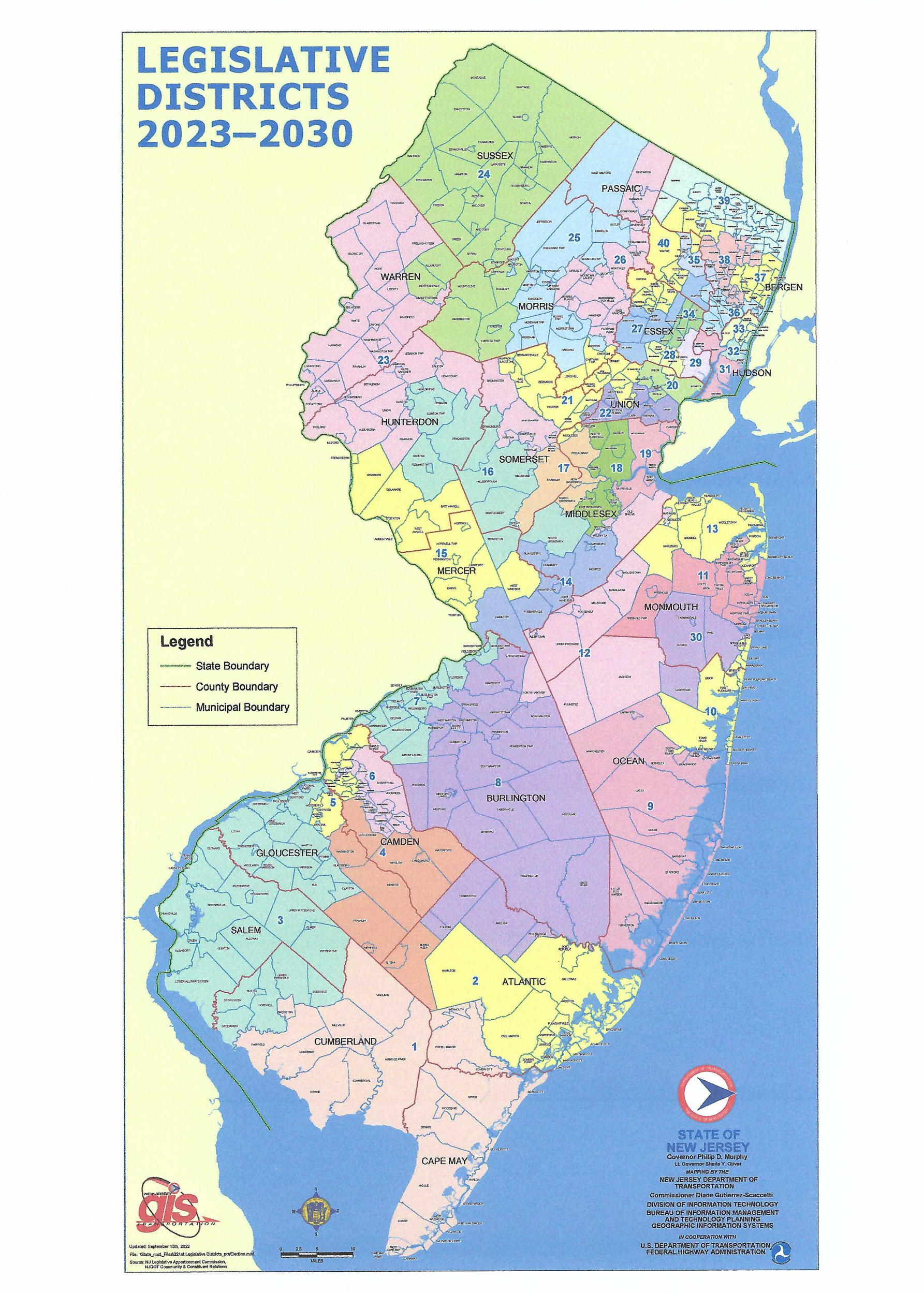
Background: New Jersey is divided into 40 legislative districts (See Handout 2: New Jersey Legislative Districts). The people of each district elect one State Senate and two General Assembly members. Each district has about the same number of people in it, so each legislator represents about the same number of people.
New boundary lines for the districts are drawn every ten years after an official count or census has been taken of the people and where they live. The shapes of the districts may be changed to show changes in the population. City districts are usually small because more people live in a small area. Suburban and rural legislative districts may be very large, which shows that the people live farther apart.
Until 1966, State Senators had been elected on a county basis, even though this had resulted in much greater representation for more rural counties than the urbanized counties. Following the U.S. Supreme Court’s decision in Reynolds v. Simms (1964), a constitutional convention in New Jersey amended the State Constitution to meet the requirement of “one person, one vote” by requiring members of the State Senate as well as members of the General Assembly to be elected from legislative districts with similar populations.
Activity 3: Have your students go to the Municipalities Index at http://www.njleg.state.nj.us/districts/municipalities.asp and find your legislative district by going to “District: Filter by Municipality” and typing in your municipality. Or, print out a poster-size version of NJ Legislative Districts at https://www.njleg.state.nj.us/district-map or use Handout 2 for an overview of the Legislative Districts 2023-2030.
Who represents you in the New Jersey Legislature?
Activity 4: Have your students go to the district map of the New Jersey legislature at http://www.njleg.state.nj.us/districts/njmap210.html and click on your district number to find out who represents you in Trenton.
Invite one of the members of the New Jersey legislature from your legislative district to visit your class and talk about the legislative process.
How does a bill become a law in New Jersey?
Activity 5: Have your students go to https://pub.njleg.gov/publications/Student_Guide_Legislative_Process.pdf or https://www.njstatehousetours.org/161/Student-Guide-to-Lawmaking
to review the process for a bill becoming a law in New Jersey. Students compare the process of how a bill becomes a law in New Jersey with the process at the national level (which is very similar) and draw a diagram demonstrating how a bill becomes a law.
How can individuals influence the development of laws in New Jersey?
Activity 6: Have your students select a bill currently before the New Jersey Legislature or identify an issue that they would like the New Jersey legislature to address and hold a mock legislative hearing and/or a mock legislative debate about the issue.
Legislative Hearings are held by committees of the U.S. Congress, the New Jersey State Legislature and other legislative bodies to gather information from witnesses testifying about issues of public concern. Role-playing a legislative hearing gives students an opportunity to better understand the purpose and procedures of such hearing as well as the role of committee members. It also helps students to gain experience in clarifying information, interests and values associated with the subject being discussed. See Handout 3 for directions on conducting a mock legislative hearing.
Legislative Debates are what happens on the floor of the U.S. Congress, the New Jersey State Legislature or other legislative bodies as they discuss and make a decision about legislation. Roleplaying a mock legislative debate enables students to understand the process of making laws. See Handout 4 for directions on conducting a mock legislative debate.
Go to “Improving Your Community” lesson or Project Citizen at https://civiced.rutgers.edu/programs/project-citizen. Project Citizen is a project-based civic education program that involves students in understanding public policy and emphasizes responsible participation in local and state government. Students learn how to interact with government agencies to effect change.
Assessment
Have students write a short essay comparing the process of making change at the state and national levels and the impact of the policy decisions made at each level.
Extension:
Visit the State House and take a State House tour with the Office of Legislative Services. Trained staff and volunteers provide tours and programs that match school curriculum and bring the lessons of the classroom to life in our State capitol. For additional information go to https://www.njstatehousetours.org/158/General-Information. To schedule a visit or ask a question, call the Tour Office at 609-847-3150.
For a variety of activities and games for kids in the New Jersey State House Activity book go to https://www.njstatehousetours.org/177/Resources-and-Publications.
Handout 1
Where does the Legislature get its authority?
|
New Jersey State Constitution, 1947 with additions |
||
|
Authority |
Article |
Description |
Separation of powers into executive, legislative and judicial |
Art. III, Sec. 1 |
|
|
Legislative powers in the Senate and General Assembly |
Art IV, Sec. 1, para. 1 |
|
|
Requirements to be a member of the State Senate |
Art IV, Sec. 1, para. 2 |
|
|
Requirements to be a member of the General Assembly |
Art IV, Sec. 1, para. 2 |
|
|
Composition of the Senate |
Art. IV, Sec. 2, para. 1 |
|
|
Composition of the General Assembly |
Art. IV, Sec. 2, para. 3 |
|
|
How a bill becomes a law |
Art. IV, Sec. 4, para. 6 |
|
|
Overriding a veto by the governor |
Art. V, Sec. 1, para. 14 |
|
Handout 2