
 |
 |
 |
Lesson Creator: New Jersey Center for Civic Education, Rutgers University, Piscataway, NJ
Grade Level: Secondary
Objectives: Students will be able to:
- Compare and contrast the 1776, 1844 and 1947 New Jersey Constitution regarding who can vote, the legislature, the governor and individual rights
- Explain the impact of these changes on the functioning of state government
- Analyze why these changes were made
New Jersey Student Learning Standards for Social Studies (2020):
6.1.12.CivicsPI.2.a: Prepare and articulate a point of view about the importance of individual rights, separation of powers, and governmental structure in New Jersey’s 1776 constitution and the United States Constitution.
6.1.12.CivicsDP.3.a: Compare and contrast the successes and failures of political and social reform movements in New Jersey and the nation during the Antebellum period (i.e., the 1844 State Constitution, abolition, women’s rights, and temperance).
6.1.12.HistoryCC.4.a: Analyze the extent of change in the relationship between the national and state governments as a result of the Civil War and the 13th, 14th, and 15th Amendments during the 19th century.
6.1.12.CivicsPI.13.a: Craft an argument as to the effectiveness of the New Jersey Constitution of 1947, New Jersey Supreme Court decisions (i.e., Hedgepeth and Williams v. Trenton Board of Education), and New Jersey’s laws in eliminating segregation and discrimination.
Common Core ELA Standards:
RH.9-10.1: Cite specific textual evidence to support analysis of primary and secondary sources, attending to such features as the date and origin of the information.
RH.9-10.2: Determine the central ideas or information of a primary or secondary source; provide an accurate summary of how key events or ideas develop over the course of the text
RH.11-12.1: Cite specific textual evidence to support analysis of primary and secondary sources, connecting insights gained from specific details to an understanding of the text as a whole.
RH.11-12.2: Determine the central ideas or information of a primary or secondary source; provide an accurate summary that makes clear the relationships among the key details and ideas.
W.9-10.1 and W.11-12-1: Write arguments to support claims in an analysis of substantive topics or texts, using valid reasoning and relevant and sufficient evidence.
W.9-10.2 and W.11-12-2: Write informative/explanatory texts to examine and convey complex ideas, concepts, and information clearly and accurately through the effective selection, organization, and analysis of content.
Materials:
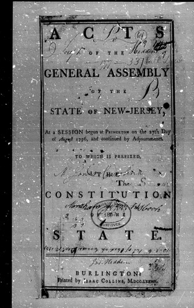
- Excerpts from NJ Constitution, 1776
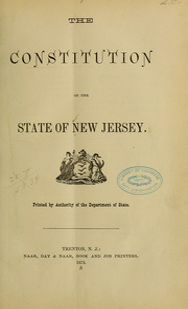
- Excerpts from NJ Constitution, 1844
- Excerpts from NJ Constitution, 1947
Focus Questions
- How has the constitutional framework in New Jersey changed over time?
- What is the impact of these changes?
- Why do you think these changes have occurred?
Activities/Procedures:
- Review the vocabulary to be used (Handout 1 -Vocabulary)
- Analyze the provisions of the 1776 New Jersey Constitution using Handout 2 - New Jersey Constitution 1776 - Simplified version and the following questions:
- Background: The Continental Congress had asked the colonies to prepare constitutions. The British were at Sandy Hook. The body meeting at the State Capitol in Elizabeth was moved inland to Burlington. The Constitution was written in a matter of days. It was the second state constitution, behind only Virginia..
- How does the 1776 New Jersey Constitution allocate legislative, executive and judicial authority?
- How are the legislators elected?
- How is the Governor elected?
- How is the Court of Appeals appointed?
- Which branch of government has the most authority in the 1776 Constitution?
- Why do you think the colonists wanted a strong legislature and a weak governor?
- You can see the idea of three separate branches of government is not fully developed with the Governor selected by the Legislature and the Court of final appeals made up of the Governor and the Legislative Council.
- What does the closing line (If the colonies reconcile with Britain, this Charter if null and void) tell us about the situation of those participating in the move to be independent from Britain?
- Analyze how the 1844 New Jersey Constitution changed the structure of state government, the electorate, religious freedom? Use Handout 3: New Jersey Constitution 1844 - Simplified Version.
- Compare the provisions of the 1776 and 1844 Constitutions
- How has the electorate changed?
- What forces were pushing for a more expanded electorate in the 1820s-40s?
- How was the electorate limited by the 1844 Constitution?
- How were judges appointed after the 1844 Constitution?
- How was the role of the Governor strengthened by the 1844 Constitution?
- Why do you think New Jersey wanted a stronger governor by the 1840’s?
- What limits the governor’s authority?
- Would you conclude that the New Jersey Governor in the 1844 Constitution was weak or strong? Why?
- How did the 1947 New Jersey Constitution change the structure of government, the electorate, religious and social freedom? Use Handout 4: New Jersey Constitution 1947 - Simplified Version.
- Compare the provisions of the 1844 and 1947 Constitutions.
- How has the electorate changed?
- How are judges appointed after the 1947 Constitution?
- How has the role of the Governor been strengthened by the 1947 Constitution?
- Why do you think New Jersey wanted a stronger governor by the 1940’s?
- What limits the governor’s authority?
- Would you conclude that the New Jersey Governor in the 1947 Constitution was weak or strong? Why?
Complete the graphic organizer (Handout 5 - New Jersey’s Constitutions - 1776 to 1947) comparing 1776, 1844 and 1947 New Jersey Constitutions regarding individual rights, the electorate, separation of powers, and the scope of authority of the legislature and the governor.
|
1776 Constitution |
1844 Constitution |
1947 Constitution |
|
|
Individual Rights |
● May practice any religion ● Not required to pay church taxes ● No established church ● Civil rights of Protestants protected ● Only Protestants may be elected to office |
● No established church ● Right to free religion, speech, press, assembly and petition ● No religious qualifications for office |
● Broader than the U.S. Constitution. ● No established religion. ● Right to free religion, speech, press, assembly and petition. ● No discrimination or segregation in militia or public schools. ● Right to organize regarding employment. |
|
Electorate |
● Inhabitants over 21 worth 50 pounds who resided in county for one year |
● White men over 21, residents of state for one year and the county for five months |
● Every citizen of U.S. over 18, resident of State and county for 30 days |
|
Legislature |
● Elected annually ● Elects the Governor ● The Legislative Council serves with the Governor as the Court of Appeals of last resort ● Appoints Judges for seven years ● Appoints Attorney General for five years ● Appoints Treasurer for one year |
● Elected annually ● May override gubernatorial veto by simple majority of both houses ● Appoints judges of courts of common pleas ● Appoints the State Treasurer |
● State Senators elected for four-year terms ● Member of State Assembly elected for two-year terms ● Veto by governor must be overridden by 2/3 vote by both Houses of the Legislature |
|
Governor |
● Elected by Legislature for one year ● Commander-in-chief of militia ● Serves with Legislative Council as Court of Appeals of last resort |
● Elected by voters for three years ● May not hold office for two consecutive terms ● Appoints justices of the Supreme Court, Attorney General, and Secretary of State, with the advice and consent of the Senate. |
● Elected by voters for four year term ● May serve two consecutive terms ● May line item veto an appropriation of money ● Appoints all executive offices, Secretary of State, Attorney General, with advice and consent of the Senate, to serve during term of the Governor ● Appoints the members of the Supreme Court, Appellate Courts and the Superior Courts with the advice and consent of the Senate |
Closure/Assessments:
Students write an essay using the three state constitutions to explain how religious and social rights have been expanded from the 1776 to the 1947 Constitutions.
Students write an essay using the three state constitutions to explain how voting rights have been expanded from 1776 to 1947.
Students write an essay using the three state constitutions to explain how and why authority has moved from the legislative to the executive branch of government.
New Jersey’s Constitutional Framework, 1776-1947
Handout 1 - Vocabulary
Advice and Consent Recommendation given regarding a decision or course of action; refers to the NJ Senate’s ability to check the governor’s power by having to approve the governor’s appointments to many executive-branch jobs
Appoint To officially assign to a position of responsibility
Appropriation A sum of money set apart for a specific purpose; an act of a legislature authorizing money to be paid from the treasury for a specified use
Conscience Sense of moral goodness or wrongfulness of one’s own conduct or character
Discrimination Prejudicial treatment of an individual based on their actual or perceived membership in a certain group or category
Electorate The body of qualified voters
Expired Finished or ended
Grievances Complaints, protests, criticism, objections
Nominate Recommend or propose a person for a position of authority
Qualifications Requirements to run for an elected position
Religious Sect A subgroup of a larger established religious group. For example, the Religious Society of Friends (Quakers) is considered a sect of Protestant Christianity.
Resident A person who lives in a particular town or state
Segregated Set apart or separated from others, especially based on race, religion or ethnicity
Successive Following in order, consecutive
Term Length of time a person serves in an elected position
Veto To refuse to approve a legislative bill (a power of the governor)
Handout 2
New Jersey Constitution 1776 - Simplified Version
July 2, 1776 - Burlington, NJ
Since the authority that the kings of Great Britain had over the colonies came from the people and King George III had not protected the colonies, his authority ended.
However, since some form of government is necessary to unite people and preserve order, the Continental Congress has advised the colonies to adopt a constitution for their government.
We, the representatives of the colony of New Jersey have been elected by the counties, assembled and agreed upon the following Constitution:
I. The government shall be vested in a Governor, Legislative Council (Senate) and General Assembly.
III. Each year the counties shall each choose one person to be a member of the Legislative Council and three to be members of the Assembly. To be a member of the Legislative Council, a person must have lived and owned property in the county for at least one year and must be worth at least 1000 pounds. To be a member of the Assembly, a person must have lived in the country at least one year and must be worth at least 500 pounds. (These were significant amounts of money in 1776.)
IV. Inhabitants of this Colony, age 21 or more, who are worth 50 pounds and have resided in the county in which they want to vote for one year, may vote for representatives to the Council and Assembly and for all other public officers. (Unmarried or widowed women and African Americans with 50 pounds of money or property could vote in NJ until the Legislature took away this right in a 1807 statute.)
VII. The Council and Assembly by majority vote elect a person to be Governor for one year, who shall also be President of the Council and cast a vote in the Council.
VIII. The Governor shall have supreme executive power, be Chancellor of the Colony, and commander in chief of the militia.
IX. The Governor and Council shall form the Court of Appeals of last resort (Supreme Court).
XVIII. Inhabitants may practice whatever religion they please and no one will be compelled to attend a place of worship contrary to his beliefs or be required to pay taxes for the building or repairing of a place of worship or for the maintenance of a religious minister.
XIX. There is no established church; the civil rights of Protestants are protected and Protestants may be elected to any office.
XXII. The common law of England shall remain in force until altered by a future law of the Legislature.
If Great Britain and the colonies reconcile, this Charter shall be null and void—otherwise to remain firm and inviolable.
Handout 3
New Jersey Constitution 1844 - Simplified Version
June 29, 1844 - Trenton, NJ
Art. 1 Rights and Privileges
3. No person shall be deprived of the privilege of worshipping God according to his conscience, or be compelled to attend a place of worship contrary to his faith or pay taxes for church purposes.
4. There shall be no establishment of one religious sect in preference to another, no religious test required as a qualification for any office
5. Every person may freely speak, write, and publish his sentiments on all subjects
18. People have the right freely to assemble together and to petition for redress of grievances
Art. II. Electorate
Every white male citizen of the United States, of the age of 21 years, who shall have been a resident of this State one year, and of the county, in which he claims his vote five months, next before the election, shall be entitled to vote for all officers that now are, or hereafter may be elective by the people
Art. IV. Legislative
- The legislative power shall be vested in a Senate and General Assembly.
- Members of the Senate and General Assembly are elected annually.
- The Governor's veto may be overridden by a majority of both houses.
Article V. Executive
- The Governor shall be elected by the legal voters of this State.
- The Governor shall hold his office for three years
- He shall be incapable of holding that office for three years next after his term of service shall have expired
- No appointment or nomination to office shall be made by the Governor during the last week of his said term.
Art. VI. Judiciary
The Court of Errors and Appeals shall consist of the Chancellor, the Justices of the Supreme Court, and six Judges, or a major part of them; which Judges are to be appointed for six years.
Art. VII Appointments
- The Legislature appoints the State Treasurer and judges of the lower courts
- The Governor shall appoint, with the advice and consent of the Senate, justices of the State Supreme Court, the Attorney General, and the Secretary of State.
Handout 4
New Jersey Constitution 1947 - Simplified Version
1947 with amendments through 2008 - New Brunswick, NJ
Art. I Rights and Privileges
3. No person shall be deprived of the privilege of worshipping God according to his conscience, or be compelled to attend a place of worship contrary to his faith or pay taxes for church purposes.
4. There shall be no establishment of one religious sect in preference to another, no religious test required as a qualification for any office
5. No person shall be discriminated against or segregated in the militia or the public schools because of religious principles, race, color, ancestry or national origin.
6. Every person may freely speak, write, and publish his sentiments on all subjects
18. The people have the right to freely assemble together and to petition for redress of grievances.
19. Persons in private employment have the right to organize and bargain collectively. Persons in public employment have the right to organize and their grievances known to the State or political subdivision or agency.
Art. II Elections
Every citizen of the United States 18 years or older who has been a resident of New Jersey and of the county in which he claims his vote for 30 days shall be entitled to vote for all officers.
Art. IV Legislative
Sec. II. 2. The Senate shall be composed of 40 senators elected for a term of four years.
Sec. II. 3. The General Assembly shall be composed of 80 members for a term of two years.
Art. V. Executive
Sec. I. 2. The Governor must be at least 30, at least 20 years a citizen of the United States and a resident of the State for 7 years.
Sec. I. 3. No member of Congress may be Governor.
Sec. 1.4. The Governor and Lt. Governor shall be elected…by the legally qualified voters pf the State.
Sec. I. 5. No person who has been elected Governor for two successive terms is eligible to run again until 4 years after the end of his second term. The term of the office of Governor is four years.
Sec. 1.11. The Governor shall take care that the laws be faithfully executed.
Sec. I. 12. The Governor may propose legislation in his annual speech to the Legislature at the opening of every session on the condition of the state. He is commander-in-chief of all the military and naval forces of the State. He shall nominate and appoint, with the advice and consent of the Senate, all officers whose appointment is not otherwise made by the Constitution or by law.
Sec. I. 14. The Governor has the power to sign and approve a law or veto a law. The legislature can override the Governor’s veto with 2/3 of all the members of each house.
Sec. I. 15. If a bill contains one or more items about the appropriation of money, the Governor may object in whole or in part to any such item or items while approving the other portions of the bill.
Sec. II.1. The Governor may grant pardons and reprieves in cases other than impeachment and treason and may suspend and remit fines and forfeitures.
Sec. III.2. The Governor shall nominate and appoint, with the advice and consent of the Senate, all officers of the militia.
Sec. IV. 2. The Governor shall nominate and appoint, with the advice and consent of the Senate, the heads of all of the principal departments to serve at the pleasure of the Governor during the Governor’s term in office.
Sec. IV. 3. The Governor shall nominate and appoint, with the advice and consent of the Senate, the Secretary of State and Attorney General to serve during the term of office of the Governor. (Attorney generals are elected in most states)
Article VI, Sec. VI. 1. The Governor shall nominate and appoint, with the advice and consent of the Senate, all members of the New Jersey State Supreme Court and Superior Court judges in all counties. (Judges are elected in the vast majority of states)
Article VII, Sec. II. 1. The Governor shall nominate and appoint, with the advice and consent of the Senate, county prosecutors (who are the chief law county enforcement officers) for a term of five years.
Handout 5
New Jersey’s Constitution, 1776-1947
|
1776 Constitution |
1844 Constitution |
1947 Constitution |
|
|
Religious and Social Rights |
|||
|
Electorate |
|||
|
Legislature |
|||
|
Governor |