

Scales of Justice
Lesson Creator: New Jersey Center for Civic Education, Rutgers University, Piscataway, NJ
Grade Level: Secondary
Objectives: Students will be able to:
- Identify the role of the judiciary
- Explain why judicial independence is important
- Describe how the New Jersey judicial system in New Jersey is structured
- Examine the jurisdiction of the New Jersey State Supreme Court
- Compare and contrast the proceedings of New Jersey’s trial and appellate courts
- Engage in a moot court proceeding
New Jersey Student Learning Standards for Social Studies (2020):
6.3.8.CivicsPI.4: Investigate the roles of political, civil, and economic organizations in shaping people’ lives and share this information with individuals who might benefit from this information.
6.3.8.CivicsPD.3: Construct a claim as to why it is important for democracy that individuals are informed by facts, aware of diverse viewpoints, and willing to take action on public issues.
6.3.8.CivicsDP.2: Make a claim based on evidence to determine the extent and the limitations of FirstAmendment rights (e.g., U.S. Supreme Court decisions).
6.3.8.CivicsDP.3: Use historical case studies and current events to explain why due process is essential for the protection of individual rights and maintenance of limited government.
6.3.8.CivicsPR.5: Engage in simulated democratic processes (e.g., legislative hearings, judicial proceedings, elections) to understand how conflicting points of view are addressed in a democratic society.
6.1.12.CivicsPI.13.a: Craft an argument as to the effectiveness of the New Jersey Constitution of 1947, New Jersey Supreme Court decisions (i.e., Hedgepath and Williams v. Trenton Board of Education), and New Jersey’s laws in eliminating segregation and discrimination.
6.1.12.EconET.14.a: Use current events to judge what extent the government should intervene at the local, state, and national levels on issues related to the economy.
6.1.12.HistoryCA.14.b: Create an evidence-based argument that assesses the effectiveness of actions taken to address the causes of continuing racial tensions and violence.
6.1.12.CivicsPD.16.a: Construct a claim to describe how media and technology has impacted civic participation and deliberation.
6.1.12.CivicsPR.16.a: Analyze government efforts to address intellectual property rights, personal privacy, and other ethical issues in science, medicine, and business that arise from the global use of new technologies.
6.3.12.HistoryCA.1: Analyze the impact of current governmental practices and laws affecting national security and/or First Amendment rights and privacy (e.g., immigration, refugees, seizure of personal property, juvenile detention, listening devices, deportation, religion in schools).
Focus Questions:
- How does the state judicial system in New Jersey work?
- How are judges selected?
- Why is judicial independence important?
- What is the scope of jurisdiction of the New Jersey State Supreme Court?
- What is the difference between trial and appellate courts?
- What is a moot court proceeding?
Anticipatory Set:
Do a quick quiz with your students using Kahoot, a free game-based learning platform, which lets you set up a quiz and responses where the students can click the answers on their Chromebooks, iPads or cellphones and the teacher can see how many answered correctly. Go to Kahoot!. Or simply ask your students the following questions:
- What is the role of a judge? (Answer: Judges are impartial decision-makers in the pursuit of justice.)
- What court hears traffic violations? (Answer: Municipal courts)
- How are judges selected in New Jersey? (Answer: Except for municipal court judges in a single municipality, members of the judiciary are appointed by the Governor with the advice and consent of the State Senate.)
What are laws?
The law is a set of rules that people are made to follow by the state. The courts and police enforce this system of rules and punish people who break the laws, such as by making them pay a fine or other penalty or sending them to jail. In ancient societies, laws were written by leaders, to set out rules on how people can live, work and do business with each other. Today in most countries, laws are written and voted on by groups of elected politicians in a legislature, such as a parliament or congress.
The history of law is closely connected to the development of human civilizations . Ancient Egyptian law developed in 3000 BC. In 1760 BC King Hammurabi, took ancient Babylonian law and organized it, and then had it chiseled in stone for the public to see in the marketplace. These laws became known as the Code of Hammurabi. The Torah from the Old Testament is an old body of law. It was written around 1280 BC. It has moral rules such as the Ten Commandments, which tell people what things are not permitted.
What do judges do?
The judiciary is a group of judges who resolve people's disputes and determine whether people who are charged with crimes are guilty. In some jurisdictions the judge does not find guilt or innocence but instead directs a jury how to interpret facts from a legal perspective, but the jury determines the facts based on evidence presented to them and finds the guilt or innocence of the charged person.
How are judges selected in New Jersey?
The colonists brought over from England the tradition of appointing judges. By the early 1800s, appointing judges had become increasingly unpopular and many states began to select judges by popular vote. By the end of the 19th century, in an era when political corruption was a growing problem, the idea of choosing judges using a nonpartisan, commission-selection process became more prevalent.
In New Jersey, members of the judiciary are appointed by the Governor with the advice and consent of the Senate. The only exceptions are municipal judges who are appointed by the governing body of the municipality. Unlike most other states, there are no elections for judges in New Jersey. See Handout 1: New Jersey State Constitution, Article VI. The vast majority of states (35 out of 50 states in 2020) have partisan or non-partisan elections or retention elections or appointments based on the recommendations of a commission. California is the only other state that fills all judicial appointments by the governor with the consent of the State Senate. The unwritten institutional requirement that the judiciary be balanced between the political parties is a system unique to New Jersey. New Jersey Judges stand for reappointment after seven years in office, and once reappointed, they serve until they reach the age of 70. (See Handout 1: NJ State Constitution, 1947, updated to 2020.)
Typically, after serving a specified initial term, a judge is evaluated for retention by the commission or by voters in a Retention election - Ballotpedia. . This allows the judge to be held accountable for his or her performance while serving on the bench. Judges then face a similar evaluation process at the end of each subsequent term
Why is judicial independence important?
Judicial independence refers to the insulation of the judiciary from the influence of other political institutions, interest groups, and the general public. Judicial independence is important because it fosters impartial judgment by judges in individual cases. Judicial independence permits judges to make decisions that they believe are correct, fair and just, even though their decisions may sometimes be unpopular.
The impartial administration of justice and the accountability of government officials to the public are two of the most strongly held American values. Yet these values are often in direct conflict with one another. At the national level, the U.S. Constitution resolves this tension in favor of judicial independence, insulating judges from the undue influence of other political institutions, interest groups, and the general public. Federal judges are appointed by the president with the advice and consent of the Senate (However, at the state level, the debate has continued as to the proper balance between judicial independence and judicial accountability. In most states, judges are elected and, therefore, accountable to the public. New Jersey is one of only twelve states that does not elect any of its judges.
In 2012, the Ninth Circuit federal appeals court struck down Montana’s nonpartisan system of electing state judges in Sanders County Republican Central Committee v Bullock, opening the door to party endorsements of judicial candidates for the first time in 77 years. The Ninth Circuit rejected the state of Montana’s argument that nonpartisan elections are necessary for a “fair and independent” judiciary, and based its ruling on the U.S. Supreme Court decision in Citizens United v. Federal Election Commission (2010), which held that political spending is protected under the First Amendment, and allowed corporations and unions to spend unlimited amounts of money on political activities, as long as it was done independent of a party or candidate.
Activity 1: Analyze Political Cartoon
Have students look at Handout 2: Judicial Independence. Ask students the following questions:
- What is happening in the political cartoon?
- Explain why judicial independence is important to democracy and the rule of law.
Activity 2: Research and Critical thinking
Compare the advantages and disadvantages of an elected or an appointed judiciary. Have students break into pairs, research the costs and benefits of elected versus appointed judges. Some possible sources of information include the following:
- Ballotpedia: The Encyclopedia of American Politics, “The Partisan Election of Judges” at
Partisan election of judges - Ballotpedia
- American Constitution Society, "Justice At Risk: An empirical analysis of campaign contributions and judicial decisions” June 2013 at Justice at Risk An Empirical Analysis of Campaign Contributions and Judicial Decisions
- The Federalist Society, "The Case for Partisan Judicial Elections," January 1, 2003 at
The Case for Partisan Judicial Elections.
- Alan Tarr, Without Fear or Favor: Judicial Independence and Judicial Accountability in the State, Stanford University Press, 2012.
Have students prepare a summary of the advantages and disadvantages by completing the graphic organizer, Handout 3: Advantages and Disadvantages of Appointed and Elected Judges. A completed chart might look as follows:
|
Advantages |
Disadvantages |
|
|
Appointed Judiciary |
• Judges are non-partisan • Governor appoints officials he can work with |
• Undemocratic--The people do not have a direct say in the selection of judges. • Governors may select only those who agree with his or her political views. |
|
Elected Judiciary |
• True democratic system • If a judge is not being accountable to the people, they can elect someone else |
● Judges may not make independent decisions because they are subject to partisan elections. |
Alternatively, have your students argue for an appointed or an elected judiciary. Follow with a class discussion and conclusions.
The Jurisdiction of State Courts
Unlike legislative bodies or governmental executives (mayors, governors or the President of the United States) who can proactively address public policy problems, courts must wait until someone, either the state in a criminal case or a private individual in a civil case, files a law suit before addressing the issues raised. The federal courts address issues that arise under federal law. State courts address issues arising under state law.
Federal court jurisdiction is limited to certain types of cases listed in the U.S. Constitution (U.S. Constitution, Art. III, Sec. 2). For the most part, federal courts only hear cases in which the United States is a party, cases involving violations of the Constitution or federal law, crimes on federal land, and bankruptcy cases. Federal courts also hear cases based on state laws that involve parties from different states. The majority of cases—from parking violations to murder and simple contracts to violations of the state constitution—are brought in state courts.
The impact of New Jersey’s State Supreme Court
New Jersey’s highest court has been the source of many precedent-setting decisions. In 1944, the New Jersey Supreme Court held in Hedgpeth-Williams V. Trenton Board of Education that racial segregation in schools violated the state constitution. This case was cited in the U.S. Supreme Court’s 1954 decision in Brown v. Board of Education.
While the U.S. Supreme Court held in a 5/4 decision in San Antonio v. Rodriguez in 1973 that there was no constitutional right to an equal education, the New Jersey Supreme Court found a right to a “thorough and efficient education” under the state constitution in Robinson v. Cahill (1973), which led to a series of lawsuits that required the state to equalize funding for public schools.
In 1975, the State Supreme Court in Southern Burlington County NAACP v. Mt. Laurel held that exclusionary zoning that bars the poor was unconstitutional and a system for requiring municipalities to provide their fair share of low- and moderate-income housing followed.
In re Quinlan, the NJ Supreme Court found a state constitutional basis for the right to refuse medical treatment (70 NJ 10 (1976), which the U.S. Supreme Court let stand and has become the law of the land.
Vocabulary
Activity 3: Vocabulary.
Share Handout 4: Vocabulary with your students and have them define the meaning of each term:
- The Judiciary is the system of courts that interprets and applies the law in the name of the state.
- The Plaintiff is the person (or corporation) who brings a legal action in court.
- The Defendant is a person (or corporation) who is being sued or accused of a crime in a court of law.
- A Hearing is a proceeding before a judge.
- A Jury is a group of citizens summoned to and sworn by a court to hear evidence and render a verdict in a trial
- Trial Court— Court of original jurisdiction where a case is first heard. Evidence (physical and testimony) is presented for the judge and jury to determine its veracity and to apply the law to the facts and to make a determination regarding the guilt or innocence of a defendant in a criminal case or a decision regarding a civil issue.
- Appellate Court—hear appeals from trial courts and review their decisions to determine if there were procedural errors and if the law was applied correctly. They can affirm or reverse the trial court’s decision.
- The Appellant or Petitioner is the party who petitioned the Supreme Court to review the case. The petitioner or appellant must demonstrate sufficient grounds for appeal, which are usually specified by statute, in order to challenge the judgment or findings. Whether a party was a plaintiff or defendant in the lower court has no bearing on his or her status as an appellant.
- The Respondent or Appellee is the party being sued or tried.
- A Mock Trial is a simulation or enactment of a judicial proceeding in a trial court. The focus is on the evidence provided by witnesses and physical evidence.
- A Moot Court is a mock appellate court hearing. No witnesses are called, nor are the basic facts of the case in dispute. The focus is on the application, fairness or constitutionality of the law.
- Opening Statement is made by the Prosecutors (for a criminal case) or the plaintiff’s attorney (for a civil case) to explain what their evidence will be and what they will try to prove; or in an appellate court, a summary of the case below and why you are appealing the decision.
- Rebuttal is evidence or an argument that is presented to contradict or nullify the evidence or argument that has been presented by an opposing party.
- Closing Statement is made by the attorney for each side including a concise summary of the evidence that emphasizes that which is most favorable for your side. Each side asks for a decision in its favor and explains why. On appeal, it is a summary of the case law, constitutional application, public policy and/or practical reasons why your side should prevail.
Criminal Cases
Criminal cases are those in which a defendant is accused of a serious crime, such as robbery, theft, drug possession or murder. In a criminal case, a prosecutor tries to prove that the defendant committed a crime. The prosecutor is an attorney who represents the State of New Jersey, and the defense attorney represents the defendant. The judge oversees the proceedings and ensures that they are conducted according to the law and the rules of court.
Most criminal trials are decided by a jury consisting of 12 citizens. The jury represents the community in which the crime occurred. The jury's role is to hear the evidence presented by the prosecutor and the defense attorney. Evidence is presented to the jury by witnesses who testify.
After all the evidence has been presented, the jury discusses the case in private. If all the jurors believe the evidence proves the defendant committed the crime, the jury convicts the defendant by returning a guilty verdict. After a defendant is convicted, the judge imposes a sentence, such as a term in prison.
If the jurors do not believe the evidence proves the defendant committed the crime, then the jury acquits the defendant by returning a verdict of not guilty. If the jurors are unable to decide between conviction and acquittal, the judge can declare a mistrial, and a new trial can be held with different jurors.
Not every criminal case is decided by a trial. Many cases are resolved through a plea bargain. In a plea bargain, the defendant agrees to plead guilty by admitting that he or she committed a crime. In return, the prosecutor asks the judge to impose a sentence that is less severe than if the defendant had gone to trial and been convicted. The judge, however, is not required to agree to the recommendation and may choose to ignore it. A plea bargain ensures that a guilty defendant is punished. Plea bargains can be entered either before or even during the trial.
Civil Cases
Civil lawsuits are cases in which a plaintiff claims that he or she has been injured by the actions of the defendant. Injury is a legal term meaning any harm done to a person's body, property, reputation or rights.
In some civil cases, the plaintiff seeks damages, or money, from the defendant as compensation for injuries allegedly caused by the defendant. Examples are cases involving car accidents, age, race or gender discrimination in the workplace, medical malpractice, defective products, differences over the terms of contracts, and disputes between landlords and tenants. Civil juries consist of six members.
Not all civil cases, however, involve attempts to receive compensation for injuries. People also file lawsuits to enforce their rights. In New Jersey, these kinds of non-monetary lawsuits are called General Equity cases. A General Equity case may involve a terminally ill person's right to refuse life-sustaining medical treatment, or a dispute between labor and management over rights in the workplace, or even a company's ability to protect its trade secrets, such as how it makes or markets a product.
Instead of money, the plaintiff in a General Equity case may ask the court to order the defendant to do something: remove a feeding tube, for instance, or end a strike and return to work. General Equity cases are decided by judges instead of juries.
As in criminal cases, the parties in civil cases often agree to settle their disputes without a trial. Settlements may occur before a trial starts or even during a trial. A settlement allows each side to resolve the dispute satisfactorily rather than risk losing at a trial. (For additional information see: The Differences between Criminal Court and Civil Court | LawHelp.org
Family Cases
Family cases are civil cases in which the disputes involve children, spouses or domestic partners. Examples of family cases are those involving divorce, adoption, juvenile delinquency, child abuse, child support, and domestic violence. Most cases in the Family Court are decided by a judge instead of a jury. To protect the privacy of children, judges are permitted to close some types of Family Court cases to the public.
Tax Court
The Tax Court is a court of limited jurisdiction. Tax Court judges hear appeals of tax decisions made by County Boards of Taxation. They also hear appeals on decisions made by the Director of the Division of Taxation on such matters as state income, sales and business taxes, and homestead rebates. Appeals from Tax Court decisions are heard in the Appellate Division of Superior Court. Tax Court judges are appointed by the Governor for initial terms of seven years, and upon reappointment are granted tenure until they reach the mandatory retirement age of 70. There are 12 Tax Court judgeships.
Municipal Court
Municipal Courts are operated by the city, township or borough in which the courts are located and municipal court judges are appointed by the mayor of the municipality. By far, most of the cases filed in New Jersey's courts are heard in the Municipal Courts The Municipal Courts carry out most of the day-to-day work in the New Jersey courts, where simple traffic tickets, minor criminal offenses, and small civil matters are heard. The Municipal Courts have responsibility for motor vehicle and parking tickets, minor criminal-type offenses (known as disorderly person offenses, such as simple assault and bad checks), municipal ordinance offenses (such as dog barking or building code violations) and other offenses, such as fish and game violations. A Municipal Court has jurisdiction only over those cases that occur within the boundaries of its municipality. Many serious criminal cases, such as robbery, auto theft, or assault, start out as complaints filed in the Municipal Court, however, those cases are transferred to the Superior Court located at the county courthouse.
The Municipal Courts hear a great variety of cases. Municipal Court is where cases involving motor-vehicles offenses, such as illegal parking, speeding and driving while intoxicated, are heard.
Municipal Courts also hear cases involving minor criminal offenses such as simple assault, trespassing and shoplifting. In New Jersey, these minor crimes are known as disorderly persons offenses. Cases involving hunting, fishing and boating laws and even minor disputes between neighbors are also heard in Municipal Courts.
Open Proceedings
Not only must the court system work and be fair, but it is important that people see that it works and is fair. When people have confidence in the legal system, they will support it and their respect for the law will grow. For this reason, most court proceedings, including trials, are open to the public.
For our courts to be fair, judges must be impartial -- that is, they may not favor either side in a case. The goal of our courts is to provide equal treatment for all people, regardless of their wealth, position, race, gender, religion, ethnic background or physical disability.
Juries
A jury trial, or trial by jury, is a legal proceeding in which a jury makes a decision or findings of fact, which then direct the actions of a judge. It is distinguished from a bench trial in which a judge or panel of judges makes all decisions. The U.S. Constitution (Art. III, Sec. 2, para. 3; and the Sixth Amendment) require criminal trials to be jury trials. The 7th Amendment provides a right of trial by jury for suits in common law (civil suits) where the value in controversy exceeds $20. However, the 7th Amendment is not binding on the states. The right to a jury trial in New Jersey must arise either by state statute or under the state constitution. Article I, Section 9 of the New Jersey Constitution explicitly provides that "the right of trial by jury shall remain inviolate; but the Legislature may authorize the trial of civil causes by a jury of six persons. However, this language has never been interpreted to require a jury trial in all civil cases. In fact, New Jersey has precluded jury trials in many civil cases. See New Jersey Developments: The Right to a Civil Jury Trial in New Jersey, 47 Rutgers L. Rev. 1461 (1995). Typically, there is no right to a jury trial for purely statutory causes of action unless the statute provides such a right. In Jersey Central Power & Light Co. v. Melcar Utilities Co., decided January 24, 2013, the Court held that the State Constitution guarantees the right of trial by jury for a statutory cause of action that is rooted in the common law.
The United States jury system and the jury system in New Jersey have their source in English history. The right to trial by jury in this country dates back to the Colonial period. It is both an honor and a duty to participate in our judicial process as a juror. In New Jersey, jurors are chosen at random from among a county’s registered voters and licensed drivers, as well as from among residents who file state income tax returns. In order to serve as a juror in New Jersey, a person must be a U.S. citizen at least 18 years old and able to read and understand English. The entire group summoned to serve as jurors is called the jury panel. The Jury Management Office within each county works with the trial judges and criminal and civil division managers to schedule a sufficient number of jurors for each day's anticipated trials. The first step in a trial is to select from the panel the number of jurors required to try the case. In a civil case there are usually eight jurors seated, with six deliberating and the others selected as alternates. In criminal cases, there are usually 14 jurors selected so that alternates are available.
After a short statement is given describing the case and the parties involved, the judge will question the prospective jurors to determine if they are qualified to act fairly impartially and have no interest in the result of the case. There are certain legal grounds for which a juror may be challenged for cause and excused, such as a juror being incapable of being impartial due to prior dealings with a party, witness, or attorney involved in the case. In addition, each side can excuse a certain number of jurors without giving any reason. These are called peremptory challenges. Peremptory challenges may be used, for example, when a party believes that a prospective juror has had some experience with the issues or facts in the case, and that experience could impact how that juror will decide the matter. In that situation, a party may simply prefer to have another juror seated. The lawyers or the judge may ask prospective jurors questions about their personal lives and beliefs. If there is any reason prospective jurors feel they should not serve, that reason should be made known during this questioning. The entire process of juror questioning is called "voir dire", which is French for "speak the truth." See General Jury Information | NJ Courts; and Attachment E - Overview -- Jury Selection in New Jersey)
Background: The Structure of New Jersey’s Judiciary
Prior to the 1947 New Jersey State Constitution, the court system in New Jersey was cumbersome, fragmented and slow-moving, following the judicial system in England from the 1700s which even England had abandoned. That all changed with the 1947 New Jersey State Constitution which streamlined and organized the state judiciary and is still being followed today. There are three trial courts in New Jersey. The Superior Court is the trial court of general jurisdiction. Trial courts also include the municipal courts and the Tax Court, both with specifically limited jurisdiction. The appellate courts include the Appellate Division and the New Jersey Supreme Court. Share Handout 5 - The Structure of New Jersey Courts or go to Attachment E - Overview -- Jury Selection in New Jersey
What do New Jersey Trial Courts do?
A lawsuit is first heard at the trial level, which focuses on determining the facts and then applying the law. The jury determines what the facts are. Since this often involves contradictory testimony by witnesses, a large part of the jury’s role is to determine the credibility of the witnesses and which version of the facts they believe to be true. The judge decides issues of law and instructs the jury on the law. The jury’s verdict is based on an application of the law to the facts.
Trial judges assess the evidence presented, and control how hearings and trials unfold in their courtrooms and interpret the law. Legal cases are contests between opposing sides, which ensures that evidence and legal arguments will be fully and forcefully presented. The judge, however, remains above the fray, providing an independent and impartial assessment of the facts and how the law applies to those facts. The judge presides over the trial from a desk, called a bench, on an elevated platform. The judge has five basic tasks. The first is simply to preside over the proceedings and see that order is maintained. The second is to determine whether any of the evidence that the parties want to use is illegal or improper. Third, before the jury begins its deliberations about the facts in the case, the judge gives the jury instructions about the law that applies to the case and the standards it must use in deciding the case. Fourth, in bench trials, the judge must also determine the facts and decide the case. The fifth is to sentence convicted criminal defendants. Trials include civil and criminal cases. (For additional information see: The New Jersey Courts - A Guide to the Judicial Process)
What is the role of New Jersey’s Appellate Courts?
The losing party in the trial court may appeal that court’s decision to an appellate court. An appellate court consists of a panel of two or three judges (or seven justices in the case of the New Jersey Supreme Court or nine justices in the case of the United States Supreme Court). Unlike the trial court, the appellate court reviews the application of the law and not the facts. Therefore, the appellant or petitioner (the party losing at the trial level who is bringing the appeal) can only assert arguments based on the law, such as the constitutionality or unfairness of the application of the law. Unlike a trial, no evidence is presented: no witnesses are called and the facts are not in issue. The appellate court relies on the facts as established by the trial court.
The appellant writes a detailed brief addressing these issues and then submits this to the court in a timely manner. The respondent (the party winning at the trial level and responding to the appeal) has an opportunity to address the appellant’s arguments in his/her brief. After the appellate court reviews the litigants’ briefs and the trial record, they hold oral arguments. At this point, the judges have the opportunity to question the attorneys. Appellate courts review the process and evidence presented at the trial court level and determine whether the process meets constitutional requirements of due process (fairness) and whether the law has been interpreted and applied correctly to the facts. The appellate court subsequently makes their decision. This ruling either overturns or upholds the trial court’s decision. The losing party at the appellate level may appeal the case to the Supreme Court of the specific state or the United States Supreme Court.
Trials from the Tax Courts and the Superior Courts are first reviewed by the Appellate Division. The Appellate Division’s decision is reviewed by the N.J. State Supreme Court if there is a constitutional question, dissent in the Appellate Division, a certification, or appeal from other causes as provided by the law. Formerly, capital cases involving murder where the defendant was sentenced to death, had automatic appeals to the NJ State Supreme Court. However, since New Jersey abolished the death penalty in 2007, this is no longer relevant. (See: Appellate Division | NJ Courts)
Activity 4: Compare trial and appellate courts
Ask students to compare the function, structure and process of trial and appellate courts in New Jersey by using the graphic organizer, Handout 6 - New Jersey Courts. A completed chart might look like the following:
|
Trial Courts |
Appellate Courts |
|
|
Number of judges |
One judge |
● NJ Appellate Division sits in panels of 2-3 judges ● NJ Supreme Court has 7 members ● US Supreme Court has 9 members |
|
Jury |
In all criminal cases and some civil cases. |
No |
|
Evidence |
Physical evidence and testimony from witnesses |
No new evidence is presented |
|
Role |
The trial courts determine the facts and then apply the law to render a decision. |
Appellate courts review the process and evidence presented at the trial court level and determine whether the process meets constitutional requirements of due process (fairness) and whether the law has been interpreted and applied correctly to the facts. |
|
Number in NJ |
539 Municipal Courts 10 Tax Courts 21 Superior Courts (Trial courts), one in each county |
One State Supreme Court 32 Appellate Court judges meet in panels of 2 or 3 |
|
Jurisdiction |
Municipal Courts hears cases involving motor vehicle and parking tickets, disorderly person offenses, and municipal ordinance and other offenses that occur within the boundaries of its municipality Tax Courts—jurisdiction limited to appeals of tax decisions by County Boards of Taxation and the State Division of Taxation. NJ Superior Courts are trials courts of general jurisdiction. |
The Appellate Division courts are intermediate courts that hear appeals from decisions of the trial courts, the tax court and state administrative agencies. The NJ Supreme Court is the court of last resort and hears cases that raise a constitutional question, where there is dissent in the Appellate Division, a certification, or appeal from other causes as provided by the law. |
Activity 5: Conduct a Mock Trial
A mock trial is a simulation or enactment of a judicial proceeding in a trial court. Mock trials may be based on a hypothetical fact pattern, school situations, historical events or a current event. They are designed to provide students with knowledge about the legal process and courtroom procedure, including the roles of the various actors in the legal system. The simulation will also help develop student critical thinking skills and oral presentation skills.
The New Jersey State Bar Foundation offers online mock trial resources for grades 4-8 at Online Civics & Mock Trial Content - New Jersey State Bar Foundation The New Jersey State Bard Foundation also offers information regarding a high school mock trial competition at High School Mock Trial - New Jersey State Bar Foundation.
Preparation for a Mock Trial
- Distribute the mock trial materials to all students (the hypothetical, historical facts or current events) for all students to read.
- Review the various roles:
- Attorneys
- Witnesses
- Jurors
- Bailiff
- Court Reporter
- Observers
- Judge--You may want to invite a real judge, an attorney, or a law student to be the judge.
- Assign students roles and divide them into plaintiff and teams to prepare
- Review the Simplified Rules of Evidence (share and review Handout 7- Simplified Rules of Evidence with students)
- Introduction of Physical Evidence
- Ask the judge for permission to have the item marked for identification
- Show the item to each side
- Ask the witness on the stand to identify the item
- Move the item into evidence
b. Forms of questions
- Only direct questions (“can you please tell me…”) can be used during the direct examination to evoke a narrative answer
- Leading questions (isn’t it true that….?) can only be asked during cross examination
c. Witness opinions
- Witnesses should confine their testimony to what they did, saw, heard , smelled, etc.)
- Witnesses generally may not give their opinions unless they are expert witnesses testifying about their area of expertise.
d. Hearsay
- Hearsay is an out-of-court statement offered to prove the truth of what is asserted. (“I heard that Sam was a wild kid”)
- Hearsay is generally not permitted.
e. Relevancy
- Evidence or testimony that has nothing to do with the issues of the case are “irrelevant” and may not be presented
f. Impeachment
- If a witness contradicts facts in his or her previous statements, the opposing side can impeach the witness on cross-examination.
- To do this, the opposing side must show the witness the statement, ask “Is this your sworn statement?”, and then read the portion that is contradictory and point out the contradiction.
Conducting the Mock Trial
- Set up your classroom as a courtroom would be set up (see Handout 8- Conducting a Mock Trial)
- Bailiff calls the case” All rise. The Court of ____________ is now in session. The Honorable Judge ___________________ presiding.
- Opening statements by the Prosecutors (for a criminal case) or the plaintiff’s attorney (for a civil case) explains what their evidence will be and what they will try to prove.
- The opening statement by the Defendant’s attorney explains their evidence and what they will try to prove.
- The prosecutor calls witnesses to testify (direct examination) and introduces other physical evidence.
- Each prosecutor/plaintiff witness may be cross-examined by the defense attorney.
- Defendant’s attorney calls witnesses to testify (direct examination).
- Each defense witness may be cross-examined by the prosecutor/plaintiff’s attorney.
- Closing Statements. The lawyer for the plaintiff or government usually goes first to review the evidence presented. Then the defense presents its closing reviewing the evidence and emphasizing that most favorable. Each side asks for a decision in its favor and explains why.
- Jury instructions (for jury trials). The judge explains to the jury the appropriate rules of law that it is to consider in weighing the evidence.
- Deliberations and decision by the jury (or judge, if no jury trial) based on the evidence presented and the credibility of the witnesses.
Debrief the Mock Trial
Have students review their performances and what they might do differently to improve it. Clarify and correct anything that was not done properly.
Activity 5: Conduct A Moot Court
A moot court is a mock appellate court hearing. The court, composed of a panel of judges or justices, is asked to rule on a lower court’s decision. No witnesses are called, nor are the basic facts of the case in dispute. The focus is on the application, fairness or constitutionality of the law. In many ways, a moot court is like a debate. Each side presents arguments for consideration by the judges. A moot court is an effective strategy for focusing student attention on the underlying principles and concepts of justice.
Preparation:
- Select an actual or hypothetical case
- Ask the class to identify the issue involved.
- Select an odd number of students (3-9) to be the panel of appellate judges or justices.
- Select or have the panel select one person to be the chief judge or justice
- Divide the remaining students into two teams.
- One team will represent the person or group appealing the lower court decision (the appellant or petitioner).
- The other team will represent the person or team defending the lower court’s decision (the respondent).
- Alternatively, you can do mini moot courts with three members (a judge, an appellant and a respondent) in each group.
- Each team should meet to prepare arguments for its side of the case. The team should select one or two students to present their arguments.
- Develop a brief statement of your position
- Cite facts from the case to support your position
- Explain how the facts support your position
- Cite and apply previous court decisions that supports your position
- Explain why a ruling in your favor is best for policy reasons (social, educational, etc.).
- The judges should meet to discuss the issue involved and to develop questions to ask the counsel for the opposing sides in order to clarify the facts, the law or the social impact. The judges or justices should select one student to serve as the chief judge or justice, who will preside over the hearing. He or she will call for each side to present its case as well as recognizing other judges to ask questions. The judges will:
- Develop questions to clarify facts, the relationship between previous court decisions and this case, and the policy implications of a ruling in favor of each side
- The teams may NOT argue that any of the facts are inaccurate. They must assume that all of the facts have been established at the trial court as they have been presented to them.
- The panel of judges should be seated in front of the room. The attorneys for each side should sit on opposite sides of the room facing the judges. The other team members should sit behind their respective attorneys.
The Hearing: (See Handout 9- Conducting a Moot Court)
1. Opening Statement and Argument
- The chief judge/justice should ask each side to present its arguments in the following order:
- Appellant/Petitioner: 1-2 minute Opening Statement explaining what happened during the lower court’s proceedings, followed by a 5-10 minute argument based on the U.S. or NJ Constitution, statute, case law, and/or public policy or practical considerations.
- Respondent/Appellee: 1-2 minute Opening Statement followed by a 5-10 minute argument.
- Teachers may want to make the time shorter or longer depending on the case and the level of sophistication of the students.
2. Questions by the judges
- During and/or after each presentation, the justices can and should actively question the attorney in an effort to clarify the arguments
- Questions should be short and to the point.
- Attorneys may ask for time to consult with other members of their team before answering questions.
3. Rebuttal and Closing
- The rebuttal entails listening to the other side’s arguments and formulating a response. The attorney must listen to the arguments of the other side and then formulate a response. A thorough and detailed reply to the arguments is necessary.
- The closing should be a concise summary of the arguments for your side.
- First the Respondent makes a 3-5 minute rebuttal and closing
- Then the Appellant makes a 3-5 minute rebuttal and closing.
The Judicial Conference and Decision:
- After all arguments have been presented, the justices may move to another room for deliberations or hold an open judicial conference by remaining in the room to discuss the arguments and make a decision.
- The rest of the class should listen to the members of the court deliberate but they cannot talk or interrupt the deliberations.
- The judges should discuss:
- The strongest arguments presented by each side, as well as points that could/should have been raised but weren't.
- Each judge should explain his or her initial thinking on how to decide and the reasons.
- If there are differences of opinion, and adequate time, the judges should try to convince the other judges to change their views.
- First the Respondent makes a 3-5 minute rebuttal and closing
- Then the Appellant makes a 3-5 minute rebuttal and closing.
Debriefing:
- If you are using an actual case, share the court’s decision with the class after the student court has reached its decision.
- If you are using a purely hypothetical set of facts or a case which has not yet been decided, discuss the strength and weaknesses of the arguments that were made, and any other arguments that should or might have been made.
- If the moot court is based on an historical case, place the decision within its historical context.
- In order to dispel the idea that there is always one “right” decision, help your students to understand the reasoning behind any dissenting opinions along with the reasoning of the majority of the court at the time the decision was made.
Alternative Mini Moot Court - This is a method for ensuring that every student is involved in the moot court, by having students work in groups of three.
- Make sure that everyone understands the factual and legal background.
- Divide your class into triads or groups of three.
- In each group of three, one person is the judge or justice, one the attorney for the appellant/petitioner and one the attorney for the respondent.
- Assign or let the students decide which role each person will play.
- The roles are the same for the judges and two attorneys as they would be in a full class moot court.
- Give the triads 10-30 minutes to make their arguments, depending on the complexity of the case.
- After the arguments have been made and the judges have announced their decisions to their two litigants, ask all of the judges to come to the front of the room and have an “open court hearing” where the judges discuss their opinions and reasons. Some judges may decide to change their views after they have heard from their colleagues.
- Debrief the activity by discussing the actual ruling in the case, if a decision has been rendered, or the strongest and weakest arguments if a decision is still pending, or if it is a purely hypothetical case.
Handout 1:
New Jersey State Constitution (1947 updated through 2020)
ARTICLE VI: JUDICIAL
SECTION I
1. The judicial power shall be vested in a Supreme Court, a Superior Court, and other courts of limited jurisdiction. The other courts and their jurisdiction may from time to time be established, altered or abolished by law.
SECTION II
1. The Supreme Court shall consist of a Chief Justice and six Associate Justices. Five members of the court shall constitute a quorum. When necessary, the Chief Justice shall assign the Judge or Judges of the Superior Court, senior in service, as provided by rules of the Supreme Court, to serve temporarily in the Supreme Court. In case the Chief Justice is absent or unable to serve, a presiding Justice designated in accordance with rules of the Supreme Court shall serve temporarily in his stead.
2. The Supreme Court shall exercise appellate jurisdiction in the last resort in all causes provided in this Constitution.
3. The Supreme Court shall make rules governing the administration of all courts in the State and, subject to the law, the practice and procedure in all such courts. The Supreme Court shall have jurisdiction over the admission to the practice of law and the discipline of persons admitted.
SECTION III
1. The Superior Court shall consist of such a number of judges as may be authorized by law, each of whom shall exercise the powers of the court subject to rules of the Supreme Court. The Superior Court shall at all times consist of at least two judges who shall be assigned to sit in each of the counties of this State, and who are resident therein at the time of appointment and reappointment.
2. The Superior Court shall have original general jurisdiction throughout the State in all causes.
3. The Superior Court shall be divided into an Appellate Division, a Law Division, and a Chancery Division, which shall include a family part. Each division shall have such other parts, consist of such a number of judges, and hear such causes, as may be provided by rules of the Supreme Court. At least two judges of the Superior Court shall at all times be assigned to sit in each of the counties of the State, who at the time of their appointment and reappointment were residents of that county provided, however, that the number of judges required to reside in the county wherein they sit shall be at least equal in number to the number of judges of the county court sitting in each of the counties at the adoption of this amendment.
4. Subject to rules of the Supreme Court, the Law Division and the Chancery Division shall each exercise the powers and functions of the other division when the ends of justice so require, and legal and equitable relief shall be granted in any cause so that all matters in controversy between the parties may be completely determined.
SECTION V
1. Appeals may be taken to the Supreme Court:
(a) In causes determined by the appellate division of the Superior Court involving a question arising under the Constitution of the United States or this State;
(b) In causes where there is a dissent in the Appellate Division of the Superior Court;
(c) In capital causes;
(d) On certification by the Supreme Court to the Superior Court and, where provided by rules of the Supreme Court, to the inferior courts; and
(e) In such causes as may be provided by law.
2. Appeals may be taken to the Appellate Division of the Superior Court from the law and chancery divisions of the Superior Court and in such other causes as may be provided by law.
Article VI, Section V, paragraphs 1 and 2 amended effective December 7, 1978.
3. The Supreme Court and the Appellate Division of the Superior Court may exercise such original jurisdiction as may be necessary to the complete determination of any cause on review.
4. Prerogative writs are superseded and, in lieu thereof, review, hearing and relief shall be afforded in the Superior Court, on terms and in the manner provided by rules of the Supreme Court, as of right, except in criminal causes where such review shall be discretionary.
SECTION VI
1. The Governor shall nominate and appoint, with the advice and consent of the Senate, the Chief Justice and associate justices of the Supreme Court, the Judges of the Superior Court, and the judges of the inferior courts with jurisdiction extending to more than one municipality; except that upon the abolition of the juvenile and domestic relations courts or family court and county district courts as provided by law, the judges of those former courts shall become the Judges of the Superior Court without nomination by the Governor or confirmation by the Senate. No nomination to such an office shall be sent to the Senate for confirmation until after 7 days' public notice by the Governor.
2. The justices of the Supreme Court and the judges of the Superior Court shall each prior to his appointment have been admitted to the practice of law in this State for at least 10 years.
3. The Justices of the Supreme Court and the Judges of the Superior Court shall hold their offices for initial terms of 7 years and upon reappointment shall hold their offices during good behavior; provided however, that, upon the abolition of the juvenile and domestic relations courts or family court and county district courts as provided by law, the judges in office in those former courts who have acquired tenure and the Judges of the Superior Court who have acquired tenure as a judge in those former courts prior to appointment to the Superior Court, shall have tenure as Judges of the Superior Court. Judges of the juvenile and domestic relations courts or family court and county district courts who have not acquired tenure as a judge of those former courts shall hold their offices for the period of their respective terms which remain unexpired and shall acquire tenure upon reappointment to the Superior Court. Such justices and judges shall be retired upon attaining the age of 70 years. Provisions for the pensioning of the Justices of the Supreme Court and the Judges of the Superior Court shall be made by law.
Article VI, Section VI, paragraph 3 amended effective December 8, 1983.
4. The Justices of the Supreme Court and the Judges of the Superior Court shall be subject to impeachment, and any judicial officer impeached shall not exercise his office until acquitted. The Judges of the Superior Court shall also be subject to removal from office by the Supreme Court for such causes and in such manner as shall be provided by law.
5. Whenever the Supreme Court shall certify to the Governor that it appears that any Justice of the Supreme Court or Judge of the Superior Court is so incapacitated as substantially to prevent him from performing his judicial duties, the Governor shall appoint a commission of three persons to inquire into the circumstances; and, on their recommendation, the Governor may retire the justice or judge from office, on pension as may be provided by law.
Article VI, Section VI, paragraphs 4 and 5 amended effective December 7, 1978.
6. The Justices of the Supreme Court and the Judges of the Superior Court shall receive for their services such salaries as may be provided by law, which shall not be diminished during the term of their appointment, except for deductions from such salaries for contributions, established by law from time to time, for pensions as provided for under paragraphs 3 and 5 of Section VI of this Article, health benefits, and other, similar benefits. They shall not, while in office, engage in the practice of law or other gainful pursuit.
7. The Justices of the Supreme Court and the Judges of the Superior Court shall hold no other office or position of profit, under this State or the United States. Any such justice or judge who shall become a candidate for an elective public office shall thereby forfeit his judicial office.
SECTION VII
1. The Chief Justice of the Supreme Court shall be the administrative head of all the courts in the State. He shall appoint an Administrative Director to serve at his pleasure.
2. The Chief Justice of the Supreme Court shall assign Judges of the Superior Court to the Divisions and Parts of the Superior Court, and may from time to time transfer Judges from one assignment to another, as need appears. Assignments to the Appellate Division shall be for terms fixed by rules of the Supreme Court.
3. The Clerk of the Supreme Court and the Clerk of the Superior Court shall be appointed by the Supreme Court for such terms and at such compensation as shall be provided by law.
Handout 2: Judicial Independence?
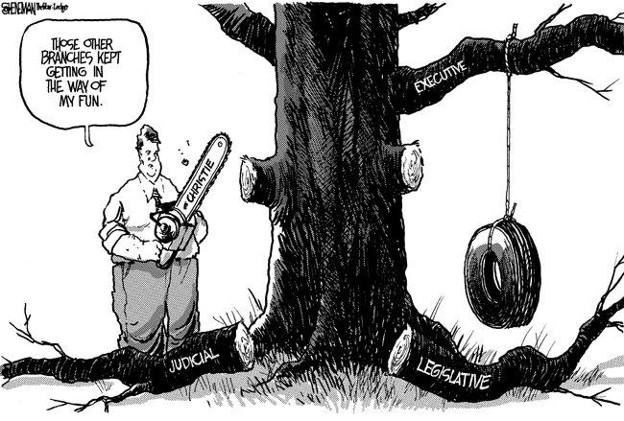
Consider the political cartoon. What is happening?
Explain why judicial independence is important to democracy and the rule of law.
Handout 3: Advantages and Disadvantages of Appointed and Elected Judges
|
Advantages |
Disadvantages |
|
|
Appointed Judiciary |
||
|
Elected Judiciary |
Handout 4: Vocabulary
The Judiciary
Plaintiff
Defendant
Hearing
Jury
Trial Court
Appellate Court
Appellant/Petitioner
Respondent/Appellee
Mock Trial
Moot Court
Opening Statement
Rebuttal
Closing Statement
Handout 5: The Structure of the New Jersey Courts
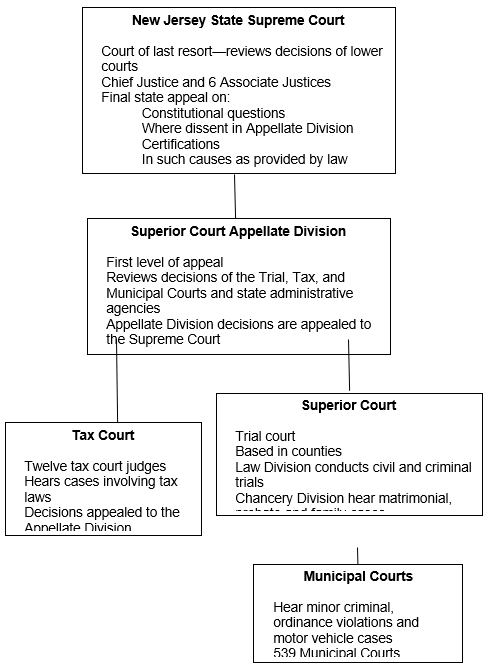
Handout 6: New Jersey Courts
|
Trial Courts |
Appellate Courts |
|
|
Number of judges |
||
|
Jury |
||
|
Evidence |
||
|
Role |
||
|
Number in NJ |
||
|
Jurisdiction |
Handout 7: Simplified Rules of Evidence
- Introduction of Physical Evidence
- Ask the judge for permission to have the item marked for identification
- Show the item to each side
- Ask the witness on the stand to identify the item
- Move the item into evidence
- Forms of questions
- Only direct questions (“can you please tell me…”) can be used during the direct examination to evoke a narrative answer
- Leading questions (isn’t it true that….?) can only be asked during cross examination
- Witness opinions
- Witnesses should confine their testimony to what they did, saw, heard, smelled, etc.)
- Witnesses generally may not give their opinions unless they are expert witnesses testifying about their area of expertise.
- Hearsay
- Hearsay is an out-of-court statement offered to prove the truth of what is asserted. (“I heard that Sam was a wild kid”)
- Hearsay is generally not permitted.
- Relevancy
- Evidence or testimony that has nothing to do with the issues of the case are “irrelevant” and may not be presented
- Impeachment
- If a witness contradicts facts in his or her previous statements, the opposing side can impeach the witness on cross-examination.
- To do this, the opposing side must show the witness the statement, ask “Is this your sworn statement?”, and then read the portion that is contradictory and point out the contradiction.
Handout 8: Conducting a Mock Trial
- Bailiff calls the case “All rise. The Court of ____________ is now in session. The Honorable Judge ___________________ presiding.”
- Opening statement by the Prosecutors (for a criminal case) or the plaintiff’s attorney (for a civil case) explains what their evidence will be and what they will try to prove.
- Opening statement by the Defendant’s attorney explains their evidence and what they will try to prove.
- The prosecutor or plaintiff’s attorney calls witnesses to testify (direct examination) and introduces physical evidence.
- Each prosecutor/plaintiff’s witness may be cross-examined by the defense attorney.
- Defendant’s attorney calls witnesses to testify (direct examination).
- Each defense witness may be cross-examined by the prosecutor/plaintiff’s attorney.
- Closing Statements. The lawyer for the plaintiff or government usually goes first to review the evidence presented, emphasizing that which is most favorable to the plaintiff/prosecution. Then the defense presents its closing, reviewing the evidence and emphasizing what is most favorable. Each side asks for a decision in its favor and explains why.
- Jury instructions (for jury trials). The judge explains to the jury the appropriate rules of law that it is to consider in weighing the evidence.
- Deliberations and decision by the jury (or judge, if no jury trial) based on the evidence presented and the credibility of the witnesses.
- Review your performance and what you might do differently to improve it.
Handout 9: Conducting a Moot Court
The Hearing:
1. Opening Statement and Argument
- The chief judge/justice should ask each side to present its arguments in the following order:
- Appellant/Petitioner: 1-2 minute Opening Statement explaining what happened during the lower court’s proceedings, followed by a 5-10 minute argument based on the U.S. or NJ Constitution, statute, and case law.
- Respondent/Appellee: 1-2 minute Opening Statement followed by a 5-10 minute argument.
- Teachers may want to make the time shorter or longer depending on the case and the level of sophistication of the students.
2. Questions by the judges
- During and/or after each presentation, the justices can and should actively question the attorney in an effort to clarify the arguments.
- Questions should be short and to the point.
- Attorneys may ask for time to consult with other members of their team before answering questions.
3. Rebuttal and Closing
- The rebuttal entails listening to the other side’s arguments and formulating a response. The attorney must listen to the arguments of the other side and then formulate a response. A thorough and detailed reply to the arguments is necessary.
- The closing should be a concise summary of the arguments
- First the Respondent makes a 3-5 minute rebuttal and closing
- Then the Appellant makes a 3-5 minute rebuttal and closing.
The Judicial Conference and Decision:
- After all arguments have been presented, the justices may move to another room for deliberations or hold an open judicial conference by remaining in the room to discuss the arguments and make a decision.
- The rest of the class should listen to the members of the court deliberate but they cannot talk or interrupt the deliberations.
- The judges should discuss:
- The strongest arguments presented by each side, as well as points that could/should have been raised but weren't.
- Each judge should explain his or her initial thinking on the decision and the reasons.
- If there are differences of opinion, and adequate time, the judges should try to convince the other judges to change their views
- The chief justice should ask for a decision by a majority vote.
- The decision and the basis for it should take into account the facts, the law, precedent and any public policy considerations.
Debriefing:
- If you are using an actual case, share the court’s decision with the class after the student court has reached its decision.
- If you are using a purely hypothetical set of facts or a case which has not yet been decided, discuss the strength and weaknesses of the arguments that were made, and any other arguments that should or might have been made.
- If the moot court is based on an historical case, place the decision within its historical context.
- In order to dispel the idea that there is always one “right” decision, help your students to understand the reasoning behind any dissenting opinions along with the reasoning of the majority of the court at the time the decision was made