

New Jersey Statehouse
Lesson Creator: New Jersey Center for Civic Education, Rutgers University, Piscataway, NJ
Grade Level: Secondary
Objectives: Student will be able to:
- Identify the role of the Governor
- Determine the qualifications for Governor of New Jersey
- Explain how the New Jersey governor changed from one of the weakest to one of the strongest positions in the country
- Use a graphic organizer to draw evidence from informational texts (the New Jersey Constitution and a video prepared by NJN-TV) about the scope of the New Jersey Governor’s authority
- Identify the sources of the New Jersey’s governor’s powers
- Compare the powers of the NJ governor with those of governors from other states
- Analyze potential benefits and problems with the current structure of New Jersey government
- Identify ways to make the NJ governor more accountable and his actions more transparent
New Jersey Student Learning Standards for Social Studies (2020):
6.3.8.CivicsPI.3: Use a variety of sources from multiple perspectives to examine the role of individuals, political parties, interest groups, and the media in a local or global issue and share this information with a governmental or nongovernmental organization as a way to gain support for addressing the issue.
6.3.8.CivicsPI.4: Investigate the roles of political, civil, and economic organizations in shaping people’s lives and share this information with individuals who might benefit from this information.
6.3.8.CivicsPD.1: Deliberate on a public issue affecting an upcoming election, consider opposing arguments, and develop a reasoned conclusion.
6.3.8.CivicsPD.2: Propose and defend a position regarding a public policy issue at the appropriate local, state, or national level.
6.3.8.CivicsPD.3: Construct a claim as to why it is important for democracy that individuals are informed by facts, aware of diverse viewpoints, and willing to take action on public issues.
6.3.8.CivicsPR.7: Compare how ideas become laws at the local, state, and national level.
6.3.8.EconET.1: Using quantitative data, evaluate the opportunity cost of a proposed economic action, and take a position and support it (e.g., healthcare, education, transportation),
6.3.8.EconET.2: Assess the impact of government incentives and disincentives on the economy (e.g., patents, protection of private property, taxes).
6.3.12.CivicsPD.1: Develop a plan for public accountability and transparency in government related to a particular issue(s) and share the plan with appropriate government officials.
6.3.12.EconGE.1: Participate in a simulated meeting (e.g., President's Council, World Bank, International Monetary Fund (IMF), research evidence from multiple sources about an economic problem (e.g., inflation, unemployment, deficit), and develop a plan of action.
Materials:
Excerpts from the New Jersey Constitution are attached as Handout 1. The full New Jersey Constitution | NJ Legislature is available on-line. A searchable version of the Constitution is also available. N.J. Constitution
Introduction/Anticipatory Set:
- Who is currently the governor of New Jersey?
- What does the governor’s job entail? The Governor is the chief executive officer for the state, similar to the President of the United States. His job is to see that the laws are carried out.
Activity One: Historical Background
- For a short history of the powers of New Jersey’s governor, play the Introduction (the first two minutes) to “New Jersey’s Powerful Governor,” produced by NJN-TV, at 1 Overview
- Have students compare the terms of the Governor in the 1776, 1844, and 1947 NJ Constitutions and how the governor was elected under the three state Constitutions by using the chart, Handout One, and completing the “Impact” section.
- A completed student chart should look something like the following:
|
NJ Constitution |
Governor’s Term |
Impact |
|
1776 |
Elected by Legislature for a one-year term |
Beholden to the Legislature Has little power or authority |
|
1844 |
Elected by voters for a three-year term Many not hold office for two consecutive terms |
Beholden to the people of the state Is a lame duck from day one Hard to get anything done in three years |
|
1947 |
Elected by voters for a four-year term May serve two consecutive terms |
Beholden to the people of the state Eight years is enough time to accomplish something |
Discuss:
- Why were the early governors so weak under the 1776 and 1844 state constitutions?
- What are the problems with a weak executive?
- Students should explain the problems with a weak executive as the following:
- Little authority
- Beholden to the Legislature
- Hard to get anything done
Activity Two: Why is the New Jersey Governor (since 19470 so strong?
Divide the class into eight groups and watch a section of the “New Jersey’s Powerful Governor” videotape as well as Handout Two: The New Jersey Constitution. Each group should complete a portion of Handout Three identifying the sources of the governor’s powers and its impact
- Group One: What authority does the Governor have regarding the military? Law enforcement? Legislation? Have students watch the video clip at 8 Governor and Legislature 1 The list should include the following:
- The New Jersey Constitution gives the governor broad authority:
- To “take care that the laws be faithfully executed” (Art. V, Sec. 1, Para. 11)
- To “communicate to the Legislature” (Art. V, Sec. 1, Para. 12)
- To “fill vacancies” (Art. V, Sec. 1, Para. 13)
- To approve or veto legislation (Art. V, Sec. 1, para. 14)
- To line-item veto appropriations (Art. V, Sec. 1, Para. 15)
- To grant clemency and parole (Art. V, Sec. 2)
- To nominate officers and provide training and regulation of a militia (Art. V, Sec. 3)
- To appoint, supervise and investigate executive and administrative officers, departments, and instrumentalities (Art. V, Sec. 4)
Group Two: What Appointment Powers does New Jersey’s Governor have? Have students watch the video clip at: 4 Appointment Power
Students should list the Governor’s appointment powers to include the following:
The Governor appoints:
- All the members of the NJ State Supreme Court and Superior Court judges (with the advice and consent of the Senate) (NJ Const., Art. VI, Sec. VI., para. 1)
- All Cabinet members, including the State Treasurer and State Attorney General (NJ Const., Art. V, sec., IV, paras. 2, 3, and 4)
- The county prosecutors (chief county law enforcement officers)(NJ Const., Art. VII, Sec. II, para. 1)
- All officers for whose election or appointment provision is not otherwise made by this Constitution or by law (with the advice and consent of the Senate)(NJ Const., Art. V, Sec. 1, para. 12).
- All general and flag officers of the militia, with the advice and consent of the Senate. All other commissioned officers of the militia shall be appointed and commissioned by the Governor according to law (NJ Const., Art. V, Sec. 3, para. 2)
- Whenever a board, commission or other body shall be the head of a principal department, the members thereof shall be nominated and appointed by the Governor with the advice and consent of the Senate, and may be removed in the manner provided by law. (NJ Const., Art. V., Sec. 4, para. 4)
- May fill any vacancy occurring in any office during a recess of the Legislature, appointment to expire at the end of the next regular session of the Senate. (NJ Const., Art. V, Sec. 1, para. 13)
Group Three: How does a centralized state government enhance the power of the NJ Governor? Have student watch the video clip at: 5 Centralized Management
Students should list how a centralized state government enhances the power of New Jersey’s Governor and the source. The list should include the following:
- All executive and administrative offices, departments, and instrumentalities of the State government, including the offices of Secretary of State and Attorney General, and their respective functions, powers and duties, shall be allocated by law among and within not more than twenty principal departments (NJ Const., Art. V, Sec. 2, para. 1)
- Each principal department shall be under the supervision of the Governor. (NJ Const., Art. V, Sec. 2, para. 2)
- The Governor may cause an investigation to be made of the conduct in office of any officer or employee who receives his compensation from the State of New Jersey, except a member, officer or employee of the Legislature or an officer elected by the Senate and General Assembly in joint meeting, or a judicial officer. (NJ Const., Art. V, Sec. 4, para. 5)
- The Governor has authority over all offices and departments of state government and can terminate cabinet officers and other employees at will.
Group Four: What control does the New Jersey Governor have over the state budget? Students should watch the video clip at: 6 Budget Control
Students should list the New Jersey Governor’s control over the state budget and the source. The list should include the following:
The Governor:
- Provides an annual budget speech in February each year, setting out his budget priorities (NJ Const., Art. V, Sec. 1, para. 12)
- Has a “line-item veto” for appropriation bills, that is, the governor can object in whole or in part to any item in a bill that appropriates money while approving the other portions (NJ Const., Art. V, Sec. 1, para. 15)
Group Five: What veto powers does New Jersey’s Governor have?
Students should watch the video clip at: 7 Veto Powers
Students should list the veto powers that New Jersey’s Governor has and the sources. The list should include the following:
The Governor:
- May veto any bill (the legislature can override the veto with a 2/3 vote of each house)(NJ Const., Art. V, Sec. 1, para. 14)
- May “conditionally” veto a bill with objections for reconsideration by the legislature (must be approved by 2/3 vote of each house)(NJ Const., Art. V, Sec. 1, para. 14)
- Has a “line-item veto” for appropriation bills, that is, the governor may object in whole or in part to any item in a bill that appropriates money while approving the other portions (NJ Const., Art. V, Sec. 1, para. 15)
Group Six: How can the governor use executive orders to expand his power?
Have students watch the video clip at: https://www.youtube.com/watch?v=CLbZjRODXwo
Students list how the governor can use executive orders to expand his power and the sources. The list should include the following:
- The Governor shall take care that the laws be faithfully executed. To this end he shall have power, by appropriate action or proceeding in the courts brought in the name of the State, to enforce compliance with any constitutional or legislative mandate, or to restrain violation of any constitutional or legislative power or duty, by any officer, department or agency of the State; but this power shall not be construed to authorize any action or proceeding against the Legislature. (NJ Const., Art. V, Sec. 1, para. 11)
- Example: Governor Byrne used an executive order to establish a Pinelands Commission to develop a comprehensive development plan
Group Seven: How can the governor use emergency powers?
Have students watch the video clip at 10 Emergency Powers
Students list how the governor can use emergency powers and the sources of emergency powers. The list should include the following:
- The Governor uses emergency powers to enable the NJ Office of Emergency Management to deal with natural and man-made disasters, e.g. storms, floods, fires, etc. that may affect many in the state
- Examples: Hurricane Sandy; winter storms; droughts
- Do you think Governor Kean went too far using emergency powers to put a moratorium on building in wetlands until a bill was passed?
Group Eight: How can the governor use the “bully pulpit” to expand his powers?
Have students watch the video clip at 8 Governor and Legislature 1
Students list how the governor can expand his power through the use of the “bully pulpit”. The list should include the following:
- The Governor and the Lt. Governor are the only officials elected by voters statewide.
- As one person rather than one of 120 state legislators, the Governor has an ability to address the press and the public that is not available to members of the legislative branch.
Directions for the Jigsaw
- Have groups jigsaw so that each group can hear from the “experts” from all eight groups
- Each group should complete the graphic organizer regarding the sources of the NJ Governor’s authority
- Where does the Governor get his authority?
- Have groups jigsaw so that each group can hear from the “experts” from all seven groups
- Have all the students complete the graphic organizer (Handout #4) regarding the sources of the NJ Governor’s authority using what they learned from the videotapes as well as from the New Jersey Constitution (Handout #1 or at New Jersey 1947 State Constitution)
- The completed chart should include the following:
|
SOURCES OF GOVERNOR’S AUTHORITY |
EXPLANATION OF POWERS |
|
|
1. Constitutional Powers: What power does the Governor have over the state military? What power does the Governor have regarding state law enforcement? What power/s does the Governor have regarding legislation? |
NJ Const., Art. V, Sec. 1, para. 12 NJ Const., Art. V, Sec. II, paras. 1 and 2 NJ Const., Art. V., Sec. 1, para. 12 |
The Governor is commander-in-chief of all the military and naval forces of the state. The Governor appoints country prosecutors with the advice and consent of the Senate. The Governor may propose legislation in his annual message to the Legislature. |
|
2. Appointment Powers: Judges Cabinet members, State Treasurer, Attorney General |
NJ Const., Art. VI, Sec. VI, para. 1 NJ Const., Art. V, Sec. IV, paras. 2-4 |
The Governor appoints all members of the NJ State Supreme Court and all Superior Court judges with the advice and consent of the Senate. The Governor appoints the head of each of the Executive departments of the states, including the Attorney General, with the advice and consent of the Senate. |
|
3. What power does the NJ Governor have from a centralized government? |
NJ Const., Art. V, Sec. IV, para. 1-2 |
All executive and administrative offices, departments and instrumentalities of the State and their functions are allocated among not more than 20 principal departments and each principal department is under the supervision of the Governor, giving the Governor control of all of state government. |
|
4. What control does the NJ governor have over the state budget? Annual budget speech Line-item veto |
NJ Const., Art. V., Sec. 1, para. 12 NJ Const., Art. V., Sec. 1, para. 15 |
The Governor may propose legislation in his annual message to the Legislature. The Governor may veto one or more items (“line item veto”) of money to be funded in a bill unless 2/3 of the members of each house object. |
|
5. What veto powers does the Governor have? |
NJ Const., Art. V, Sec. I, para. 14 NJ Const., Art. V., Sec. 1, para. 15 |
The Governor may veto a bill which can only be overridden by a 2/3 vote of each house. The Governor may veto one or more items (“line item veto”) of money to be funded in a bill unless 2/3 of the members of each house object. |
|
6.Executive Orders |
NJ Const., Art. V, Section I, para. 11 |
The Governor shall “take care that the laws be faithfully executed”. |
|
7. Emergency Powers |
NJ Const., Art. V., Sec. 1, para. 1 |
All executive authority is vested in the Governor. |
|
8. Bully Pulpit |
NJ Const., Art. V., Sec. 1, para. 1 NJ Const., Art. V., Sec. 1, para. 4. |
All executive power is vested in the Governor. The Governor and Lt. Governor are the only officials elected by voters statewide. The Governor speaks with one voice rather than one of 120 states legislators. Because of this, the Governor has the ability to address the press and public not available to members of the legislative branch. |
Activity Three: Research the accomplishments of New Jersey’s Governors since 1947
Have students conduct research and identify one, two or three major accomplishments of each of the New Jersey governors since 1947. Possible sources: New Jersey - National Governors Association; New Jersey Governors. Then have students put together a chart summarizing the accomplishments. A completed chart should look something like this:
|
Governor |
Accomplishments |
|
Alfred Driscoll,1947-54 |
The state constitution was revised State agencies were restructured Sn equal pay for equal work bill was sanctioned |
|
Robert Meyner,1954-62 |
State employees compensation plan was authorized The usage of absentee ballots was sanctioned The state highway system was advanced The Delaware River Basin Compact was approved |
|
Richard Hughes,1962-70 |
Created a commission to study the Meadowlands development Brought the Democratic National Convention to New Jersey for the first time Secured the takeover of the Hudson and Manhattan Railroad by the Port of New York Authority in return for approval of the construction of the World Trade Center Vetoed a bill requiring students to salute the flag in contravention to a U.S. Supreme Court ruling Urged social reform to eliminate causes of civil disorders in urban areas |
|
William Cahill, 1970-74 |
Helped create the New Jersey Sports and Exposition Authority Department of Environmental Protection established Coastal Area Facility Review Act (CAFRA) passed National’s first daily statewide lottery implemented in NJ |
|
Brendan Byrne, 1974-82 |
Enacted state’s first income tax to provide equalized funding to school districts Casino gambling authorized in Atlantic City The Meadowlands Sports Complex opened The Pinelands Preservation Act enacted, creating the nation’s first National Reserve. |
|
Thomas Kean, 1982-90 |
Instituted a federally replicated welfare reform program Enacted Highland Water Protection and Planning Act Extensive educational reforms |
|
James Florio, 1990-94 |
Health and welfare reform Urban economic development |
|
Christie Todd Whitman, 1994-2001 |
Bond issue to preserve open space and farmland Signed Megan’s Law and “Three Strikes and You’re In.” Reduce state income tax but left future shortfalls in state’s pension funds Whitman resigned as governor when she was named EPA Administrator by President George W. Bush in January 2001. |
|
James McGreevey, 2002-04 |
Revamped the state’s Business Employment Incentive Program Undertook extensive school construction project Auto insurance reform |
|
Jon Corzine, 2006-10 |
Criminal Justice and Children Responded to the Great Recession of 2008 |
|
Chris Christie, 2010-2018 |
Reformed pension and health benefits Reformed education Reduced funding to school districts |
Activity Four: Active Citizenship
- Have the class identify several pressing current social and/or economic issues that should be addressed by the New Jersey government.
- Have students debate and prioritize the issues and select 1, 2 or more as the subject of a simulated hearing before the NJ legislature and governor. (Teacher may want to consider the New Jersey activity, “Improving Your Community” for helpful suggestions on how to proceed in guiding a class through the process of identifying, researching and developing a solution to a public policy issue)
- Extension: Send the results of the simulated hearing to the NJ Governor and legislature for action.
Activity Five: Is New Jersey’s Governor too powerful?
Show students the political cartoon, attached as Handout Four. Ask students, “What is the cartoon tying to say?” Students should respond that NJ Governor Christie in 2011 saw the other branches of government—the judiciary and the legislature—as “interfering with his fun” and was “cutting down” the other branches of government. Is this an indication that New Jersey’s Governor had too much power? Why?
To put the power of the New Jersey governor in perspective, Handout Five, compares the position of governor of New Jersey with the position of governor of Mississippi, where the powers of the governor are much more limited. In thirty-five states, judges are elected rather than appointed by the governor.
|
New Jersey |
Mississippi |
|
|
How is the Governor elected? |
The people vote for the Governor. |
The people vote for the Governor. |
|
How is the lieutenant Governor elected? |
The people vote for the Lieutenant Governor. (effective 2009) |
The people vote for the Lieutenant Governor. |
|
Are the Governor and Lieutenant Governor elected on the same ballot? |
Yes. They therefore must be from the same political party. |
No. The Governor and Lieutenant Governor are elected on separate ballots. They therefore can be from different political parties. |
|
Who elects the judges within the state? |
With the advice and consent of the Senate, the Governor nominates and appoints the Justices to the Supreme Court and the judges to the Superior Court and inferior courts extending to more than one municipality. |
The people vote for the Judges on the Supreme Court and inferior courts. |
|
How long are the Judges in Office? |
The Justices of the Supreme Court and the Judges of the Superior Court hold their offices initially for seven years. Upon reappointment, they hold their offices during good behavior. They must retire at 70. |
The Supreme Court Justices and Court of Appeals Judges are elected for eight years. The inferior judges are elected to four-year terms. |
|
Who selects the key positions of the executive branch such as the Attorney General, the Secretary of State and the State Treasurer? |
The Attorney General, Secretary of State and State Treasurer are nominated and appointed by the Governor, with advice and consent by the Senate. |
The Attorney General, Secretary of State and State Treasurer are all elected to these positions. |
|
How long does the Governor of this state serve? |
The Governor can serve two successive terms. Each term is four years. He/she will be eligible again for that office the fourth year after the expiration of the second successive term. |
The Governor serves a term of four years. The Governor can only serve two terms as Governor. |
Ask students to use Handout Six to identify and list the advantages and disadvantages of the system used in New Jersey and Mississippi. In the third box, identify two questions that you have about the structure of states more like New Jersey and state more like Mississippi. The boxes might look something like the following:
|
Advantages |
Disadvantages |
Questions |
|
|
New Jersey |
• One true executive • Governor is democratically elected • Judges are non-partisan • Governor appoints officials he can work with |
• If Governor is not dependable, whole system could fail • The people do not have a direct say in a lot of the actions/people within the State |
• Have most of the Governors been responsible in this state? • Does this system actually create non-partisan judges? |
|
• True democratic system • If an official is not accountable to the people, they can elect someone else |
● Governor may not have an effective working executive, because different parties/people elected ● Judges are subject to partisan elections |
• Have the people elected a governor and lt. governor from different parties? How did it work? • Do the elected officials work well together? |
Complete the comparison with the following questions in a Class Discussion:
- Which system is based more on the ideals of pure democracy?
Answers will vary. Students may assert that states structured like Mississippi are more democratic. The people within this state vote for more officials, including judges. The people also can choose a Governor and Lt. Governor from different parties. This further exemplifies how this system represents the ideals of a pure democracy.
- Which system seems to be more efficient?
Answers will vary. Students should recognize, however, that the Governor in states like New Jersey is very powerful. He/She possesses the power to appoint numerous important governmental positions, including the Attorney General and judges. He/She has the power to shape the government, based on party and personality.
- Which state Governor possesses more power?
Clearly, the Governor in New Jersey has more power because he is able to appoint judges, the attorney general, the state treasurer, and county prosecutors, whereas they are all separately elected in Mississippi.
- Identify which state system you prefer. Support your answer with at least five facts.
Answers will vary. Clearly there is a great amount of “democracy” (that is, voting) in a state like Mississippi where judges and other public servants are elected rather than appointed by the governor.
Assessment
Have students write an essay on the following topics, supporting their opinions with research and analysis:
- Analyze why the governor of New Jersey Governor is considered one of the most powerful in the country
- Evaluate the structure of New Jersey’s government regarding the governor in terms of accountability, transparency, efficiency and democracy
Activity Six: Who Can be Governor of New Jersey?
Can anyone serve as Governor of New Jersey? What does the New Jersey Constitution require?
- Have students look at Handout Two, which includes relevant provisions from the New Jersey State Constitution (Section 1) regarding who is eligible to run for the office of Governor of the State.
- Conclude that the Governor must be at least thirty years old, a citizen of the United States for at least 20 years and a resident of New Jersey for at least seven years.
Handout Seven has four possible candidates for Governor of New Jersey. Which of these individuals is eligible to run for Governor? Consider the relevant provisions of the New Jersey State Constitution to determine which of the individuals described in Handout Seven (Frankie Jonas, Bruce Springsteen, former NJ Governor Thomas Kean and current U.S. Senator from New Jersey Cory Booker) would be eligible to run for Governor of New Jersey.
- Can Frankie Jonas run for Governor of New Jersey?
No, he is not over 30 years old and, although he was born in New Jersey, he has not been a resident of the state for the past seven years. He lives in Los Angeles.
- Can Bruce Springsteen run for Governor of New Jersey?
Yes. He is over 30 years old and has a residence in Colts Neck, New Jersey. However, Springsteen travels a lot and is not always at his home in NJ. People who own more than one home can only be domiciled for tax, voting and office holding purposes in one place—the place where they intend to make a permanent home, which has been defined for tax purposes as where someone spends more than half of their time (more than 183 days a year). Springsteen is domiciled in New Jersey.
- Can former Governor Thomas Kean run for Governor of New Jersey again in 2016?
Yes, he is over 30 years old and has resided in New Jersey for the past seven years. According to the New Jersey Constitution, Article V, Section I, Paragraph 5, he may run again four years after the end of his second successive term. He may run again since it has been more than four years since he left office in 1990.
- Can U.S. Senator Cory Booker run for Governor of New Jersey?
He is over 30 years old, but mostly lives in Washington, D.C. However, the New Jersey Constitution, Article V, Section I, Paragraph 2 allows someone to be “absent during that time on the public business of the United States or of this State.” He qualifies for this exception as U.S. Senator. But, Paragraph 3 makes it clear that no member of Congress can also serve as Governor. Senator Booker would have to vacate his U.S. Senate seat in order to run for Governor. This was done by U.S. Senator Jon Corzine, who ran for Governor of New Jersey in November 2005, and won, and resigned from his Senate seat to serve as governor. This was also done by U.S. Congresswoman Mikie Sherrill, who ran for Governor of New Jersey in November 2025, and won, and resigned from her seat in Congress to serve as governor.
- Alternative Online Quiz about the New Jersey Governor using Kahoots.
Go to https://create.kahoot.it/details/4c477b77-1aac-413b-a3af-1adec725dcca for the link to Kahoots. Set up your game with the potential candidates for governor. All students can play the game at the same time for points and see who wins. You may want to change the candidates.
Closure for activity six: Critical thinking
Have a classroom discussion or ask students to write short essays on the following;
- Do you think that it is important that the governor be a resident of the state he or she serves? Why or why not? Do you think that there should be additional qualifications or fewer qualifications? What would you add or subtract?
- Why do you think that it is necessary for someone to meet age, residency and other requirements in order to serve as Governor of the State? Do you think that it is a good idea to have age requirements for the Governor and other elected positions of authority? Why or why not?
Assessment:
- Students will be assessed throughout this exercise by their class and group participation skills.
- Students will write a short paragraph explaining what powers the Governor of New Jersey is authorized to exercise and the sources of this authority.
Extension: Student Mock Election
The governor of New Jersey is elected every four years. Have your students get in the “habit of voting” every year by participating in the annual student mock election, which in 2025 (and every four years thereafter) will include a vote for the state governor. The annual student mock election is held online the last two weeks of October before the actual election. Students may vote online or with paper ballots. Students are not identified in the voting. For additional information contact Robert O’Dell at
Extension: Take your class to the Statehouse
Take your class on a visit to the Statehouse in Trenton. Contact: NJ State House Tours. The Eagleton institute has a grant program, the Statehouse express, to help school districts defray the cost of a field trip to the New Jersey Statehouse. Contact: Center for Youth Political Participation
Handout One: Compare the Governor in the 1776, 1844 and 1947 Constitutions
|
NJ Constitution |
Governor’s Term |
Impact |
|
1776 |
Elected by the Legislature for one year |
|
|
1844 |
Elected by voters for three years May not hold office for two consecutive terms |
|
|
1947 |
Elected by voters for four years May serve two consecutive terms \ |
Handout Two: New Jersey Constitution (Excerpted Provisions regarding the Governor)
Article I--Rights and Privileges
Article II—Elections
Article III—Distribution of Powers
- The powers of the government shall be divided among three distinct branches, the legislative, executive, and judicial. No person belonging to one branch shall exercise any of the powers properly belonging to either of the others, except as expressly provided in this Constitution.
Article IV—Legislative
Article V--Executive
Section I
1. The executive power shall be vested in a Governor.
2. The Governor shall be not less than thirty years of age, and shall have been for at least twenty years a citizen of the United States, and a resident of this State seven years next before election, unless the Governor shall have been absent during that time on the public business of the United States or of this State. A person shall be eligible for the office of Lieutenant Governor only if eligible under this Constitution for the office of Governor.
3. No member of Congress or person holding any office or position, of profit, under this State or the United States shall be Governor or Lieutenant Governor. If the Governor or Lieutenant Governor or person administering the office of Governor shall accept any other office or position, of profit, under this State or the United States, the office of Governor or Lieutenant Governor, as the case may be, shall thereby be vacated. No Governor or Lieutenant Governor shall be elected by the Legislature to any office during the term for which the person shall have been elected Governor or Lieutenant Governor.
4. The Governor and Lieutenant Governor shall be elected conjointly and for concurrent terms by the legally qualified voters of this State, and the manner of election shall require each voter to cast a single vote for both offices. The candidate of each political party for election to the office of Lieutenant Governor shall be selected by the candidate of that party nominated for election to the office of Governor. The selection of the candidate for election to the office of Lieutenant Governor shall be made within 30 days following the nomination of the candidate for election to the office of Governor. A person shall not seek election to both offices simultaneously. The joint candidates receiving the greatest number of votes shall be elected; but if two or more joint candidacies shall be equal and greatest in votes, one set of joint candidates shall be elected by the vote of a majority of all the members of both houses in joint meeting at the regular legislative session next following the election for Governor and Lieutenant Governor by the people. Contested elections for the offices of Governor and Lieutenant Governor shall be determined in such manner as may be provided by law.
5. The term of office of the Governor and of the Lieutenant Governor shall be four years, beginning at noon of the third Tuesday in January next following their election, and ending at noon of the third Tuesday in January four years thereafter. No person who has been elected Governor for two successive terms, including an unexpired term, shall again be eligible for that office until the third Tuesday in January of the fourth year following the expiration of the second successive term.
11. The Governor shall take care that the laws be faithfully executed. To this end he shall have power, by appropriate action or proceeding in the courts brought in the name of the State, to enforce compliance with any constitutional or legislative mandate, or to restrain violation of any constitutional or legislative power or duty, by any officer, department or agency of the State; but this power shall not be construed to authorize any action or proceeding against the Legislature.
12. The Governor shall communicate to the Legislature, by message at the opening of each regular session and at such other times as he may deem necessary, the condition of the State, and shall in like manner recommend such measures as he may deem desirable. He may convene the Legislature, or the Senate alone, whenever in his opinion the public interest shall require. He shall be the Commander-in-Chief of all the military and naval forces of the State. He shall grant commissions to all officers elected or appointed pursuant to this Constitution. He shall nominate and appoint, with the advice and consent of the Senate, all officers for whose election or appointment provision is not otherwise made by this Constitution or by law.
13. The Governor may fill any vacancy occurring in any office during a recess of the Legislature, appointment to which may be made by the Governor with the advice and consent of the Senate, or by the Legislature in joint meeting. An ad interim appointment so made shall expire at the end of the next regular session of the Senate, unless a successor shall be sooner appointed and qualify; and after the end of the session no ad interim appointment to the same office shall be made unless the Governor shall have submitted to the Senate a nomination to the office during the session and the Senate shall have adjourned without confirming or rejecting it. No person nominated for any office shall be eligible for an ad interim appointment to such office if the nomination shall have failed to be confirmed by the Senate.
14.(a) When a bill has finally passed both houses, the house in which final action was taken to complete its passage shall cause it to be presented to the Governor before the close of the calendar day next following the date of the session at which such final action was taken.
(b) A passed bill presented to the Governor shall become law:
(1) if the Governor approves and signs it within the period allowed for his consideration; or,
(2) if the Governor does not return it to the house of origin, with a statement of his objections, before the expiration of the period allowed for his consideration; or,
(3) if, upon reconsideration of a bill objected to by the Governor, two-thirds of all the members of each house agree to pass the bill.
15. If any bill presented to the Governor shall contain one or more items of appropriation of money, he may object in whole or in part to any such item or items while approving the other portions of the bill. In such case he shall append to the bill, at the time of signing it, a statement of each item or
part thereof to which he objects, and each item or part so objected to shall not take effect. A copy of such statement shall be transmitted by him to the house in which the bill originated, and each item or part thereof objected to shall be separately reconsidered. If upon reconsideration, on or after the third day following said transmittal, one or more of such items or parts thereof be approved by two-thirds of all the members of each house, the same shall become a part of the law, notwithstanding the objections of the Governor. All the provisions of the preceding paragraph in relation to bills not approved by the Governor shall apply to cases in which he shall withhold his approval from any item or items or parts thereof contained in a bill appropriating money.
Section II
1. The Governor may grant pardons and reprieves in all cases other than impeachment and treason, and may suspend and remit fines and forfeitures. A commission or other body may be established by law to aid and advise the Governor in the exercise of executive clemency.
Section III
1. Provision for organizing, inducting, training, arming, disciplining and regulating a militia shall be made by law, which shall conform to applicable standards established for the armed forces of the United States.
2. The Governor shall nominate and appoint all general and flag officers of the militia, with the advice and consent of the Senate. All other commissioned officers of the militia shall be appointed and commissioned by the Governor according to law.
Section IV
1. All executive and administrative offices, departments, and instrumentalities of the State government, including the offices of Secretary of State and Attorney General, and their respective functions, powers and duties, shall be allocated by law among and within not more than twenty principal departments, in such manner as to group the same according to major purposes so far as practicable. Temporary commissions for special purposes may, however, be established by law and such commissions need not be allocated within a principal department.
2. Each principal department shall be under the supervision of the Governor. The head of each principal department shall be a single executive unless otherwise provided by law. Such single executives shall be nominated and appointed by the Governor, with the advice and consent of the Senate, to serve at the pleasure of the Governor during the Governor's term of office and until the appointment and qualification of their successors, except as herein otherwise provided with respect to the Secretary of State and the Attorney General. The Governor may appoint the Lieutenant Governor to serve as the head of a principal department, without the advice and consent of the Senate, and to serve at the pleasure of the Governor during the Governor's term of office.
3. The Secretary of State and the Attorney General shall be nominated and appointed by the Governor with the advice and consent of the Senate to serve during the term of office of the Governor, except the Governor may appoint the Lieutenant Governor to serve as Secretary of State without the advice and consent of the Senate.
4. Whenever a board, commission or other body shall be the head of a principal department, the members thereof shall be nominated and appointed by the Governor with the advice and consent of the Senate, and may be removed in the manner provided by law. The Governor may appoint the Lieutenant Governor hereto without the advice and consent of the Senate. Such a board, commission or other body may appoint a principal executive officer when authorized by law, but the appointment shall be subject to the approval of the Governor. Any principal executive officer so appointed shall be removable by the Governor, upon notice and an opportunity to be heard.
5. The Governor may cause an investigation to be made of the conduct in office of any officer or employee who receives his compensation from the State of New Jersey, except a member, officer or employee of the Legislature or an officer elected by the Senate and General Assembly in joint meeting, or a judicial officer. He may require such officers or employees to submit to him a written statement or statements, under oath, of such information as he may call for relating to the conduct of their respective offices or employments. After notice, the service of charges and an opportunity to be heard at public hearing the Governor may remove any such officer or employee for cause. Such officer or employee shall have the right of judicial review, on both the law and the facts, in such manner as shall be provided by law.
Article VI--Judicial
Section VI
1. The Governor shall nominate and appoint, with the advice and consent of the Senate, the Chief Justice and associate justices of the Supreme Court, the Judges of the Superior Court, and the judges of the inferior courts with jurisdiction extending to more than one municipality; except that upon the abolition of the juvenile and domestic relations courts or family court and county district courts as provided by law, the judges of those former courts shall become the Judges of the Superior Court without nomination by the Governor or confirmation by the Senate. No nomination to such an office shall be sent to the Senate for confirmation until after 7 days' public notice by the Governor. 5. The Governor may investigate the conduct of any officer or employee who receives his compensation from the State of New Jersey, except a member, officer or employee of the Legislature or an officer elected by the Senate and General Assembly in joint meeting, or a judicial officer.
5. Whenever the Supreme Court shall certify to the Governor that it appears that any Justice of the Supreme Court or Judge of the Superior Court is so incapacitated as substantially to prevent him from performing his judicial duties, the Governor shall appoint a commission of three persons to inquire into the circumstances; and, on their recommendation, the Governor may retire the justice or judge from office, on pension as may be provided by law.
Article VII—Public Officers
Section II
1. County prosecutors shall be nominated and appointed by the Governor with the advice and consent of the Senate. Their term of office shall be five years, and they shall serve until the appointment and qualification of their respective successors.
Handout Three: Why is the New Jersey Governor so Powerful?
As the head of the New Jersey government, the Governor holds numerous powers listed in Article V of the New Jersey Constitution. Many of these powers mirror those held by the President on the national level. Using the New Jersey Constitution, complete the chart below by explaining the powers that the Governor holds.
|
SOURCES OF GOVERNOR’S AUTHORITY |
EXPLANATION OF POWERS |
|
|
1. Constitutional Powers: What power does the Governor have over the state military? What power does the Governor have in regarding state law enforcement? What power/s does the Governor have regarding legislation? |
||
|
2. Appointment Powers: Judges Cabinet members, State Treasurer, Attorney General |
||
|
3. What power does the NJ Governor have from a centralized government? |
||
|
4. What control does the NJ governor have over the state budget? |
||
|
5. What veto powers does the Governor have? |
||
|
6.Executive Orders |
||
|
7. Emergency Powers |
||
|
8. Bully Pulpit |
Handout Four: Is the New Jersey Governor Too Powerful?
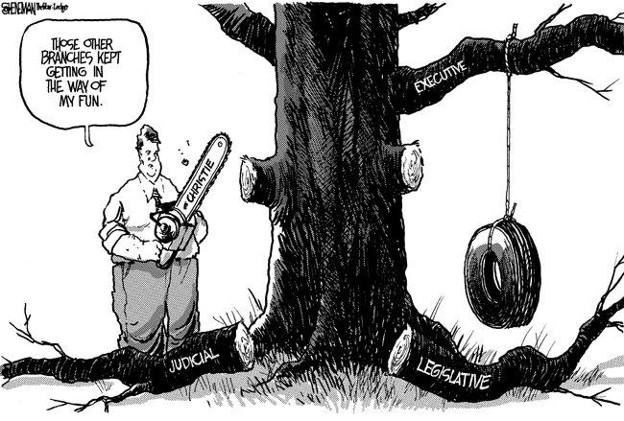
Drew Sheneman, “The Tree Doctor,” OpEd, The Star Ledger, May 6, 2011.
Handout Five: Comparison of Weak and Strong Governors: New Jersey and Mississippi
|
New Jersey |
Mississippi |
|
|
How is the Governor elected? |
The people vote for the Governor. |
The people vote for the Governor. |
|
How is the lieutenant Governor elected? |
The people vote for the Lieutenant Governor. (effective 2009) |
The people vote for the Lieutenant Governor. |
|
Are the Governor and Lieutenant Governor elected on the same ballot? |
Yes. They therefore must be from the same political party. |
No. The Governor and Lieutenant Governor are elected on separate ballots. They therefore can be from different political parties. |
|
Who elects the judges within the state? |
The Governor nominates and appoints the Justices in the state to the Court. In addition, the Governor appoints the judges to the Superior Court and inferior courts extending to more than one municipality. The Senate must give the advice and consent to the judicial nominations. |
The people vote for the Judges on the Supreme Court and inferior courts. |
|
How long are the Judges in Office? |
The Justices of the Supreme Court and the Judges of the Superior Court hold their offices initially for seven years. Upon reappointment, they hold their offices during good behavior. They must retire at the age of 70. |
The Supreme Court Justices and Court of Appeals Judges are elected for eight years. The inferior judges are elected to four-year terms. |
|
Who selects the key positions of the executive branch such as the Attorney General, the Secretary of State and the State Treasurer? |
These positions are nominated and appointed by the Governor, with advice and consent by the Senate. |
The people elect these positions. |
|
How long does the Governor of this state serve? |
The Governor can serve two successive terms. Each term is four years. He/she will be eligible again for that office the fourth year after the expiration of the second successive term. |
The Governor serves a term of four years. The Governor can only serve two terms as Governor. |
Handout Six: Questions for Discussion
Using Handout 6, list the advantages, disadvantages and of the system used in New Jersey and Mississippi. In the third box, identify two questions that you have about the structure of states.
|
Advantages |
Disadvantages |
Questions |
|
|
New Jersey |
|||
|
Mississippi |
Which system is based more on the ideals of pure democracy? Explain.
Which system seems to be more efficient? Explain.
Which state Governor possesses more power? Explain.
Identify which state system you prefer. Support your answer with at least five facts.
Handout Seven: Who Can be Governor of New Jersey?
Assignment: Consider the provisions of Section V of the New Jersey Constitution to determine whether any of the following individuals could serve as Governor in the state of New Jersey. Be prepared to explain why or why not.
 Name: Frankie Jonas
Date and place of birth: Sept. 28, 2000/Ridgewood, New Jersey
Current Residence: Los Angeles, California
Ever held the position of New Jersey Governor? No
Current Occupation: Recording artist, Actor
 Name: Bruce Springsteen
Date and place of birth: Sept. 23, 1999/Long Branch, NJ
Current residence: Colts Neck, NJ (one of many)
Ever held position of NJ governor? No
Current occupation: Singer
 Name: Thomas H. Kean
Date and place of birth: April 21, 1935/New York City, New York
Current Residence: Bedminster Township, New Jersey (since 1990)
Ever held the position of New Jersey Governor? Yes (1982–1990)
Current Occupation: Lecturer/ Journalist
 Name: U.S. Senator Cory Booker
Date and place of birth: April 27, 1969/Washington, D.C.
Current Residence: Newark, New Jersey
Ever held the position of New Jersey Governor? No
Current occupation: U.S. Senator from New Jersey