
Prepared by: The New Jersey Center for Civic Education, Rutgers University, Piscataway, NJ
Grade Level: Secondary
This unit includes several topics and classroom activities:
- The Plessy Decision and De Jure and De Facto Segregation
- The Hedgepeth-Williams v. Trenton Board of Education decision
- The impact: Brown v. Board of Education and anti-discrimination laws in NJ
- School Desegregation in New Jersey today
- Unequal funding of schools
- A Thorough and Efficient Education
- School Consolidation or Regionalization
Teachers may choose to use all or parts of the lessons and activities included in this unit.
Objectives: Students will be able to:
- Describe the difference between the de jure and de facto discrimination
- Explain why de facto discrimination might be harder to eliminate
- Explain how the Hedgepeth-Williams Trenton Board of Education decision reflected the fight to end segregation in NJ schools
- Explain how the Hedgepeth-Williams decision contributed to the watershed Brown v. Board of Education decision by the U.S. Supreme Court
- Investigate actions taken by New Jersey and at least one other state or city to eliminate segregation in public schools
- Explain how school funding works in New Jersey
- Explain how school consolidation might reduce segregation in the schools
- Determine the effectiveness of cases and laws in ending segregated schools
- Determine whether the primary issue is school desegregation or equal funding for schools
- Develop a plan to ensure a high quality education for all New Jersey students
NJ Social Studies Content Standards:
6.1.12.CivicsPI.13.a: Craft an argument as to the effectiveness of the New Jersey Constitution of 1947, New Jersey Supreme Court decisions (i.e., Hedgepeth and Williams v. Trenton Board of Education), and New Jersey’s laws in eliminating segregation and discrimination
6.1.12.CivicsDP.13.a: Analyze the effectiveness of national legislation, policies, and Supreme Court decisions in promoting civil liberties and equal opportunities (i.e., the Civil Rights Act, the Voting Rights Act, the Equal Rights Amendment, Title VII, Title IX, Affirmative Action, Brown v. Board of Education, and Roe v. Wade).
Focus Questions:
- What was the immediate and long-term impact of the Hedgepeth-Williams v. Trenton Board of Education decision?
- Have the Hedgepeth-Williams and Brown v. Board of Education decisions been successful in eliminating segregated schools in New Jersey? Why or why not?
- Is it acceptable for schools to be segregated by socio-economic factors (de facto or residential segregation)?
- How might consolidating or regionalizing the New Jersey schools reduce segregation in the schools?
- How do you think schools in New Jersey could be successfully integrated?
- What constitutes a “thorough and efficient” education?
- How can the state of New Jersey ensure that every New Jersey child receives a “thorough and efficient” education?
I. Historical Background: The Plessy Decision
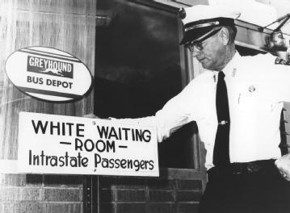
Segregated Waiting Room in Bus Depots
Despite the Civil War Amendments (the 13th Amendment outlawing slavery, the 14th prohibiting states from denying “due process of law” and “equal protection of the laws” and the 15th prohibiting states from denying anyone the right to vote on the basis of race), African Americans were not treated the same as whites, especially in southern states where state laws often required that the races be segregated. The U.S. Supreme Court had struck down the Civil Rights Act of 1875 which would have made it a crime for an individual to deny “the full and equal enjoyment of any of the accommodations, advantages, facilities, and privileges of inns, public conveyance on land or water, theaters or other places of public amusement…to citizens of every race and color.” The court ruled that the 14th Amendment did not give Congress authority to prevent discrimination by private individuals. This left victims of racial discrimination to seek relief from the states. But state governments were enacting “Jim Crow” laws, requiring that blacks and whites could not legally use the same public facilities, ride the same trains, or attend the same schools, etc.
Although some people believed that these laws were unjust, it was not until the 1890s that they were directly challenged in court. In 1892, an African American man named Homer Plessy (who was 7/8 white) sat in the white compartment on a train in New Orleans and refused to move when he was challenged by the conductor. Plessy was arrested for violating Louisiana state law that required him to sit in a segregated compartment. Plessy’s attorney, financed by a group of concerned black men in New Orleans, argued in court that the Louisiana law separating Blacks from Whites on trains violated the equal protection clause of the 14th Amendment. By 1896, his case, Plessy v. Ferguson, had made it all the way to the United States Supreme Court. By a vote of 8-1, the Supreme Court ruled against Plessy, stating that: "The object of the [Fourteenth] amendment was undoubtedly to enforce the equality of the two races before the law, but in the nature of things it could not have been intended to abolish distinctions based upon color, or to endorse social, as distinguished from political, equality. . . If one race is inferior to the other socially, the Constitution of the United States cannot put them upon the same plane."
The lone dissenter, Justice John Marshal Harlan, interpreted the 14th Amendment another way: "Our Constitution is color-blind, and neither knows nor tolerates classes among citizens." Justice Harlan's dissent would become a rallying cry for those in later generations who argued that segregation on the basis of race was unconstitutional. However, based on the Plessy decision, the U.S. Supreme Court continued to uphold the legality of Jim Crow laws and other forms of racial discrimination into the 20th century.
Activity 1: Critical thinking: De Jure and De Facto Segregation
- Have students look up the phrase “de jure” in a dictionary. “De Jure” is Latin and means according to law or by law. Discuss with students what they think this means in relation to segregation. Some ideas that will probably be mentioned are Jim Crow laws, such as those requiring segregation on buses and trains, and in restaurants, hotels and schools. De jure segregation is segregation of a race, ethic or other group as required by law, as it was required in public accommodations such as training, buses, hotels, schools, etc., in most southern states after the Civil War until the 1950s.
- Have students then look up the meaning of “de facto”. “De Facto” means actual or in fact. Have students discuss how de facto segregation differs from de jure segregation. De facto segregation is segregation that happens in practice but is not required by law. De facto segregation was very prevalent in northern states until the 1950s.
- Ask students to give examples of de facto segregation. Responses might be: De facto segregation would include schools that are segregated because of a policy of having neighborhood schools where the housing pattern separates families by their income and creates wealthier and poorer neighborhoods, which are then reflected in the schools. Or de facto segregation might result from the exodus of some students from public to charter schools or from self-segregation by students for courses, sports or even lunch tables.
- Ask students why it might be more difficult to end de facto segregation and discuss. Responses should recognize that since de facto segregation in public schools is often the result of housing patterns, the solution then becomes a land use rather than a school issue. In addition, a school might have a diverse student population overall, but classes may end up being unintentionally segregated.(See the Land Use in New Jersey lesson regarding Mt. Laurel housing discrimination at https://civiced.rutgers.edu/nj-lessons/new-jersey-history-lessons).
II. Hedgepeth- Williams v. Trenton Board of Education
Historical Background
After the Civil War, all states were required to change their constitutions to meet the Civil War Amendments. New Jersey went further and, in 1881, enacted RS 18:14-2, which prohibited segregated schooling based on race, one of the very first such laws in the nation. Although not enforced with Southern-style heavy-handedness, de facto segregation also existed in the North. There were no "whites only" signs in public places, or lynchings in the North. But, Blacks sat in the balconies of movie theaters while whites got the best seats. Blacks could swim at public pools from noon to 2 p.m. while whites got to swim the rest of the day
By the early part of the 20th century, changes were taking place that would doom racial segregation. World War I had triggered one of the greatest population movements in American history -- the exodus of millions of poor sharecroppers and tenant farmers from the South to the North for better jobs and the chance to join their own communities in big industrial cities. In Trenton, most of the Black newcomers came from Virginia, the Carolinas and Georgia. They settled in the industrial North Ward and on Spring Street and Passaic Street in the shadow of the State House. In 1920, there were 5,315 Blacks in Trenton, 4 percent of the city; by 1950, they made up 11 percent of the city. Today the figure hovers around 50 percent. Blacks of Trenton included skilled factory hands, teachers, lawyers, doctors and other professionals. One of them was Robert Queen, an eloquent lawyer who reinvigorated Trenton's branch of the NAACP. In 1932, Queen sued to stop the practice of requiring Black students to take swimming lessons at the high school on Friday afternoon only, while white children could swim the rest of the week. The state Supreme Court struck down the school rules and ordered the school pool integrated. Once America went to war against Nazi Germany in 1941, it became harder than ever to defend Jim Crow laws. How could the country discriminate against Blacks when we were fighting for democracy?
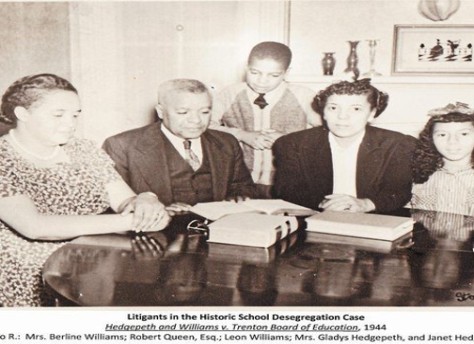
In 1943, a couple of 12-year-old students, Leon Williams and Janet Hedgepeth, wanted to go to the same classes as their playmates. But, when their parents tried to get them into their neighborhood school, Junior High No. 2, they were told by the principal that they could not attend that school because it was “not built for Negroes.” Since Leon Williams and Janet Hedgepeth were black, they had to walk 2 ½ miles instead to the all-Black New Lincoln School.
To the angry mothers of Leon Williams and Janet Hedgepeth, the Jim Crow era rules of Trenton just were not fair. The New Lincoln School, on North Montgomery Street, was built as a Black-only junior high school in 1923 -- and celebrated as a sign of racial progress. But Gladys Hedgepeth and Berline Williams did not see it that way. They both served as volunteers for the NAACP; Mrs. Hedgepeth also belonged to the city's Interracial Committee for Unity. All their lives, they had put up with petty discrimination --- but they also never wavered in believing they deserved equality.
"My mother saw that Black people were treated differently than white people," said Williams' daughter, Thelma Smith. "But our neighborhood was mixed, and we all took care of each other. We had Italian neighbors, Jewish neighbors, and Polish neighbors. We were all in poverty, but it was a poverty of money, not a poverty of spirit. As kids, I don't think we were even conscious of color. We just played with each other. We'd be out on the street, jumping rope, playing red-light, rolling around on scooters. Or we'd have a Popsicle on the front porch. And our parents would be sitting around to make sure we didn't get in trouble."
On Sept. 13, 1943, the school year began. Mrs. Hedgepeth and Mrs. Williams enrolled their kids at the Lincoln School -- but they also filed suit against the Trenton Board of Education demanding that their children be allowed to attend the same school as their white friends. The NAACP took over their legal defense and argued it all the way to the New Jersey Supreme Court in less than a month. The parents' lawyer was Robert Queen, the same man who had desegregated the swimming classes at Trenton High School. Queen read the 1881 law that prohibited school boards from excluding children based on race, color or creed, then asked Trenton’ school superintendent, Paul Loser, why blacks were excluded from the white junior high schools. "Aren't Leon and Janet excluded from Junior 2 on the grounds of color?" Queen asked Loser. The superintendent hesitated then said the answer was yes, but only because it was better for the black students. Blacks, he said, tended to segregate themselves anyway, and they would have "better opportunities for leadership when they are segregated." "In that case," Queen shot back, "do you consider it advisable to set up separate schools for minority groups such as Italians, Poles, Jews, Hungarians and Germans?" The superintendent had no answer.
When the Supreme Court made its ruling on January 31, 1944, the justices held unanimously for Mrs. Hedgepeth and Mrs. Williams. Chief Justice Newton Porter, writing for the court, stated: “The sole question presented is the legal right of the respondent (Trenton Board of Education) to refuse these children admission in the school nearest their residences. The only reason the admission sought is denied them is because of their race. We think it clear that the children are unlawfully discriminated against. It is unlawful for Boards of Education to exclude children from any public school on the ground that they are of the Negro race.” (131 NJL 153 (1944). The court cited the 1881 statute that declared it “unlawful for boards of education to exclude children from any public school on the ground that they are of a Negro race”. (See The Trentonian, 1943: Hedgepeth-Williams)
Optional Activity 2: Roleplay the 1943 Trenton Board of Education meeting
Have students act out the meeting that Mrs. Hedgepeth and Mrs. Williams had with School Superintendent Paul Loser and members of the Trenton Board of Education. Use the information provided above or have students do additional research.
The roles: Mrs. Hedgepeth, Mrs. Williams, their lawyer Robert Queen, Paul Loser, members of the Trenton Board of Education, Parents Association of the newer white school (Junior High No. #2, the NAACP).
Following the roleplay, have students write letters to the editors of the local newspaper, The Trenton Times, explaining why they agree or disagree with the decision of the Trenton Board of Education. (For additional information on the structures and process of New Jersey Board of Education meetings, see A Guide to Board of Education Meetings in New Jersey)
Activity 2: The impact of Hedgepeth-Williams
In Topeka, Kansas in the 1950s, schools were still segregated by race. Each day, Linda Brown and her sister had to walk through a dangerous railroad switchyard to get to the bus stop for the ride to their all-black elementary school. There was a school closer to the Brown's house, but it was for white students only. Linda Brown and her family believed that the segregated school system violated the Fourteenth Amendment and took their case to court. The federal district court decided that segregation in public education was harmful to Black children, but because all-Black schools and all-white schools had similar buildings, transportation, curricula, and teachers, the segregation was legal. The Browns appealed their case to the Supreme Court stating that even if the facilities were similar, segregated schools could never be equal to one another. Brown v. Board of Education was the name given to five separate cases that were consolidated and heard by the U.S. Supreme Court concerning the issue of segregation in public schools. While the facts of each case differed, the main issue in each was the constitutionality of state-sponsored segregation in public schools.
NAACP lawyer, Thurgood Marshall, argued the case before the U.S. Supreme Court. He contended that separate school systems for blacks and whites were inherently unequal, and thus violated the "equal protection clause" of the Fourteenth Amendment to the U.S. Constitution. Furthermore, relying on sociological tests, such as the one performed by social scientist Kenneth Clark, and other data, he also maintained that segregated school systems had a tendency to make Black children feel inferior to white children, and thus such a system should not be legally permissible. Seeking precedents, Marshall wrote to the lawyer, Robert Queen, who had represented the plaintiffs in the Hedgepeth-Williams case. Marshall cited the New Jersey State Supreme Court's decision as one of several precedents for overturning racial segregation everywhere in the United States, the only one involving public schools.
Meeting to decide the case, the Justices of the Supreme Court realized that they were deeply divided over the issues raised. On May 14, 1954, after a rehearing and a change on the court-- Chief Justice Fred Vinson died and was replaced by Gov. Earl Warren of California—Chief Justice Warren delivered the unanimous opinion of the Court, stating that "We conclude that in the field of public education the doctrine of 'separate but equal' has no place. Separate educational facilities are inherently unequal. . ."
Expecting opposition to its ruling, especially in the southern states, the Supreme Court did not immediately try to give direction for the implementation of its ruling. Rather, it asked the attorney generals of all states with laws permitting segregation in their public schools to submit plans for how to proceed with desegregation. After still more hearings, on May 31, 1955, the Justices handed down a plan for how it was to proceed; desegregation was to proceed with "all deliberate speed." Although it would be many years before all segregated school systems were to be desegregated, the Brown decisions started the process of eliminating legally segregated schools. (See History - Brown v. Board of Education Re-enactment)

FIRST DAY The Supreme Court’s decision in Brown v. Board of Education integrated the schools. But today its meaning is at issue. Here, the first day of desegregation, on Sept. 8, 1954, at Fort Myer Elementary School in Fort Myer, Va. CreditBettmann/Corbis
In addition to providing precedent for U.S. Supreme Court decision in Brown v. Board of Education, the Hedgepeth- Williams decision influenced the creation of affirmative action law and policy in New Jersey:
- 1945: The Fair Employment Act was enacted, prohibiting discrimination in employment on the basis of race.
- 1945: The New Jersey Division Against Discrimination was established in the New Jersey Department of Education to protect the civil rights of persons on the basis of race, color, creed, ancestry and national origin in schools and in employment and housing practices.
- 1947: The New Jersey Constitution was ratified, with a list of Rights and Privileges including the right of every student not to “be segregated…in the public schools because of religious principles, race, color, ancestry or national origin” (Art I, para. 5)
- 1949: The Freeman Act was passed to provide victims of discrimination with a vehicle for filing for relief via appeals to, and orders for relief from, the NJ Division Against Discrimination
- 1950: The New Jersey Law Against Discrimination was enacted, prohibiting discrimination in every arena of public life in New Jersey; transferring the Division Against Discrimination to the NJ Department of Law and Public Safety, thereby giving its decisions the force of law and empowering it with the full authority of the State Attorney General; but keeping oversight of school desegregation with the NJ Dept. of Education.
- 1965: Hedgepeth-Williams served as a legal precedent for the landmark New Jersey Supreme Court case,Booker v. Board of Education, City of Plainfield(1965), which found that the unintentional segregation of students by race due to housing patterns and neighborhood schools injures students; and required local boards of education to take reasonable actions to correct the racial imbalance of schools.
- 1973: NJSA 18A:36-20 was enacted, requiring local school districts to remove all vestiges of discrimination in their educational policies and practices, and to act affirmatively to provide equal opportunity for all students and staff in the district.
- 1975: The State Board of Education issued regulations governing Equality in Educational Programs (NJAC 6:4) to enforce equity compliance in all NJ public schools.
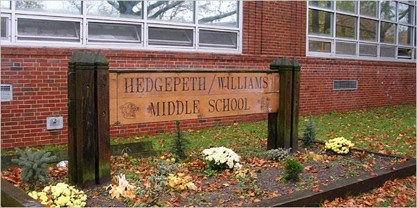
- 1991: The Trenton Board of Education renamed the former "whites only" Junior High School #2, the Hedgepeth-Williams School.
In response to the Brown decision, many of the Southern states established, expanded and supported private schools to preserve the Southern tradition of racial segregation. White students left public schools in droves to both traditional and newly formed private schools. From 1950 to 1965 private school enrollment grew at unprecedented rates all over the nation, with the South having the largest growth. This growth was catalyzed by Southern state legislatures, who enacted as many as 450 laws and resolutions between 1954 and 1964 attempting to block, postpone, limit, or evade the desegregation of public schools, many of which expressly authorized the systematic transfer of public assets and monies to private schools. Eventually these enactments supporting private schools were invalidated by federal courts or abandoned by Southern states that faced likely court challenges.
With the adoption of the Civil Rights Act of 1964, the federal government was authorized by Title IV to file school desegregation cases. In 1968, the U.S. Supreme Court ordered states to dismantle segregated school systems "root and branch." The next year, the Court ordered the “immediate” desegregation of Mississippi schools. In 1971, the Court approved busing, magnet schools, compensatory education and other tools as appropriate remedies to overcome the role of residential segregation in perpetuating racially segregated schools. However, even into the 1970s, Alabama, Arkansas, Georgia, Louisiana, Mississippi, North and South Carolina had dual systems of education. Ultimately, some of the Southern states moved to county or city-wide school districts, which helped to reduce the segregation in the schools.
Most Northern states, like New Jersey, continued to have neighborhood schools, which became more and more segregated especially after the riots in the 1960s (See the Lesson on Civil Rights and Race Riots in New Jersey at https://civiced.rutgers.edu/nj-lessons/new-jersey-history-lessons) as a large portion of the white population previously in the cities moved to the suburbs leaving a mostly poor, mostly minority population in the city schools. Efforts to integrate schools by busing students in Northern cities like Boston and New York met with fierce resistance by parents.
Emphasizing that court orders are not intended "to operate in perpetuity," the Supreme Court in 1991 made it easier for formerly segregated school systems to fulfill their obligations under desegregation decrees. (See Board of Education of Oklahoma City Public Schools v. Dowell | Oyez). After being released from a court order, the Oklahoma City school system abandoned its desegregation efforts and returned to segregated neighborhood schools. In 2001, white parents in Charlotte, N.C., schools successfully sought an end to the desegregation process and the use of race in making student assignments. A 2002 report from Harvard's Civil Rights Project concluded that America's schools were resegregating. (See https://archive.learningforjustice.org/magazine/spring-2004/brown-v-board-timeline-of-school-integration-in-the-us)
Activity 3: Compare efforts to desegregate the schools in NJ with school desegregation elsewhere
Students should read the synopsis of both the factual background, arguments and decisions in Hedgepeth- Williams vs Trenton Board of Education (1944) and Brown vs Board of Education (1954) provided above or research an online synopsis of the cases at Brown v. Board of Education of Topeka (1) |Oyez. Then, have students research the response to court-mandated desegregation of public schools in New Jersey and elsewhere (e.g., in the South, in Boston, in Denver, in Detroit, in New York City, in California), Students should select at least one other state or city for comparison, record their findings, and discuss the results as a class.
For example, a “freedom of choice” plan for school desegregation in Virginia was rejected and the court required a more realistic plan to desegregate schools. (See Green v. County School Board of New Kent County | Oyez). In Charlotte, North Carolina, which merged its public school system with surrounding Mecklenburg County schools, but still only had 2% of the district’s Black students attending school with white students and the vast majority of these were in one school, the U.S. Supreme Court held that busing was an appropriate remedy for the problem of racial imbalance in schools, even when the imbalance resulted from the selection of students based on geographic proximity to the school rather than from deliberate assignment based on race. See Swann v. Charlotte-Mecklenburg Board of Education, 402 U.S. 1 (1971). However, when the NAACP sued the state of Michigan to desegregate Detroit’s schools and suggested a desegregation plan that would involve both the city and the suburbs and significant busing across 53 school districts, the U.S. Supreme Court held in a 5/4 decision in Milliken v. Bradley, 418 U.S. 717 (1974), that such a plan was not required because neither the school districts nor the municipalities had deliberately engaged in a policy of segregation.
III. School Desegregation in New Jersey today
In 2015, the New York Times created an interactive map of racial segregation. You can go to Mapping Segregation - The New York Times to see the racial make-up of every city and town. New Jersey, along with New York, Illinois and Michigan have some of the highest levels of residential segregation by race and income, which is reflected in the schools.
In 2013, the Institute on Law and Policy at Rutgers-Newark and the Civil Rights Project at University of California, Los Angeles, jointly submitted a report about the state of segregation in New Jersey’s schools. The title sums up its conclusion: “New Jersey’s Apartheid and Intensely Segregated Urban Schools.” Rather than “segregation”, the report is using the term “Apartheid” to emphasize the institutional nature and extreme segregation of the New Jersey schools. “Apartheid” was the official policy of racial segregation, involving political, legal, and economic discrimination against nonwhites, formerly practiced in the Republic of South Africa. Across the country, 43 percent of Latino students and 38 percent of Black students go to schools where fewer than 10 percent of their classmates are white, and more than one in seven Black and Latino students attend schools where less than 1 percent of their classmates are white. Schools with high-minority populations usually have low-income populations, making the schools economically homogeneous as well. But the situation in New Jersey’s schools is even worse.
The studies updated and detailed the long-running picture of race in New Jersey schools, which has some of the most segregated schools in the nation. The Civil Rights Project report tracked data since 1989 to show little change, even as the general population has grown more diverse. In 1989, 5% of New Jersey schools were 99-100% African American and Latino. By 2010, it had increased to 8%. The Rutgers report explained that the most segregated schools are in the urban centers, sometimes within a stone’s throw of suburban schools where there are few Black or Hispanic students. For example, all of the 30 schools in Camden are 100% segregated; all of the 20 schools in East Orange are 100% segregated; all of the 16 schools in Passaic are 100% segregated (U.S. Dept. of Education, National Center for Education Statistics, Public Elementary/Secondary School Survey Data). In spite of the proactive New Jersey and national court decisions and legislation, segregation continues, primarily due to the legacy and continuation of segregated housing patterns in the state. (See the lessons “Civil Rights and Urban Riots in New Jersey,” and “Land Use in New Jersey”). Less than 1% of the population of Camden, East Orange and Passaic is white and more than 70% of their populations live below the poverty level. Even the charter schools were intensely segregated. Although some of the county magnet high schools have a more diversified student body, only students who meet their high academic standards are accepted.

Trenton Central High School West commencement, June 27, 2017
In Trenton, where New Jersey’s efforts against school segregation began, only 2.1% of the population was white in 2013 and 66% lived in poverty. Hedgepeth-Williams Middle School, once all white, is now almost entirely African-American and Latino: in 2015-16, 52.6% of the school population was Black, 45.5% Hispanic and 0.4% white. Students at the school performed far below the state level for proficiency in English Language (22%) and math (13%). (For additional information, see Trenton Public School District - U.S. News Education)
An updated report, “New Jersey’s Segregated Schools: Trends and Paths Forward,” issued in 2017 looked at how the state’s school population changed between 2010 and 2015. Although the state was getting more diverse, the schools were getting more segregated. Total public school enrollment in New Jersey in 2015-16 was 46.4% white, 15.7% black, 9.9% Asian, and 26.2% Hispanic. Black and Hispanic students were highly concentrated in more densely populated urban areas along the New York City/Philadelphia corridor. More than half of the students in charter schools were African American and 31% were Hispanic in 2015. School segregation was not only by race but also by income. Students’ academic outcomes are closely linked with the community’s overall social-economic levels. (For additional information, see New Jersey’s Segregated Schools Trends and Paths Forward)
The 2013 Rutgers/UCLA reports offered the following recommendations (the2017 report updated the data but did not change the recommendations) :
- Prioritize the use of regional magnet schools
- Adopt explicitly racial and socioeconomic diversity goals and procedures for all existing state-supported choice programs, such as charter schools and inter-district choice programs
- Locate affordable housing options outside of cities to bring a more diverse mix of incomes to school districts
- Require existing and new state and local legislation, policies and practices to promote racial and socioeconomic diversity of communities and their schools
- Develop a state policy to consolidate school districts for racial and socioeconomic reasons, as well as economic efficiency.
Activity 4: Analyze the Rutgers/UCLA report. Divide the class into small groups and have them evaluate the feasibility of the recommendations in the Rutgers/UCLA report.
IV. Unequal funding of education
As the above data indicates, New Jersey’s schools are segregated as much by income as by race and ethnicity. All of New Jersey’s public schools are funded by a combination of local property taxes, state aid and federal aid. The local property tax is a tax on real property based on a tax rate (ex. “X” number of dollars per $100 value of your house and property). It accounts for approximately 68% of the cost of school funding. State taxes yield 25%, and the federal government pays the additional 5%. Such heavy reliance on local property taxes has resulted in substantially unequal funding for education. Those people residing in lower-income areas of New Jersey generate less money from property taxes based on the value of their houses. Consequently, these areas yield substantially less revenue to pay for their public schools than more affluent areas.
Activity 5: Consider unequal local tax bases for funding local public education.
Have students review the chart below regarding hypothetical school districts A, B and C, then answer the questions.
|
NJ SCHOOL DISTRICT A |
NJ SCHOOL DISTRICT B |
NJ SCHOOL DISTRICT C |
|
|
School district wealth |
Very wealthy, suburban area with growing school population |
Very poor, urban area |
Middle income, working class, older exurban area with declining school population |
|
School district description |
Very little crime Most people live in expensive, single-family homes. |
There is a lot of crime and gang-related incidents are a problem. Many people live in apartment buildings. |
There is a growing amount of crime. Mixed single-family homes and apartments, with diminishing property values. |
|
Number of students in the district’s schools |
1000 |
5,000 |
1500 |
|
Amount collected from property taxes |
$20 million |
$30 million |
$15 million |
|
Amount the district contributed to the public school system |
$15 million |
$20 million |
$10 million |
|
Amount contributed to the police force |
$2 million |
$7 million |
$3 million |
|
Amount contributed to local services such as the parks and libraries, etc. |
$3 million |
$3 million |
$2 million |
Questions:
What is the per pupil expenditure for School Districts A, B and C?
Answer: A = $20,000; B = $6,000; C = $10,000
Explain why School District A is able to collect more money from their property taxes.
Answer: School District A has wealthy homeowners
Explain why School Districts B and C cannot contribute all revenue to their public school system.
Answer: School Districts B and C need to spend more money on their police because of higher crime rates.
How could the differences in funding affect the education of the students?
Answer: Facilities might not be taken care of or may be overcrowded. Students may not have high quality, up-to-date materials. Teachers might not be well-paid and may leave for other districts.
Historical Background to school funding
Following the Brown v. Board of Education decisions, the U.S. Supreme Court refused to take the next step and require equal funding for public education. In a 5/4 decision in San Antonio Independent School District v. Rodriguez | Oyez the high court rejected the argument that education was a fundamental right protected by the equal protection clause of the Constitution. The majority reasoned that the federal constitution did not explicitly or implicitly guarantee a right to education and added that there was no proof that the Texas school system "fails to provide each child with an opportunity to acquire the basic minimal skills necessary for the enjoyment of the rights of speech and of full participation in the political process." The U.S. Supreme Court left the issue of funding for public education to the individual states.
The same year as the San Antonio decision, the New Jersey Supreme Court took a very different approach to funding public education. Since 1875 the New Jersey State Constitution has included the following provision: “The Legislature shall provide for the maintenance and support of a thorough and efficient system of free public schools for the instruction of all the children in the State between the ages of five and eighteen years.” It was continued in the 1947 State Constitution as Art VIII , Sec. IV, para. 1. Known as the “thorough and efficient” or “T and E” clause, it was never put to a test until 1973 when the parents of students from several urban school districts argued in Robinson v. Cahill that the system of funding local public schools, which relied primarily on local property taxes, violated the “thorough and efficient” clause, which made the funding of public schools a state responsibility.
Rather than focusing on whether education is a fundamental right under the state constitution, the New Jersey State Supreme Court found that the existing system for funding education based primarily on local property taxes could not meet the requirements of a thorough and efficient education and was, therefore, unconstitutional. The Court gave the state a year to come up with a constitutional plan. (See Robinson v. Cahill at Robinson v. Cahill :: 1973 :: Supreme Court of New Jersey Decisions). By 1976, no solution had been agreed upon, so the State Supreme Court enjoined all public school spending (essentially closing the schools) until the Legislature acted to fund a system that satisfied the terms of the previous rulings. The Legislature and Governor Byrne responded with the state’s first income tax.
Five years later in 1981, the Education Law Center filed a complaint on behalf of 20 children attending public schools in the cities of Camden, East Orange, Irvington, and Jersey City, claiming in Abbott v. Burke that the school funding system still failed to satisfy the “thorough and efficient” clause. The Supreme Court agreed and laid out a plan for the state to follow. In Abbott II in 1990, the Supreme Court made the state’s responsibility clearer by requiring it to provide aid to the 30 poorest urban school districts in order to raise the per-pupil spending on par with the average per pupil spending in districts of the highest socioeconomic levels. This decision has led to dramatic increases in aid to the “Abbott” school districts. The Abbott III decision in 1994 directed the Legislature to adopt a funding law that would assure “substantial equivalence” in per pupil foundational funding with suburban districts and would provide the necessary supplemental programs. Three additional Abbott decisions established a mandate for early education in the urban districts. Several additional Abbott decisions required state funding for facilities remediation and construction. (For additional information see The History of Abbott v. Burke - Education Law Center)
As a result of the Abbott court decisions, middle income suburban areas and wealthier suburban areas have seen a decline in state aid for education, thus necessitating a yearly increase in local property taxes which has resulted in New Jersey having the highest property-tax rates in the nation. Since taking office in 2010, Governor Christie has refused to fully fund the state education plan but was required by the court to fund the 31 districts designated by the Abbott decision as special needs. He then cut funding to all other districts. In 2017, Governor Christie proposed an overhaul of state funding for education, with what he called a "fairness formula," that would have shifted millions in state aid from urban and low-income districts to provide some additional funding to most of the other school districts. After negotiations with the state’s Democratic Legislature, the state budget for 2018 included additional school funding, with some shifted to districts considered underfunded. Although state aid to school districts for 2018 is more than $9 billion--nearly a third of the total state budget--there is still a gap between what the school districts receive and what the law calls for.
Activity 6: Critically Thinking about School Funding
1. What constitutes a “thorough and efficient” education?
Divide the class into small groups of 3 to 5 and have them try to come to an agreement as to the meaning of a “through and efficient” education. Then have the groups share their results and discuss as a whole class. There will probably be differences of opinion. Students may describe a merely “adequate” or “minimal” education, or they may describe a “high quality” education, one involving up-to-date and adequate school facilities, equipment and materials, good school leadership, dedicated and well-prepared teachers, and may even suggest good outcomes as shown by statewide testing. Try to have the class come to some sense of agreement.
2. What do you think?
The Abbott decisions were, and still are, highly controversial. On the one hand, they seem to have addressed the disparity that existed in the funding of the local school districts. On the other hand, some people question whether this additional funding really modifies and advances the public school systems in the lower-income areas. Others ask whether their state tax monies should be distributed unevenly to the low-income areas.
What do you think? Do you agree with the Supreme Court of the United States that education is not a fundamental right and that students in low-income areas are not being denied an equal opportunity to obtain basic minimal skills because of the limited ability of local property taxes to meet the needs of the school district? Or do you think that there should be parity within the educational system as specified in the Abbott decisions?
3. Does equal funding guarantee equal education? Why or why not?
Ask students whether equal funding guarantees an equal education and to explain why or why not. Have students respond orally or prepare written responses. Have students compare their answers and discuss. Most students will probably answer “no”. The NJ Supreme Court recognized that equal funding was necessary but not sufficient. Brainstorm what other factors might influence the quality of one’s education? Possible answers include the quality of the teacher and administrative staff, the involvement and support of parents, stable home life, adequate food and sleep, freedom from fear of crime or injury, etc. The majority of white and Asian students in New Jersey attend schools where 22% to 24% of students are poor, while many Black and Hispanic students attend schools where nearly 60% of students are living in poverty by the same standards, according to a 2017 report from UCLA’s Center for Civil Rights.
V. School Regionalization or Consolidation
Background
New Jersey had over 600 separate school districts (now reduced to 545), with more than 100 of them (144) that have only one school. By comparison, Virginia, which has a similar size school population as New Jersey, has 25 county or city-wide school districts. Throughout the country there was a great wave of school district consolidation in the 1970s and 1980s. Generally speaking, this consolidation consisted of bringing multiple small school districts together under a single set of administrators. Sometimes, but not always, individual schools were closed in the process. New Jersey, however, has never regionalized or consolidated its schools, although the issue has been visited many times:
- 1960s report recommended consolidating schools
- 1999: An Assembly Task Force on School District Regionalization recommended regionalizing the schools (Assembly Task Force on School District Regionalization)
- 2004: A report by the NJ Association of School Administrators concluded that consolidation would not save substantial money https://www.njsba.org/wp-content/uploads/2016/05/MandateReviewStudyCommission-2004.pdf
- 2010: The county superintendents identified over 100 districts that should be consolidated https://www.njspotlightnews.org/2014/09/14-09-16-op-ed-school-district-consolidation-should-be-welcomed-in-new-jersey/
- 2013: “School District Size Matters” - Size Matters: A Look at School- District Consolidation
- 2014: “Why Schools Resist Consolidating” in Governing the States and Localities Why Schools Resist Consolidating
- 2015: The NJ Senate passed a bill to establish a 16-member Task Force on School Regionalization to study the issue but it died in the State Assembly Education Committee (NJ senators urge school district consolidation)
- A lawsuit filed in 2018 in Mercer County by the Latino Action Network, the National Association for the Advancement of Colored People (NAACP) and other organizations alleges that New Jersey’s public schools are intensely segregated racially and economically. The lawsuit asks for the following:
- A ruling declaring that New Jersey’s segregation of Black and Latino students is unlawful and that assigning students to public schools based on their municipality is unlawful because it causes segregation.
- A ruling that it is unlawful to require charter schools to prioritize enrolling students who live in-district.
- “Enjoin” or stop the practice of assigning students to public schools based on where they reside. Order the state Legislature and Education Department to adopt a “replacement assignment methodology” with a plan in three months.
- In April 2019, it was reported that settlement talks had broken down. In March 2022, Judge Robert Lougy held a hearing in the matter and, as of October 2022, the parties await a ruling.
Activity 7: Research the arguments for and against school consolidation/regionalization.
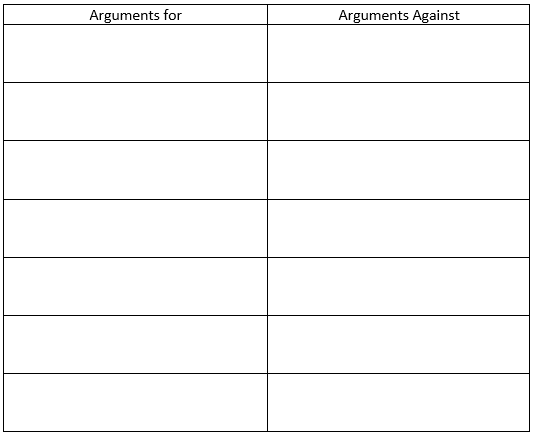
Have students research the issue of school consolidation in New Jersey or consider some of the above-mentioned reports about school consolidation/regionalization and use the graphic organizer, Handout 5, to organize the arguments for and against school consolidation/regionalization. A completed chart might look as follows:
|
Arguments for |
Arguments Against |
|
Enhances educational opportunities |
People like local control of their schools |
|
Streamlines educational services and staff |
Cost savings can result from shared services rather than consolidation |
|
Reduces property taxes |
Varying staff salaries among districts may lead to increased salaries for all and little reduction in costs |
|
Might help to desegregate schools |
Individual schools and classes may still be segregated even if the larger district reflects a more even mix of races and socio-economic classes |
|
Better articulation among grades and schools in K-12 districts—only 1/3 of NJ districts are K-12 |
Consolidation might be difficult to implement |
Have students debate or write a short essay explaining why they would support or oppose school consolidation/regionalization.
Concluding Critical Thinking Activity or Assessment: Is the primary issue today about school desegregation or the requirement to provide a thorough and efficient education (as defined by your students in activity 5) for all students?
Historical Background: Thurgood Marshall argued in Brown v. Board of Education that segregated schools not only violated equal protection but also “had a tendency to make Black children feel inferior to white children
Echoing Brown in a case involving de facto segregation in schools from “housing patterns resulting from socio-economic factors”, the New Jersey Supreme Court in Booker v. Board of Education of Plainfield, stressed the importance of integrating students in school: “The children must learn to respect and live with one another in multi-racial and multi-cultural communities and the earlier they do so the better. It is during their formative school years that firm foundations may be laid for good citizenship and broad participation in the mainstream of affairs. Recognizing this, leading educators stress the democratic and educational advantages of heterogeneous student populations and point to the disadvantages of homogeneous student populations, particularly when they are composed of a racial minority whose separation generates feelings of inferiority.” (See Booker v. Board of Education of City of Plainfield :: 1965 :: Supreme Court of New Jersey Decisions).
Dr. Napoleon-Smith, daughter of Mrs. Williams of the Hedgepeth and Williams case, and a long-time educator and administrator (now retired) in the Trenton School system, explained: “I think it’s the isolation from each other that feeds that disrespect and anger, because the children realize they’re segregated from other children.” (See “62 Years Later, a Question of What is Right,” New York Times article about the current environment of Trenton School at 62 Years Later, a Question of What Is Right - The New York Times.)
Richard Kahlenburg, senior fellow at The Century Foundation, notes that research broadly shows the importance of integration in improving the student outcomes over simply increasing funding for districts with mostly impoverished students. Howard Fuller, civil rights activist and education reform advocate and author of the book, “No Struggle, No Progress: A Warrior’s Life from Black Power to Education Reform,” argues that while he understands the research clearly illustrates the importance of integration, it is important to raise the standards for students so that they are prepared for the global marketplace, regardless of whether their schools are integrated. https://thinkprogress.org/school-segregation-is-much-bigger-than-a-few-schools-in-the-south-8a7f6d2132e1/
Concluding Activity or Assessment:
Have your class read the statements above in Handout 7 and then discuss whether the issue is school desegregation or the need to provide a thorough and efficient education for all students.
After the discussion, ask your students to select (or assign them to) either a School Desegregation Committee or a Thorough and Efficient Education Committee.
The School Desegregation Committee should develop a plan to ensure that the schools in New Jersey are desegregated.
The Thorough and Efficient Education Committee should develop a plan to ensure that every New Jersey student gets a thorough and efficient education (within the meaning of this term as previously agreed upon by the class).
Have the committees read their proposals to the whole class. After discussion and possible modification, have your students send their proposal to your state legislators.
Alternative Activity: Simulated Legislative Hearing
Alternatively, have your class hold a simulated legislative hearing. Divide the class into four groups:
- Group A will represent A School Districts as defined in Activity 4.
- Group B will represent B School Districts as defined in Activity 4.
- Group C will represent C School Districts as defined in Activity 4.
- Group D will be the members of the New Jersey Joint Legislative Committee on Public School Funding Reform.
Groups A, B and C will each develop and present a plan to reform the state’s system for funding education that will be fair as well as reduce segregation in the schools.
The Legislative Committee members will develop and ask questions of each group, discuss the proposals and then vote on what they think would be the best way to provide a thorough and efficient education for New Jersey students that will also reduce segregation in the schools.
After discussion and possible modification, have your students send their proposal to your state legislators.
Whichever format you select, a lively debate should transpire as students are forced to evaluate the educational system through varying perspectives.
Alternative Activity: Mini Moot Court Hearing
Alternatively, have your class hold a moot court hearing concerning the pending lawsuit, Latino Action Network v. New Jersey.
- Organize your students in groups of three and have each group count by 3.
- Ones = attorneys for the Latino Action Network
- Twos = attorneys for the state of New Jersey
- Threes =the judges
- Attorneys prepare their arguments; judges prepare several questions to ask
- Attorneys for the Latino Action Network make a brief 2-5 minute argument—judges may ask 1-2 short questions
- Attorneys for the state of New Jersey make a brief 2-5 minute argument—judges may ask 1-2 short questions
- Ask all of the judges from the triads to come to the front of the classroom and have an open court hearing where they discuss their opinions and reasons. Some judges may decide to change their initial views after they have heard their colleagues.
- Debrief: Have the class consider the possible options and the pros and cons of each option
- Compare the results of the class moot court with the results of the actual case after it has been decided.
Extension:
- Invite a New Jersey legislator to speak on the Abbott decision and method of funding education in the state.
- Invite an educator or administrator from one of the Abbott school districts to explain the problems that occur within their school district and to explain how additional state funding helps their school district.
- Have students examine the system of funding in other states and evaluate whether they agree with the current New Jersey system.
- Have students conduct research on the success of the Abbott decisions and evaluate whether the additional funds helped create thorough and efficient education in the Abbott school districts.
- Have students research school testing scores (ex. GEPA, HSPA) and compare Abbott district scores to those in other districts across the state.
Handout 1: Hedgepeth and Williams v. Trenton Board of Education (1944)
Historical Background
After the Civil War, all states were required to change their constitutions to meet the Civil War Amendments. New Jersey went further and, in 1881, enacted RS 18:14-2, which prohibited segregated schooling based on race, one of the very first such laws in the nation. Although not enforced as in the south, de facto segregation still continued in the North into the twentieth century. There were no "whites only" signs in public places, or lynchings. But, Blacks sat in the balconies of movie theaters while whites got the best seats. Blacks could swim at public pools from noon to 2 p.m. while whites got to swim the rest of the day
By the early part of the 20th century, changes were taking place that would doom racial segregation. World War I had triggered one of the greatest population movements in American history -- the exodus of millions of poor sharecroppers and tenant farmers from the South to the North for better jobs and the chance to join their own communities in big industrial cities. In Trenton, most of the black newcomers came from Virginia, the Carolinas and Georgia. They settled in the industrial North Ward and on Spring Street and Passaic Street in the shadow of the State House. In 1920, there were 5,315 blacks in Trenton, 4 percent of the city; by 1950, they made up 11 percent of the city. Today the figure hovers around 50 percent. The blacks of Trenton included skilled factory hands, teachers, lawyers, doctors and other professionals. One of them was Robert Queen, an eloquent lawyer who reinvigorated Trenton's branch of the NAACP. In 1932, Queen sued to stop the practice of requiring black students to take swimming lessons at the high school on Friday afternoon only, while white kids could swim the rest of the week. The state Supreme Court struck down the school rules and ordered the school pool integrated. Once America went to war against Nazi Germany in 1941, it became harder than ever to defend Jim Crow laws. How could the country discriminate against Blacks when we were fighting for democracy?
In 1943, a couple of 12-year-old kids, Leon Williams and Janet Hedgepeth, wanted to go to the same classes as their playmates. But, when their parents tried to get them into their neighborhood school, Junior High No. 2, they were told by the principal that they could not attend that school because it was “not built for Negroes.” Since Leon Williams and Janet Hedgepeth were Black, they had to walk 2 ½ miles instead to the all-black New Lincoln School.
Those were the rules of the Jim Crow era in Trenton. But to the angry mothers of Leon Williams and Janet Hedgepeth, the rules just weren't fair. The New Lincoln School, on North Montgomery Street, was built as a black-only junior high school in 1923 -- and celebrated as a sign of racial progress. But Gladys Hedgepeth and Berline Williams did not see it that way. They both served as volunteers for the NAACP; Mrs. Hedgepeth also belonged to the city's Interracial Committee for Unity. All their lives, they had put up with petty discrimination --- but they also never wavered in believing they deserved equality.
"My mother saw that black people were treated differently than white people," said Williams' daughter, Thelma Smith. "But our neighborhood was mixed, and we all took care of each other. We had Italian neighbors, Jewish neighbors, and Polish neighbors. We were all in poverty, but it was a poverty of money, not a poverty of spirit. As kids, I don't think we were even conscious of color. We just played with each other. We'd be out on the street, jumping rope, playing red-light, rolling around on scooters. Or we'd have a Popsicle on the front porch. And our parents would be sitting around to make sure we didn't get in trouble."
On Sept. 13, 1943, the school year began. Mrs. Hedgepeth and Mrs. Williams enrolled their kids at the Lincoln School -- but they also filed suit against the Trenton Board of Education demanding that their children be allowed to attend the same school as their white friends. The NAACP took over their legal defense and argued it all the way to the New Jersey Supreme Court in less than a month. The parents' lawyer was Robert Queen, the same man who had desegregated the swimming classes at Trenton High School. Queen read the 1881 law that prohibited school boards from excluding children based on race, color or creed, then asked Trenton’ school superintendent, Paul Loser, why Blacks were excluded from the white junior high schools. "Aren't Leon and Janet excluded from Junior 2 on the grounds of color?" Queen asked Loser. The superintendent hesitated then said the answer was yes, but only because it was better for the black students. Blacks, he said, tended to segregate themselves anyway, and they would have "better opportunities for leadership when they are segregated." "In that case," Queen shot back, "do you consider it advisable to set up separate schools for minority groups such as Italians, Poles, Jews, Hungarians and Germans?" The superintendent had no answer.
The decision: Hedgepeth and Williams v. Trenton Board of Education
When the Supreme Court made its ruling on January 31, 1944, the justices held unanimously for Mrs. Hedgepeth and Mrs. Williams. Chief Justice Newton Porter, writing for the court, stated: “The sole question presented is the legal right of the respondent (Trenton Board of Education) to refuse these children admission in the school nearest their residences. The only reason the admission sought is denied them is because of their race. We think it clear that the children are unlawfully discriminated against. It is unlawful for Boards of Education to exclude children from any public school on the ground that they are of the Negro race.” (131 NJL 153 (1944). The court cited the 1881 statute that declared it “unlawful for boards of education to exclude children from any public school on the ground that they are of a Negro race”. (See The Trentonian, 1943: Hedgepeth-Williams)
Handout 2: Brown v. Board of Education (1954)
FIRST DAY The Supreme Court’s decision in Brown v. Board of Education integrated the schools. But today its meaning is at issue. Here, the first day of desegregation, on Sept. 8, 1954, at Fort Myer Elementary School in Fort Myer, Va. CreditBettmann/Corbis
Historical Background
In Topeka, Kansas in the 1950s, schools were still segregated by race. Each day, Linda Brown and her sister had to walk through a dangerous railroad switchyard to get to the bus stop for the ride to their all-black elementary school. There was a school closer to the Brown's house, but it was for white students only. Linda Brown and her family believed that the segregated school system violated the Fourteenth Amendment and took their case to court. The federal district court decided that segregation in public education was harmful to black children, but because all-black schools and all-white schools had similar buildings, transportation, curricula, and teachers, the segregation was legal. The Browns appealed their case to the Supreme Court stating that even if the facilities were similar, segregated schools could never be equal to one another. Brown v. Board of Education was the name given to five separate cases that were consolidated and heard by the U.S. Supreme Court concerning the issue of segregation in public schools. While the facts of each case differed, the main issue in each was the constitutionality of state-sponsored segregation in public schools.
NAACP lawyer, Thurgood Marshall, argued the case before the U.S. Supreme Court. He contended that separate school systems for blacks and whites were inherently unequal, and thus violated the "equal protection clause" of the Fourteenth Amendment to the U.S. Constitution. Furthermore, relying on sociological tests, such as the one performed by social scientist Kenneth Clark, and other data, he also maintained that segregated school systems had a tendency to make black children feel inferior to white children, and thus such a system should not be legally permissible. Seeking precedents, Marshall wrote to the lawyer, Robert Queen, who had represented the plaintiffs in the Hedgepeth-Williams case. Marshall cited the New Jersey State Supreme Court's decision as one of several precedents for overturning racial segregation everywhere in the United States, the only one involving public schools.
The decision: Brown v. Board of Education
Meeting to decide the case, the Justices of the Supreme Court realized that they were deeply divided over the issues raised. On May 14, 1954, after a rehearing and a change on the court-- Chief Justice Fred Vinson died and was replaced by Gov. Earl Warren of California—Chief Justice Warren delivered the unanimous opinion of the Court, stating that "We conclude that in the field of public education the doctrine of 'separate but equal' has no place. Separate educational facilities are inherently unequal. . ."
Expecting opposition to its ruling, especially in the southern states, the Supreme Court did not immediately try to give direction for the implementation of its ruling. Rather, it asked the attorney generals of all states with laws permitting segregation in their public schools to submit plans for how to proceed with desegregation. After still more hearings, on May 31, 1955, the Justices handed down a plan for how it was to proceed; desegregation was to proceed with "all deliberate speed." Although it would be many years before all segregated school systems were to be desegregated, the Brown decisions started the process of eliminating legally segregated schools. (See History - Brown v. Board of Education Re-enactment)
Handout 3: School Segregation in New Jersey Today
Report by the Institute on Law and Policy at Rutgers-Newark and the Civil Rights Project at University of California, Los Angeles
In 2013, the Institute on Law and Policy at Rutgers-Newark and the Civil Rights Project at University of California, Los Angeles, jointly submitted a report about the state of segregation in New Jersey’s schools. The title sums up its conclusion: “New Jersey’s Apartheid and Intensely Segregated Urban Schools.” Rather than “Segregation”, the report is using the term “Apartheid” to emphasize the institutional nature and extreme segregation of the New Jersey schools. “Apartheid” was the official policy of racial segregation, involving political, legal, and economic discrimination against nonwhites, formerly practiced in the Republic of South Africa.
The studies updated and detailed the long-running picture of race in New Jersey schools, which continues to have some of the most segregated schools in the nation. The Civil Rights Project report tracked data since 1989 to show little change, even as the general population has grown more diverse. In 1989, 5% of New Jersey schools were 99-100% African American and Latino. By 2010, it had increased to 8%. The Rutgers report explained that the most segregated schools are in the urban centers, sometimes within a stone’s throw of suburban schools where there are few black or Hispanic students. For example, all of the 30 schools in Camden are 100% segregated; all of the 20 schools in East Orange are 100% segregated; all of the 16 schools in Passaic are 100% segregated (U.S. Dept. of Education, National Center for Education Statistics. Common Core Data, Public Elementary/Secondary School Survey Data). In spite of the proactive New Jersey and national court decisions and legislation, segregation continues, primarily due to the legacy and continuation of segregated housing patterns in the state. (See the lessons “Civil Rights and Urban Riots in New Jersey,” and “Land Use in New Jersey”). Less than 1% of the population of Camden, East Orange and Passaic is white and more than 70% of their populations live below the poverty level. Even the charter schools were intensely segregated. Although some of the county magnet high schools have a more diversified student body, only students who meet their high academic standards are accepted. (See Trenton Public School District - U.S. News Education)
Trenton Central High School West commencement, June 27, 2017
In Trenton, where New Jersey’s efforts against school segregation began, only 2.1% of the population was white in 2013 and 66% lived in poverty. Hedgepeth-Williams Middle School, once all white, is now almost entirely African-American and Latino: in 2015-16, 52.6% of the school population was black, 45.5% Hispanic and 0.4% white. Students at the school performed far below the state level for proficiency in English Language (22%) and math (13%). See Trenton Public School District - U.S. News Education)
The Rutgers/UCLA reports offered the following recommendations:
- Prioritize the use of regional magnet schools
- Adopt explicitly racial and socioeconomic diversity goals and procedures for all existing state-supported choice programs, such as charter schools and inter-district choice programs
- Do not build or subsidize low-income housing in areas where neighborhood and scholar are already intensely segregated
- Require existing and new state and local legislation, policies and practices to promote racial and socioeconomic diversity of communities and their schools
- Develop a state policy to consolidate school districts for racial and socioeconomic reasons, as well as economic efficiency.
Handout 4: School Funding Chart and Questions
|
NJ SCHOOL DISTRICT A |
NJ SCHOOL DISTRICT B |
NJ SCHOOL DISTRICT C |
|
|
School district wealth |
Very wealthy, suburban area with growing school population |
Very poor, urban area |
Middle income, working class, older exurban area with declining school population |
|
School district description |
Very little crime Most people live in expensive, single-family homes. |
There is a lot of crime and gang-related incidents are a problem. Many people live in apartment buildings. |
There is a growing amount of crime. Mixed single-family homes and apartments, with diminishing property values. |
|
Number of students in the district’s schools |
1000 |
5,000 |
1500 |
|
Amount collected from property taxes |
$20 million |
$30 million |
$15 million |
|
Amount the district contributed to the public school system |
$15 million |
$20 million |
$10 million |
|
Amount contributed to the police force |
$2 million |
$7 million |
$3 million |
|
Amount contributed to local services such as the parks and libraries, etc. |
$3 million |
$3 million |
$2 million |
What is the per pupil expenditure for School Districts A, B and C?
Explain why School District A is able to collect more money from their property taxes.
Explain why School Districts B and C cannot contribute all revenue to their public school system.
How could the differences in funding affect the education of the students?
Do you think that this is a problem? EXPLAIN!
Handout 5: School Funding in New Jersey
Historical Background: Following the Brown v. Board of Education decision, the U.S. Supreme Court refused to take the next step and require equal funding for public education. In a 5/4 decision in San Antonio v. Rodriquez, (93 S. Ct. 1278)(1973))the high court rejected the argument that education was a fundamental right protected by the equal protection clause of the Constitution. It reasoned that the federal constitution did not explicitly or implicitly guarantee a right to education and added that there was no proof that the Texas school system "fails to provide each child with an opportunity to acquire the basic minimal skills necessary for the enjoyment of the rights of speech and of full participation in the political process" (93 S. Ct. at 1299). The U.S. Supreme Court left the issue of funding for public education to the individual states.
The same year as the San Antonio decision, the New Jersey Supreme Court took a very different approach to funding public education. Since 1875 the New Jersey State Constitution has included the following provision: “The Legislature shall provide for the maintenance and support of a thorough and efficient system of free public schools for the instruction of all the children in the State between the ages of five and eighteen years.” It was continued in the 1947 State Constitution as Art VIII , Sec. IV, para. 1. Known as the “thorough and efficient” or “T and E” clause, it was never put to a test until 1973 when the parents of students from several urban school districts argued in Robinson v. Cahill that the system of funding local public schools, which relied primarily on local property taxes, violated the “thorough and efficient” clause, which made the funding of public schools a state responsibility. Rather than focusing on whether education is a fundamental right under the state constitution, the New Jersey State Supreme Court found that the existing system for funding education based primarily on local property taxes could not meet the requirements of a thorough and efficient education and was, therefore, unconstitutional. The Court gave the state a year to come up with a constitutional plan. (See Robinson v. Cahill at Robinson v. Cahill :: 1973 :: Supreme Court of New Jersey Decisions). By 1976, no solution had been agreed upon, so the State Supreme Court enjoined all public school spending (essentially closing the schools) until the Legislature acted to fund a system that satisfied the terms of the previous rulings. The Legislature and Governor Byrne responded with the state’s first income tax.
Five years later in 1981, the Education Law Center filed a complaint on behalf of 20 children attending public schools in the cities of Camden, East Orange, Irvington, and Jersey City, claiming in Abbott v. Burke that the school funding system still failed to satisfy the “thorough and efficient” clause. The Supreme Court agreed and laid out a plan for the state to follow. In Abbott II in 1990, the Supreme Court made the state’s responsibility clearer by requiring it to provide aid to the 30 poorest urban school districts in order to raise the per-pupil spending on par with the average per pupil spending in districts of the highest socioeconomic levels. This decision has led to dramatic increases in aid to the “Abbott” school districts. The Abbott III
decision in 1994 directed the Legislature to adopt a funding law that would assure “substantial equivalence” in per pupil foundational funding with suburban districts and would provide the necessary supplemental programs. Three additional Abbott decisions established a mandate for
early education in the urban districts. Several additional Abbott decisions required state funding for facilities remediation and construction.
As a result of the Abbott court decisions, middle income suburban areas and wealthier suburban areas have seen a decline in state aid for education, thus necessitating a yearly increase in local property taxes which has resulted in New Jersey having the highest property-tax rates in the nation. Since taking office in 2010, Governor Christie has refused to fully fund the state education plan but was required by the court to fund the 31 districts designated by the Abbott decision as special needs. He then cut funding to all other districts. In 2017, Governor Christie proposed an overhaul of state funding for education, with what he called a "fairness formula," that would have shifted millions in state aid from urban and low-income districts to provide some additional funding to most of the other school districts. After negotiations with the state’s Democratic Legislature, the state budget for 2018 included additional school funding, with some shifted to districts considered underfunded. Although state aid to school districts for 2018 is more than $9 billion--nearly a third of the total state budget--there is still a gap between what the school districts receive and what the law calls for.
What constitutes a “thorough and efficient” education?
In small groups of 3 to 5 try to come to an agreement as to the meaning of a “through and efficient” education. Then share your results and discuss as a whole class. There will probably be differences of opinion. Try to come to some sense of agreement.
What do you think?
Do you agree with the Supreme Court of the United States that education is not a fundamental right and that students in low-income areas are not being denied an equal opportunity to obtain basic minimal skills because of the limited ability of local property taxes to meet the needs of the school district? Or do you think that there should be parity within the educational system as specified in the Abbott decisions?
Does equal funding guarantee equal education? Why or why not?
Brainstorm what other factors might influence the quality of one’s education.
Handout 6: School Consolidation/Regionalization
Handout 7: Is the primary issue today about school desegregation or the need to provide a thorough and efficient education for all students?
Background:
Thurgood Marshall argued in Brown v. Board of Education that segregated schools not only violated equal protection but also “had a tendency to make black children feel inferior to white children “.
Echoing Brown in a case involving de facto segregation in schools from “housing patterns resulting from socio-economic factors”, the New Jersey Supreme Court in Booker v. Board of Education of Plainfield (1965), stressed the importance of integrating students in school: “The children must learn to respect and live with one another in multi-racial and multi-cultural communities and the earlier they do so the better. It is during their formative school years that firm foundations may be laid for good citizenship and broad participation in the mainstream of affairs. Recognizing this, leading educators stress the democratic and educational advantages of heterogeneous student populations and point to the disadvantages of homogeneous student populations, particularly when they are composed of a racial minority whose separation generates feelings of inferiority.” (See Booker v. Board of Education of City of Plainfield :: 1965 :: Supreme Court of New Jersey Decisions).
Dr. Napoleon-Smith, daughter of Mrs. Williams of the Hedgepeth and Williams case, and a long-time educator and administrator (now retired) in the Trenton School system, explained: “I think it’s the isolation from each other that feeds that disrespect and anger, because the children realize they’re segregated from other children.” (See “62 Years Later, a Question of What is Right,” New York Times article about the current environment of Trenton School at 62 Years Later, a Question of What Is Right - The New York Times.)
Richard Kahlenburg, senior fellow at The Century Foundation, said that research broadly shows the importance of integration in improving the student outcomes over simply increasing funding for districts with mostly impoverished students. Howard Fuller, civil rights activist and education reform advocate and author of the book, “No Struggle, No Progress: A Warrior’s Life from Black Power to Education Reform,” Fuller argues that while he understands the research clearly illustrates the importance of integration, he wants to focus on what he can do to raise standards for students now to prepare them for the global marketplace, regardless of whether those schools are integrated. https://thinkprogress.org/school-segregation-is-much-bigger-than-a-few-schools-in-the-south-8a7f6d2132e1/
See the lesson, “Land Use in New Jersey,” at for additional background on housing patterns in the state at https://civiced.rutgers.edu/nj-lessons/new-jersey-history-lessons
Committees:
Read the three statements above and then discuss whether the issue is school desegregation or the need to provide a thorough and efficient education for all students.
After the discussion, choose to be on either the School Desegregation Committee or the Thorough and Efficient Education Committee.
The School Desegregation Committee should develop a plan to ensure that the schools in New Jersey are desegregated.
The Thorough and Efficient Education Committee should develop a plan to ensure that every New Jersey student gets a thorough and efficient education (within the meaning of this term as previously agreed upon by the class).
Have the committees read their proposals to the whole class. After discussion and possible modification, have your students send their proposal to your state legislators.
Simulated Legislative Hearing
Divide into four groups:
- Group A will represent A School Districts as defined in Activity 5.
- Group B will represent B School Districts as defined in Activity 5.
- Group C will represent C School Districts as defined in Activity 6.
- Group D will be the members of the New Jersey Joint Legislative Committee on Public School Funding Reform.
Groups A, B and C will each develop and present a plan to reform the state’s system for funding education that will be fair as well as reduce segregation in the schools.
The Legislative Committee members will develop and ask questions of each group, discuss the proposals and then vote on what they think would be the best way to provide a thorough and efficient education for New Jersey students that will also reduce the segregation in the schools.