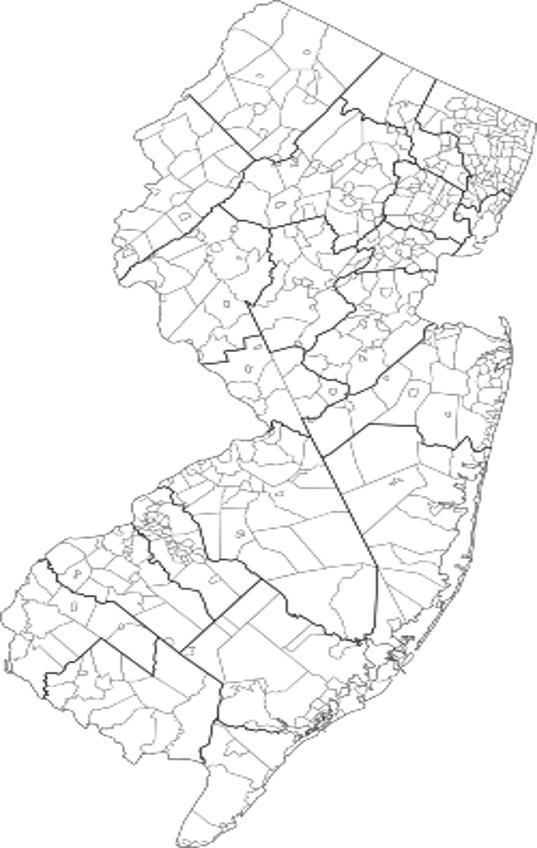
New Jersey’s 12 Congressional Districts
Lesson Creator: New Jersey Center for Civic Education, Rutgers University, Piscataway, NJ
Grade Level: Secondary
Objectives: Students will be able to:
- Describe New Jersey’s unique bipartisan commission processes for both congressional and state legislative redistricting, including the composition and roles of the Redistricting Commission (congressional districts) and the Apportionment Commission (legislative districts).
- Explain the main constitutional and legal criteria that guide district drawing in New Jersey (equal population / “one person, one vote,” contiguity, compactness, respect for municipal and county boundaries where possible, and compliance with the Voting Rights Act).
- Analyze how gerrymandering techniques can influence election outcomes, representation, and the competitiveness of districts, using historical or recent New Jersey examples.
- Evaluate the strengths and potential limitations of New Jersey’s commission-based system compared with legislative-controlled redistricting used in many other states.
- Apply their understanding by examining sample district maps (or creating simplified ones) and assessing them for fairness, compactness, and potential partisan advantage.
New Jersey Student Learning Standards for Social Studies (2020):
6.1.12.CivicsPI.14.a: Draw from multiple perspectives to evaluate the effectiveness and fairness of the processes by which local, state, and national officials are elected.
6.1.12.CivicsPI.14.c: Analyze how the Supreme Court has interpreted the Constitution to define and expand individual rights and use evidence to document the long-term impact of these decisions on the protection of civil and human rights.
6.1.12.CivicsPD.16.a: Construct a claim to describe how media and technology has impacted civic participation and deliberation.
6.1.12.CivicsCM.14.a: Use a variety of evidence, including quantitative data, to evaluate the impact community groups and state policies have had on increasing the youth vote.
6.3.12.CivicsPD.1: Develop plan for public accountability and transparency in government related to a particular issue(s) and share the plan with appropriate government officials.
Background
Under Article I, Section 2 of the United States Constitution (the “Apportionment” clause), seats in the House of Representatives are apportioned among the states by population, as determined by the census conducted every ten years. The Apportionment Clause requires that all districts be as nearly equal in population as practicable. There are currently 435 voting members of Congress. Based on the 2020 Census, the ideal (average) population for each of the 435 U.S. congressional districts is 761,169.
This figure is used for the entire decade (2020s maps) until the next census in 2030. Actual district populations must be as equal as practicable (usually within a very small deviation of this ideal). New Jersey’s ideal congressional district size after the 2020 Census was about 773,585.
Each state is entitled to at least one representative, however small its population. Seven states have only one Representative (Alaska, Delaware, Montana, North Dakota, South Dakota, Vermont and Wyoming).
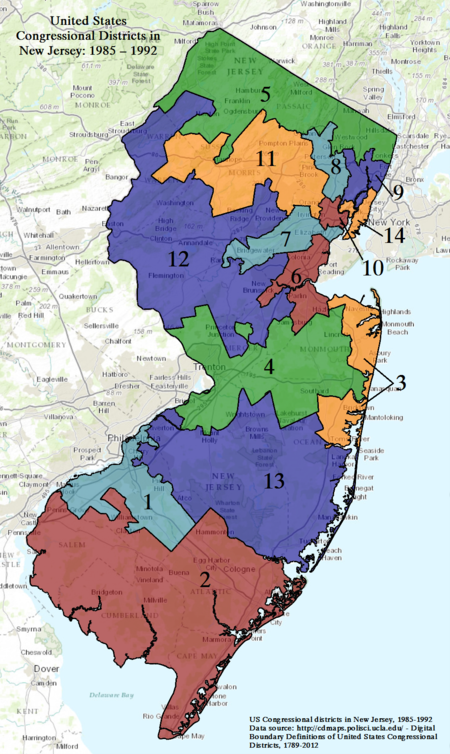
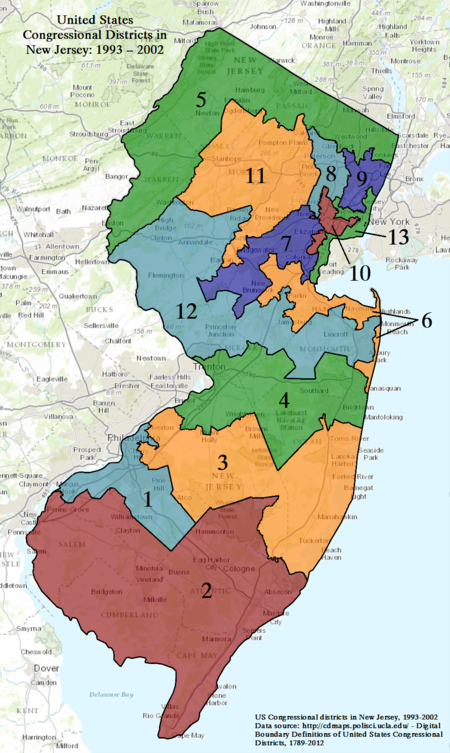
New Jersey (based on the 2020 census) has 12 Congressional Districts. Attached are charts of New Jersey’s Congressional Districts since 1973, when New Jersey had 15 Congressional Districts (See Handouts 2-6). As the population of other states grew faster than that of New Jersey over the last 50 years, the state lost Congressional districts. The 15th Congressional district became obsolete with the 1980 census; the 14th Congressional district became obsolete with the 1990 census, and the 13th Congressional district became obsolete with the 2010 census.
The process for determining the boundaries for each congressional district is set by each state. After the 2020 census was finalized, each state reviewed and revised its congressional districts. Currently, 21 states have some form of non-partisan or bipartisan redistricting commission. Of these 21 states, 13 use redistricting commissions to draw electoral district boundaries exclusively. A 14th state, Iowa, has a special redistricting process that uses neither the state legislature nor an independent redistricting commission to draw electoral district boundaries. New Jersey has a redistricting commission that is basically bipartisan. The New Jersey Redistricting Commission has 13 members: The Senate President and Assembly Speaker each name two members; the minority leaders of each house each name two members; and the state’s Democratic and Republican party chairpersons each name two members. The 12 members then select a 13th “tie-breaker” member to chair the commission. If they cannot agree on the 13th member, then each party submits a name to the state’s Supreme Court, which chooses one of the submissions as the 13th member. (See New Jersey Constitution, Article II, Section II attached as Handout One).
Since the make-up of the New Jersey (and most other) State Redistricting Commission is highly partisan, the possibility of partisan gerrymandering is inherent. Gerrymandering is a practice intended to establish an unfair political advantage for a particular party or group by manipulating district boundaries. “Gerrymandering” was named for Elbridge Gerry, one of the signers of the Declaration of Independence. As Governor of Massachusetts (1810–1812), Gerry approved a redistricting plan for the state senate that gave the political advantage to the Democratic-Republicans over the Federalists. It worked: the freakishly shaped district elected three Democratic-Republicans that year, 1812, breaking up the county’s previous delegation of five Federalist senators. A map of the district looked like a salamander, with claws and a snake-like head on its long neck. It was suggested instead that it was a “Gerry-mander” (See Handout Seven: Gerry-mandered Districts), a name which has stuck.
Partisan gerrymandering is an issue that has vexed the federal courts for more than three decades. In Reynolds v. SimsReynolds v. Sims, 377 U.S. 533 (1964) the U.S. Supreme Court held that states need to redistrict in order to have state legislative districts with roughly equal populations: "The Equal Protection Clause requires substantially equal legislative representation for all citizens in a State regardless of where they reside.” Section 2 of the Voting Rights Act of 1965 prohibits redistricting plans that are intended to, or have the effect of, discriminating against racial or language minority voters. However, aside from malapportionment and discrimination against racial or language minorities, federal courts have allowed state legislatures to engage in gerrymandering to benefit political parties or incumbents.
In a 1984 case, Davis v. Bandemer, the Supreme Court held that gerrymandered districts could be struck down based on the Equal Protection Clause, but the Court did not articulate a standard for when districts are impermissibly gerrymandered. In Shaw v. Reno, 509 U.S. 630 (1993), the United States Supreme Court ruled in a 5-4 decision that redistricting based on race must be held to a standard of strict scrutiny under the Equal Protection Clause. The Davis decision was implicitly overruled by the Supreme Court in Vieth v. Jubelirer, 51 U.S. 267 (2004) where a plurality opinion determined that partisan gerrymandering claims were nonjusticiable because there was no discernible and manageable standard for "adjudicating political gerrymandering claims."
In Rucho v. Common Cause, 588 U.S. ___ (2019), voters and other plaintiffs in North Carolina and Maryland filed suits challenging their state’s congressional districting maps as unconstitutional partisan gerrymanders. The North Carolina plaintiffs claimed that the State’s districting plan discriminated against Democrats, while the Maryland plaintiffs claimed that their State’s plan discriminated against Republicans. The plaintiffs alleged violations of the First Amendment, the Equal Protection Clause of the Fourteenth Amendment, the Elections Clause, and Article I, §2. The 5–4 decision, divided along partisan and ideological lines, held that gerrymandering claims present political questions beyond the reach of the federal courts and left in place North Carolina's congressional districts, which favor the Republican Party, and Maryland's congressional districts, which favor the Democratic Party.
In Louisiana v. Callais, 608 U.S. Materials Docket No. 24-109 (decided April 29, 2026), a challenge to Louisiana’s congressional redistricting map, specifically focused on District 6, alleging that the map was an impermissible racial gerrymander. The map was created in response to a previous lawsuit, Robinson v. Ardoin, where plaintiffs argued that the prior map violated Section 2 of the Voting Rights Act by diluting minority votes. To address these issues, the Louisiana Legislature adopted a new map (Senate Bill 8) that included a second majority-Black district. However, the plaintiffs in this case claimed that this new map violated the Equal Protection Clause of the Fourteenth Amendment by prioritizing race in its creation. A three-judge panel concluded that District 6 of the new map did indeed violate the Equal Protection Clause, leading the court to issue an injunction against using this map in future elections. In a 6-3 decision, the Court ruled that Louisiana’s creation of a second majority-Black congressional district was an unconstitutional racial gerrymander. The majority held that Section 2 did not require a second majority-minority district in this case, so there was no compelling interest in justifying the predominant use of race. The decision significantly narrows when and how states can use race in redistricting under the Voting Rights Act.
According to calculations made by Burt Neuborne, Professor of Civil Liberties at New York University School of Law and the founding legal director of the Brennan Center for Justice, using criteria set forth by the American Political Science Association, about 40 seats, less than 10% of the House membership, are chosen through a genuinely contested electoral process, given partisan gerrymandering.
The National Council of State Legislatures suggests the following traditional districting principles (or criteria), which have been adopted by many states:
- Compactness: Having the minimum distance between all the parts of a constituency (a circle, square or a hexagon is the most compact district).
- Contiguity: All parts of a district being connected at some point with the rest of the district.
- Preservation of counties and other political subdivisions: This refers to not crossing county, city, or town, boundaries when drawing districts.
- Preservation of communities of interest: Geographical areas, such as neighborhoods of a city or regions of a state, where the residents have common political interests that do not necessarily coincide with the boundaries of a political subdivision, such as a city or county.
- Preservation of cores of prior districts: This refers to maintaining districts as previously drawn, to the extent possible. This leads to continuity of representation.
- Avoiding pairing incumbents: This refers to avoiding districts that would create contests between incumbents.
They also note the following emerging criteria, which have been considered and adopted in a few states since 2000:
- Prohibition on favoring or disfavoring an incumbent, candidate or party. The prohibition in a given state may be broader, covering any person or group, or it may be limited to intentionally or unduly favoring a person or group. Details on these prohibitions are included in the state descriptions below.
- Prohibition on using partisan data: Line drawers, whether they be commissioners (California and Montana), nonpartisan staff (Iowa), or legislators (Nebraska), are prohibited from using incumbent residences, election results, party registration, or other socio-economic data as an input when redrawing districts.
- Competitiveness: Districts having relatively even partisan balance, making competition between the two major parties more intense. This criterion typically seeks to avoid the creation of “safe” districts for a particular party. For instance, the Arizona constitution (cited below) states that “to the extent practicable, competitive districts should be favored where to do so would create no significant detriment to the other goals.” (See https://www.ncsl.org/
Activity #1
Conduct a Simulated New Jersey Redistricting activity:
New Jersey will need to redistrict after the 2030 census is finalized.
- Review the NJ Congressional Districts since 1973 (Handouts 2-7) and compare them with the Gerry-mandered map (Handout 8). Identify which, if any, New Jersey districts look like they were “Gerrymandered”? Are there any noticeable patterns or drastic changes on the maps over the last 50 years?
- Read the attached article Partisan Redistricting NJ.com, which provides different perspectives on New Jersey’s most recent redistricting map. Identify an argument that supports the map as fair and identify an argument that believes it isn’t.
- Divide your class into two groups. Assume that the state will continue to have 12 congressional districts or assume that the state will lose one seat and only have 11 congressional districts.
- Have one group consider the criteria suggested above by the National Council of State Legislatures, as well as past and current New Jersey congressional districts (Handouts 2-7). Use the state map with counties and county seats identified (Handout 9) and the map of New Jersey municipalities (Handout 10) and their populations (which can be found at https://en.wikipedia.org/wiki/List_of_municipalities_in_New_Jersey) and determine what would be appropriate Congressional Districts for New Jersey.
- For the other group, assign roles for members of the Redistricting Commission:
- Senate President (2 votes)
- Assembly Speaker (2 votes)
- Senate Minority leader (2 votes)
- Assembly Minority Leader (2 votes)
- Chairman of the NJ State Democratic Committee (2 votes)
- Chairman of the NJ State Republican Committee (2 votes)
- NJ State Supreme Court Justice (chairman with one vote)
Have the students use the state map with counties and county seats identified (Handout 9) and the map of New Jersey municipalities (Handout 10) and their populations (which can be found at https://en.wikipedia.org/wiki/List_of_municipalities_in_New_Jersey to determine Congressional Districts for New Jersey.
- Class Discussion:
- What are the differences between the plans that each group developed?
- Which districts look gerrymandered?
- Which party might benefit from the gerrymandered districts?
- What would be appropriate criteria for the New Jersey Redistricting Commissions to use in the future to prevent gerrymandering?
Activity #2
Redistricting and Community Mapping in NJ
The emergence of browser-based tools has enhanced citizens' ability to create districts and build community coalitions. Districtr (https://districtr.org/) is a free browser-based tool for drawing districts and mapping your community. This activity involves students working in groups of 2 to 3 to develop their own New Jersey Congressional district map. Using the tools provided in the program, groups can access current population dynamics, draw colored-coded districts, and submit their plan for inspection based on rules of contiguity. Groups should also answer the following questions when submitting their maps.
- Briefly describe the map you created. What was your main goal when drawing the lines (e.g., equal population, competitiveness, keeping communities together, compactness)?
- What was the hardest part of drawing the districts? What trade-offs did you have to make?
- How close did you get to the ideal population size for each district in your state? Why is equal population so important?
- How does your map compare to the actual congressional map currently used in your state? What is similar? What is different?
- The program provides population layer data to identify communities based on race. To what extent did your group consider race when creating districts? Do you believe that districts should be created to concentrate the particular interests of ethnic or racial groups?
- Should mapmakers prioritize keeping cities, counties, or communities of interest together, even if it means districts are less competitive? Explain your reasoning.
- If your map were used in a real election, which party or groups of voters might benefit the most? Which might be disadvantaged?
- Imagine you are presenting your map to a redistricting commission or the state legislature. Write a short (3–5 sentence) statement defending why your map should be adopted.
Background
Smithsonian Magazine (July 20, 2017): https://www.smithsonianmag.com/history/where-did-term-gerrymander-come-180964118/
New Jersey Constitution, Art. II, Sec. II https://www.njleg.state.nj.us/lawsconstitution/constitution.asp
Reynolds v. Sims (1964) https://www.oyez.org/cases/1963/23
Davis v. Bandemer (1984) https://www.oyez.org/cases/1985/84-1244
Shaw v. Reno (1993) https://www.oyez.org/cases/1992/92-357
Viet v. Jubelirer (2004) https://www.oyez.org/cases/2003/02-1580
Rucho v. Common Cause (2019) https://www.oyez.org/cases/2018/18-422
Louisiana v. Callais (2026) https://www.oyez.org/cases/2025/24-109
National Council of State Legislatures https://www.ncsl.org/research/redistricting/redistricting-criteria.aspx
HANDOUT ONE: NEW JERSEY STATE CONSTITUTION
ARTICLE II, SECTION II
1. (a) After each federal census taken in a year ending in zero, the Congressional districts shall be established by the New Jersey Redistricting Commission.
The commission shall consist of 13 members, none of whom shall be a member or employee of the Congress of the United States. The members of the commission shall be appointed with due consideration to geographic, ethnic and racial diversity and in the manner provided herein.
(b) There shall first be appointed 12 members as follows:
(1) two members to be appointed by the President of the Senate;
(2) two members to be appointed by the Speaker of the General Assembly;
(3) two members to be appointed by the minority leader of the Senate;
(4) two members to be appointed by the minority leader of the General Assembly; and
(5) four members, two to be appointed by the chairman of the State committee of the political party whose candidate for the office of Governor received the largest number of votes at the most recent gubernatorial election and two to be appointed by the chairman of the State committee of the political party whose candidate for the office of Governor received the next largest number of votes in that election.
Appointments to the commission under this subparagraph shall be made on or before June 15 of each year ending in one and shall be certified by the respective appointing officials to the Secretary of State on or before July 1 of that year.
Each partisan delegation so appointed shall appoint one of its members as its chairman who shall have authority to make such certifications and to perform such other tasks as the members of that delegation shall reasonably require.
(c) There shall then be appointed one member, to serve as an independent member, who shall have been for the preceding five years a resident of this State, but who shall not during that period have held public or party office in this State.
The independent member shall be appointed upon the vote of at least seven of the previously appointed members of the commission on or before July 15 of each year ending in one, and those members shall certify that appointment to the Secretary of State on or before July 20 of that year. If the previously appointed members are unable to appoint an independent member within the time allowed therefor, they shall so certify to the Supreme Court not later than that July 20 and shall include in that certification the names of the two persons who, in the members' final vote upon the appointment of the independent member, received the greatest number of votes. Not later than August 10 following receipt of that certification, the Supreme Court shall by majority vote of its full authorized membership select, of the two persons so named, the one more qualified by education and occupational experience, by prior public service in government or otherwise, and by demonstrated ability to represent the best interest of the people of this State, to be the independent member. The Court shall certify that selection to the Secretary of State not later than the following August 15.
(d) Vacancies in the membership of the commission occurring prior to the certification by the commission of Congressional districts or during any period in which the districts established by the commission may be or are under challenge in court shall be filled in the same msanner as the original appointments were made within five days of their occurrence. In the case of a vacancy in the membership of the independent member, if the other members of the commission are unable to fill that vacancy within that five-day period, they shall transmit certification of such inability within three days of the expiration of the period to the Supreme Court, which shall select the person to fill the vacancy within five days of receipt of that certification.
2. The independent member shall serve as the chairman of the commission.
Article II, section II added effective December 7, 1995.
HANDOUT TWO: NJ CONGRESIONAL DISTRICTS 1973-82
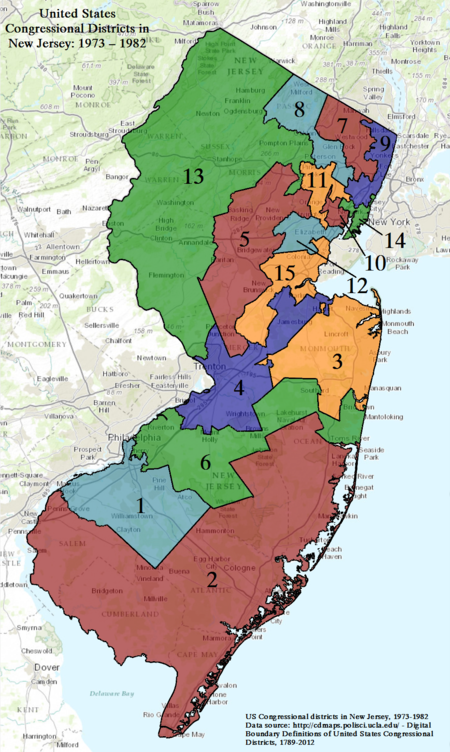
HANDOUT THREE: NJ CONGRESSIONAL DISTRICTS 1985-1992
HANDOUT FOUR: NJ CONGRESSIONAL DISTRICTS 1993-2002
HANDOUT FIVE: NJ CONGRESSIONAL DISTRICTS, 2003-2012
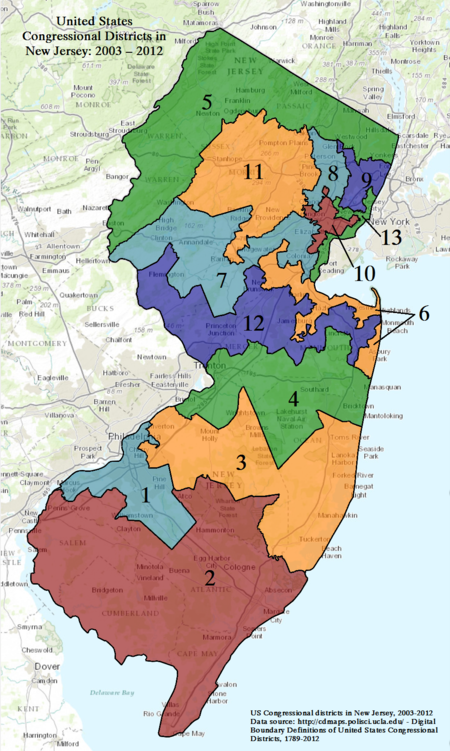
HANDOUT SIX: NJ CONGRESSIONAL DISTRICTS SINCE 2013
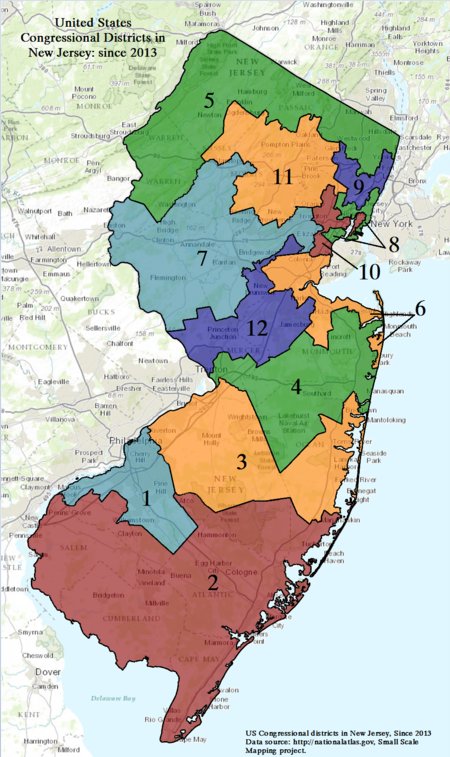
HANDOUT SEVEN: NJ CONGRESSIONAL DISTRICTS SINCE 2022
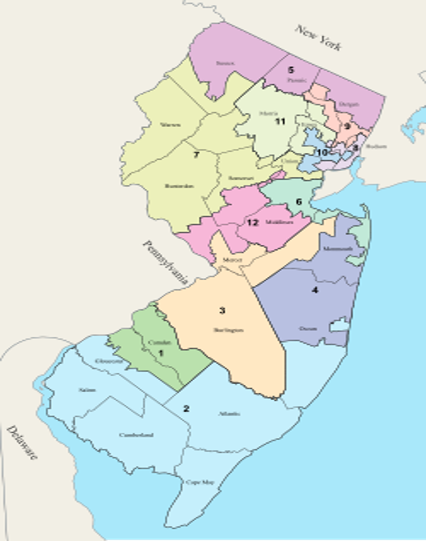
HANDOUT EIGHT: GERRYMANDERED DISTRICT
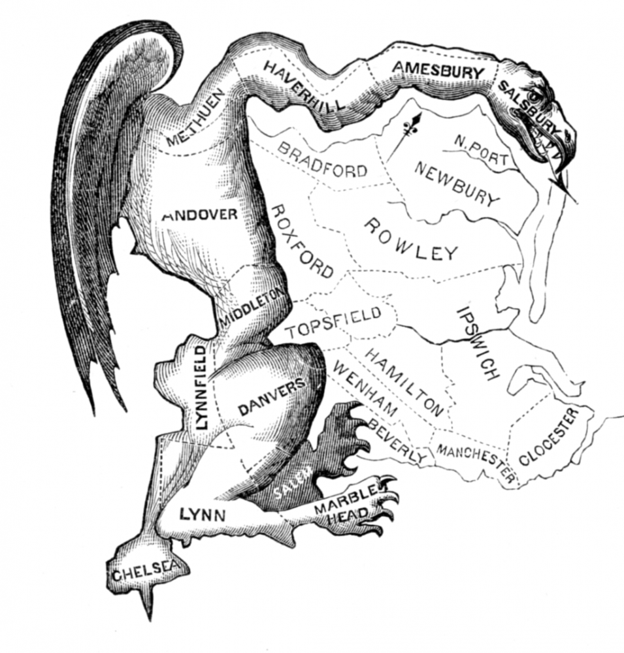
The misshapen Massachusetts Congressional District approved by Governor Gerry in 1812 that earned the name “Gerrymandered”
HANDOUT NINE: NEW JERSEY COUNTIES AND COUNTY SEATS
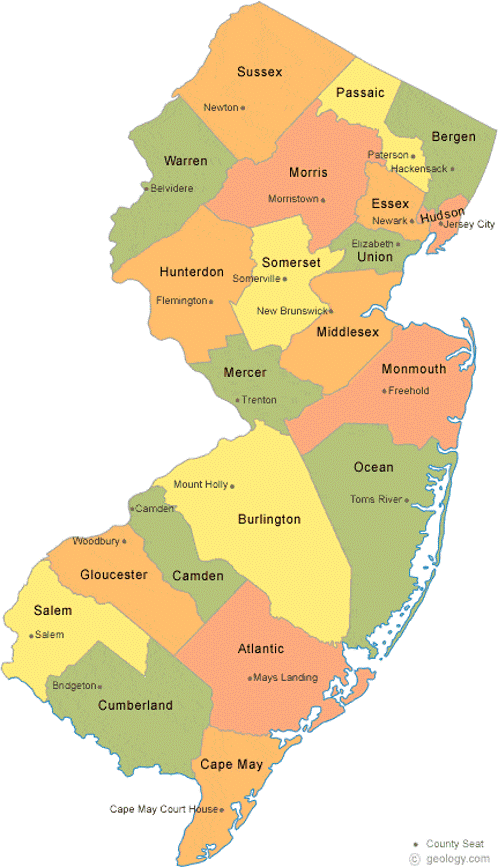
HANDOUT TEN: NJ MUNICIPALITIES WITH COUNTY LINES