
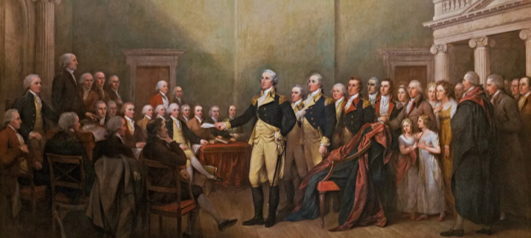
General George Washington Resigning His Commission. Painting by John Trumbull
Created by: The New Jersey Center for Civic Education, Rutgers University
Objectives: Students will:
- Define and describe the personal characteristics of civic virtue.
- Identify individuals who exemplify civic virtue and support their claim with evidence.
- Explain why civic virtue is important in a democratic society.
Student Learning Standards for Social Studies:
- 6.1.8.HistorySE.3.a: Analyze how the leadership of George Washington during the American Revolution and as president allowed for the establishment of American democracy.
- 6.3.8.CivicsPD.3: Construct a claim as to why it is important for democracy that individuals are informed by facts, aware of diverse viewpoints, and willing to take action on public issues.
I. What is civics virtue?
Definition: Civic virtue refers to the personal qualities associated with the effective functioning of the civil and political order, or the preservation of its values and principles. (See Civic virtue | Civic Duty, Civic Responsibility & Civic Engagement | Britannica ) Defining or specifying these personal qualities vary according to the needs and goals of different societies and political orders. The qualities also vary over generations and historical eras.
Background: Our Founding Fathers saw civic virtue as essential to the American Republic they designed. In his Thoughts on Government (1776), John Adams wrote We ought to consider what is the end of government … All inquirers of truth agree that the happiness of man, as well as his dignity, consists in virtue.” George Mason insisted that “liberty can be preserved only through justice, moderation, temperance, frugality, and virtue” and argued that the “stability of a free government depended on habits formed long before a ballot was cast.” Thomas Jefferson praised “a life governed by restraint and consistency” and viewed power as the opportunity to “pause, deliberate, and choose long-term good over short-term impulse.” (See: The Lifelong Pursuit of Virtue | Constitution Center) Finally, as a 14 year old boy, George Washington wrote out 110 Rules of Civility. Washington memorized and practiced many of the rules as they guided his character and informed his leadership throughout his life.
Activity - Rules of Civility: Encourage students to visit The Rules of Civility | George Washington's Mount Vernon. The site invites students to vote on their favorite rule and comment on which rules are relevant to today’s society and political order.
Activity - Franklin’s Necessary Virtues: No Founding Father gave more thought to civic virtue than Benjamin Franklin. In The Autobiography of Benjamin Franklin, he identified thirteen "necessary virtues” that not only benefits the individuals, but promotes the well-being or common good of society. Franklin listed the Necessary Virtues as:
1. Temperance
2. Silence
3. Order
4. Resolution.
5. Frigality.
6. Industry
7. Sincerity
8. Justice
9. Moderation
10. Cleanliness
11. Tranquility
12. Chastity
13. Humility
Organize students into small groups of 3-5. Provide each group a copy of Franklin’s Necessary Virtues. Then instruct each group to do the following:
- Define each term.
- Identify the five virtues that are most important to individual well-being. Draft brief explanations for their choices.
- Identify the five virtues that are most important to society’s well-being or common good. Draft brief explanations for their choices.
When each small group has completed their definitions and list, provide the opportunity to share with the larger class. This can be done either by a jigsaw activity or by having each group present to the class as a whole in turn.
Activity - Civic Virtues and Vices: Invite students to consider and discuss a more contemporary view of civic virtue. First, have students watch a 4 minute video by the Bills Of Rights Institute. Civic Virtues | Government & Politics: Civics for the American Experiment Then have students (1) consider the video’s definition of civic virtue; (2) compare the video’s list of virtues with those of Franklin; (3) assess the value of recognizing civic vices; and (4) reflect on how they can practice civic virtue in their community.
II. What are some examples of civic virtue?
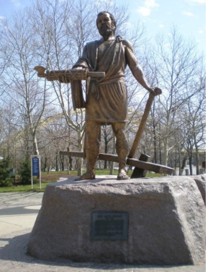 Cincinnatus was a skilled Roman military leader who had retired to work on his farm. He was asked by the government of Rome to help them as the leader during a crisis. When Cincinnatus agreed, Roman officials made him dictator with control of the army and the city of Rome. After a heroic victory, Cincinnatus could likely have remained as dictator. He chose instead to return to his farm and resume his life as a private citizen.
Discussion Question: What virtuous characteristics did Cincinnatus model? For more information see:Cincinnatus and George Washington: Ideas that Informed the American Founders, Part 19
(Image: CIncinnatus returning his sword, Cincinnati, Ohio)
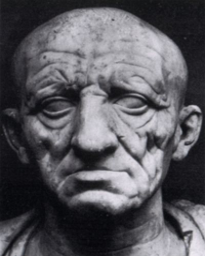 Cato the Elder rose from a “plebian” or working class upbringing to become a Roman soldier, senator and influential historian. He wore simple clothes, resisted displays of wealth and worked his own land. Cato praised the hard-working farmer as the ideal Roman citizen and service to the state as an important obligation. The Founders praised Cato’s resistance to Julius Caesar and George Washington saw in Cato a military commander who, like himself, selflessly opposed the tyranny of a leader. For more information see:Cato as an Example of Civic Virtue: Ideas that Informed the American Founders, Part 18
Discussion Questions: What virtuous characteristics did Cato the Elder model? (Image: Bust of Cato The Elder)
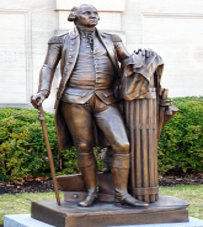 George Washington was recognized as the “American Cincinnatus.” He was chosen by the delegates in the Continental Congress to lead the Continental Army during the American Revolution. After winning Independence, Washington resigned his military commission to the Articles of Confederation Congress and returned to his farm in Mt. Vernon as a private citizen. After James Madison persuaded Washington to be a delegate at the Federal Convention in 1787, he was unanimously elected as President of the Convention. When the Constitution was ratified in 1788, Washington was again persuaded to leave private life and was twice elected unanimously to serve as President of the United States. With no constitutional term limit, Washington could likely have remained as President for as long as he liked. Instead, he walked away from power for the good of the American Republic and the United States constitutional system of government. (Image: Statue of George Washington in front of the American Cincinnatus Society)
III. Identify other examples of civic virtue.
Activity - Civic Virtue in American History: American history is filled with individuals who practiced civic virtue and made a positive difference for their society. Engage students in a class discussion of individuals in United States history who have exemplified civic virtue. Ask students to identify examples and encourage them to provide details that illustrate the individuals’ civic virtue.
If students struggle to provide examples, provide a list. Instruct students to pick a name on the list and do some research. Then go around the room and ask students which individuals are good examples of civic virtue and explain why. A sample list could include:
- John Adams
- Abraham Lincoln
- Harriet Tubman
- Martin Luther King, Jr.
- Senator Howard Baker
- Al Gore
- Pat Tillman
- Alice Paul
- John McCain
- Shirley Chisholm
- Mike Pence
- Jonas Salk
You are encouraged to identify other examples of civic virtue. An alternative example of this activity and separate list of individuals can be found at: https://billofrightsinstitute.org/activities/american-portraits-in-civic-virtue/
Activity - Civic Virtue in Society Today: Divide students into small groups of 3-5. Instruct the groups to collaborate to identify and explain examples of civic virtues in four communities: their school, local town, state and nation. Encourage them to identify at least one example for each community. The groups should use the graphic organizer below to compile their examples.
When each small group has completed their examples and organizer, provide the opportunity to share with the larger class. This can be done either by a jigsaw activity or by having each group present to the class as a whole in turn.
(Lesson adapted from https://billofrightsinstitute.org/activities/civic-virtues-today)
| Name of Individual Group, Activity, or Event | Community: School, Local, State, or National | Describe What Happened in Your Own Words | Explain What Civic Virtue Was Demonstrated |
IV. Why is civic virtue important in a democracy?
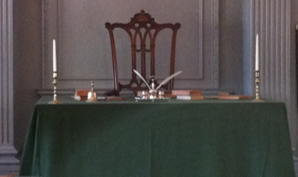
Background: Civic virtue and a concern for the common good is essential for society to function in a fair, prudent and wise manner. This is true for both the leaders in our democracy and for ordinary citizens in every community. To illustrate this, consider (and share with your students) a story from the last day of the Federal Convention in Philadelphia.
On September 17th, 1787, all the debates, and compromises were finished in the Federal Convention. However, before the delegates voted on the Constitution, Convention President George Washington recognized Benjamin Franklin for one final speech.
Franklin began his speech by admitting that the Constitution was imperfect. He nevertheless approved of the Constitution “with all its faults” because even an imperfect form of Government would “bless to the people if well administered.” Soon after, Franklin reminded the delegates that “the happiness of the people, depends, on … the wisdom and integrity of its leaders.” He then concluded his speech by urging the delegates to approve the Constitution and to “turn [their] future thoughts & endeavors to the means of having it well administered.”
The United States Constitution was approved and all the delegates adjourned and exited onto the streets where a crowd eagerly awaited news. A woman approached Franklin and asked, “Well Doctor, what have we got, a republic or a monarchy?” Franklin quickly answered. “A republic, madam, if you can keep it.”
Inside the convention hall, Franklin addressed the future leaders of an American Republic. To administer this new government well, they would have to practice the kind of civic virtue described by Adams, Jefferson, Mason, Washington, and Franklin himself - virtues like courage, wisdom, moderation, integrity, selflessness, and importantly, putting country above self.
Outside of the convention hall, Franklin addressed an ordinary citizen in an American Republic. In answering the woman’s question, he was describing every citizen's responsibility to “keep” a republic. For a republic to survive, Franklin believed, citizens, like leaders, would have to practice civic virtue in their communities.
 |
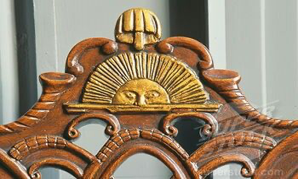 |
| George Washington’s seat at the Federal Convention | The image of the sun observed by Franklin |
Activity - Civic Virtue and a Rising Sun: Share the story from September, 1787 with students. Then use the following prompt to either (a) engage students in a class discussion, or (b) have students write a culminating essay.
After the delegates of the Federal Convention approved the Constitution, Franklin observed to those around him:
“I have often looked at that picture behind the president without being able to tell whether it was rising or setting. But now at length I have the happiness to know that it is a rising and not a setting sun.”
- In your opinion, is the United States a rising or a setting sun? Explain.
- What civic virtues need to be practiced by our leaders today to ensure that the United States is a rising sun?
- What civic virtues need to be practiced by our citizens today to ensure that the United States is a rising sun?
V. Why is civic virtue important in a democracy?
- In many countries, leaders have not had the justice, wisdom and temperance to walk away from continuing to serve as leader of their country.
- Public figures must model the values of civic virtue for the public. Otherwise, the public sees that it is okay for them to let loose bad characteristics, such as greed, fear, indulgence and thoughtlessness or foolishness. Without civic virtue and a concern for the common good, a society cannot function in a fair, prudent and wise manner.
- Without civic virtue and a concern for the common good, a society cannot function in a fair, prudent and wise manner.
Vi. Assessment
Have students identify a person (famous or from their own lives) who they believe demonstrates civic virtue and explain why is an oral and/or online presentation.