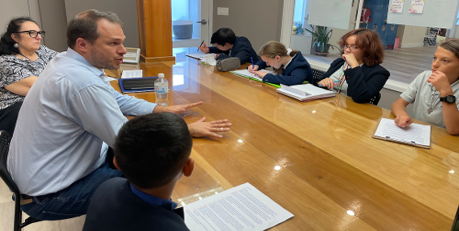
Middle School Students Meet with Jersey City Elected Officials to Discuss Community Outreach
Prepared by: The New Jersey Center for Civic Education, Rutgers University, Piscataway, NJ
Grade level: Grades 6-8
New Jersey Social Studies Student Learning Standards:
- 6.3.8.CivicsPI.1: Evaluate, take, and defend a position on why government is necessary, and the purposes government should serve.
- 6.3.8.CivicsPD.2: Propose and defend a position regarding a public policy issue at the appropriate local, state, or national level.
Objectives: Students will be able to:
- Define public policy.
- Explain the importance of learning about public policymaking in a democracy.
- Define and distinguish between the private sphere, civil society and the public sphere.
- Apply the definition of public policy to community problems.
- Create original public policy and civil society solutions to community problems.
What is Public Policy?
Government is responsible for protecting individual rights to life, liberty, and property and for promoting the common good. Consequently, the government is often responsible for developing a solution to problems in your community, state and nation.
Public policy is the concept or set of ideas that guides a course of action or procedure in dealing with public issues or problems. It is embodied in laws, rules, regulations or procedures used to fulfill the government's responsibilities to its citizens. Public policy also includes the decisions, commitments and actions made by those who hold government positions. (Source: Project Citizen, Level 1 and Level 2 Texts)
Why Learn About Public Policy?
The United States Constitution begins with the words, “We the People of the United States …” They empower the people to “establish Justice, insure domestic Tranquility … promote the general Welfare, and secure the Blessings of Liberty.” Together, the words of the Preamble are expressions of popular sovereignty, which means the people rule. Consequently, we, as citizens, have a lot of responsibility.
When citizens are ignorant about public policymaking, they lack the tools to effectively get things done. They experience confusion about procedure and who does what in the policymaking arena. That confusion often leads to frustration, apathy, and feelings of helplessness. In short, ignorance of public policymaking is an abdication of our power and responsibility.

Image: Students from Elizabeth High School rally outside the Statehouse in Trenton in support of two bills that would increase transparency around school security and discipline.
Knowledge, on the other hand, empowers citizens to influence public policy and improve communities. They can efficiently use their time, energy and resources to contact policymakers, research and attend public forums, and lobby decision makers. In short, learning about public policy helps us fulfill the responsibility and promise of “We the People.”
What Are the Three Spheres of Society?
It is useful to distinguish between three areas or spheres of society.
- Private sphere: This refers to the area or social space in society where people live private lives. They spend time with friends and family and associate with others to pursue private interest. It is characterized by personal freedom and is generally free from unreasonable intrusion by the government.
- Civil society: This refers to the area of society where people associate and interact voluntarily to pursue shared interests. They may do so as members of social or economic organizations or political associations. Organizations and associations in civil society are not part of the government, however, they often provide an effective means to promote the common good and monitor and influence government action.
- Public Sphere: This refers to the formal governmental institutions at the local, state and national levels. This sphere includes all the formally elected or appointed officials who make, enforce, and administrate decisions and actions made by all three levels of government.
Activity 1: Distinguishing Among Areas of Society.
After reviewing the three spheres of society, distribute Hand Out #1 - Distinguishing Among Areas of Society. You may use the handout as (1) an assessment to check students’ understanding; (2) a catalyst for small group discussion; or (3) a catalyst for full class discussion. (Source: Project Citizen, Level 1 Text)
Hand Out #1 - Distinguishing Among Areas of Society. For each example, there are four possible answers: (a) the private sphere; (b) civil society; (c ) government or public sphere; (d) a combination of any of these. (You may use the following as a key. Suggested answers and explanations are in italics that follow)
- A local school board changes graduation requirements. (c - the public sphere. The school is an elected government body, making policy for the district)
- Susan becomes a member of the Girl Scouts. (b- civil society. The Girls Scouts is a community organization)
- Carmen and her friend go out to dinner and a movie. (a - private sphere. This a private decision made by Carmen and her friends)
- Marco’s family and friends have a picnic on July 4. (a - private sphere. This is private decision made by Marco and his family and friends to celebrate a holiday)
- Sara and her sisters join the teachers’ union. (b - civil society. A teacher’s union is an organization that promotes the shared interests of teachers)
- The Sierra Club lobbies the New Jersey government to pass environmental protection laws. (d - a combination of civil society and governments. The Sierra Club is an environmental organization attempting to influence governmental policy)
- The New Jersey state legislature passes a law limiting the use of cell phones while driving. (c - government or public sphere. The state legislature is an elected governmental body making a law for the state of New Jersey.)
- Citizens join a taxpayer’s association in an effort to get the government to lower property taxes in NJ. (d- a combination of these. The taxpayers association was formed in civil society to change state tax law.)
- The federal government awards a contract to a private company to repair sections of an interstate highway. (d - a combination of these. The government agency made a contract with a private company in the private sphere to produce a public good.)
- A city council passes a law establishing smoke free zones in public parks. (c- government or public sphere. The city council is an elected government body make a city ordinance)
Activity 2 - Applying the Definition of Public Policy
Public policy necessarily involves the public sphere, or government. However, sometimes the other spheres are involved. Public policies may be implemented by:
- Government acting alone
- Government acting cooperatively with civil society
- Government and civil society acting independently
After reviewing the three ways public policy may be implemented, distribute examples to your students. Distribute Hand Out #2 - Applying the Definition of Public Policy. You may use the handout as (1) an assessment to check students’ understanding; (2) a catalyst for small group discussion; or (3) a catalyst for full class discussion. (Source: Project Citizen - Level 2 Text)
Hand Out #2 - Applying the Definition of Public Policy.. For each example, there are four possible answers: (a) A public policy solution to a problem by a governmental solution; (b) a public policy solution to a problem by a governmental institution cooperating with civil society; (c ) a solution to a problem dealt with by public policy and by civil society acting independently ; (d) a solution to a problem by civil society acting alone. (You may use the following as a key. Suggested answers and explanations are in italics that follow)
- Government funding of medical research, interstate highways, and higher education. (b- The government has appropriated funding to private business in civil society)
- Providing assistance to the poor through government issued food stamps and the voluntary contributions of church members (c - Both the government and churches in the civil society are independently provided assistance to the poor)
- Providing education by religious institutions to promote their specific moral standards. (d - Religious institutions in civil society are providing education to promote their interests. Government is not involved)
- Creating the Department of Homeland Security by the federal government to protect the country from terrorism. ( a- the legislature responded to the problem of terrorism by creating a new governmental agency)
- Community groups take disadvantaged youth living in a city to rural outings. (d - community groups in civil society are acting alone)
- Providing training to neighborhood watch groups by law enforcement agencies. (b - Neighborhood watch groups are civic association receiving training for governmental law enforcement agencies)
- Providing shelter for the homeless by both state government and private groups. (c - There is no indication of coordination between the state government and private civic organizations)
- Community groups arrange for young people to visit elderly members of the community who live alone and lack social contact. (d - The community groups are acting independently without government involvement)
- The federal government provides tax incentives to businesses to locate in areas of high unemployment. (b- The government is providing incentive to private business in civil society to assist in resolution to a public problem)
- Authorizing funding for after school programs in public schools. (a - Elected school boards are allocating money to public schools)
Activity 3: Is it a Public Policy Solution?
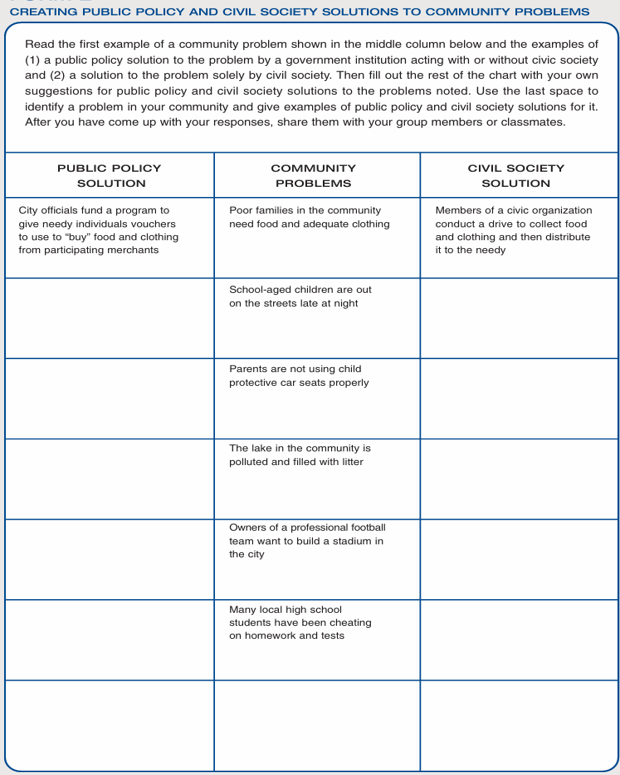
Propose the following problem to the students: Poor families in the community need food and adequate clothing. Then present two potential solutions. After each solution, engage students in a discussion - Is this a public policy solution? Why or Why not?
- Solution 1: City officials fund a program for needy individuals to “buy” food and clothing from participating merchants using vouchers. (This is a public policy. Elected city officials voted to use city funds for the program. For an example in New Jersey see; News 12 | New Jersey | East Orange To Create Food Voucher Program To Help Families Losing Snap)
- Solution 2: A women’s civic organization conducts a drive to collect food and clothing and then distributes it to needy individuals. (This is NOT a public policy. A women’s civic organization is working independently to address the problem.)
Activity 4: Creating Public Policy and Civil Solutions to Community Problems.
Divide the class into small groups of 3-5 students. Distribute to each group Handout#3 -Creating Public Policy and Civil Society Solutions. The middle column of the chart identifies a community problem. The left hand column is space for a public policy solution; the right hand column is space for a civil society solution. Explain to students that the first row has already been completed using the example in Activity 3. Instruct them to fill out the rest of the chart with public policy and civil society solutions for the community problems indicated. Finally, in that last row of the chart, they are to identify a problem in their own community as well as public policy and civil society solutions.
Extension: You may wish to explore Project Citizen with your students. Project Citizen is a project based civic education program for students grades 3-12. Entire classes of students work cooperatively in small groups to effect change in their community. Students develop a digital portfolio that documents their research about a public policy problem and proposes solutions and an action plan for implementation. The student portfolio can be shared with others at your school, policymakers in your community, or at a New Jersey State Showcase at Rutgers University in June. (For examples of student portfolios, see Project Citizen Portfolios)
Project Citizen emphasizes responsible participation in local and state government and develops a sense of civic empowerment. For more on the curriculum see Project Citizen. For more on the New Jersey State showcase watch New Jersey Project Citizen Showcase 2025. Finally, if you are interested in attending a free, full-day Project Citizen workshop, visit https://civiced.rutgers.edu/professional-development/upcoming-workshops.
Hand Out #1 - Distinguishing Among Areas of Society.
For each example, there are four possible answers: (a) the private sphere; (b) civil society; (c ) government or public sphere; (d) a combination of any of these. Be Prepared to defend your answer.
- A local school board changes graduation requirements.
- Susan becomes a member of the Girl Scouts.
- Carmen and her friend go out to dinner and a movie.
- Marco’s family and friends have a picnic on July 4.
- Sara and her sisters join the teachers’ union.
- The Sierra Club lobbies the New Jersey government to pass environmental protection laws.
- The New Jersey state legislature passes a law limiting the use of cell phones while driving.
- Citizens join a taxpayer’s association in an effort to get the government to lower property taxes in NJ.
- The federal government awards a contract to a private company to repair sections of an interstate highway.
- A city council passes a law establishing smoke free zones in parks.
Hand Out #2 - Applying the Definition of Public Policy.
For each example, there are four possible answers: (a) A public policy solution to a problem by the government or public sphere; (b) a public policy solution to a problem by a governmental institution cooperating with civil society; (c ) a public policy solution to a problem with government and civil society acting independently ; (d) a solution to a problem by civil society acting alone. Be prepared to defend your answer.
- Government funding of medical research, interstate highways, and higher education.
- Providing assistance to the poor through government issued food stamps and the voluntary contributions of church members
- Providing education by religious institutions to promote their specific moral standards.
- Creating the Department of Homeland Security by the federal government to protect the country from terrorism.
- Community groups take disadvantaged youth living in a city to rural outings.
- Providing training to neighborhood watch groups by law enforcement agencies.
- Providing shelter for the homeless by both state government and private groups.
- Community groups arrange for young people to visit elderly members of the community who live alone and lack social contact.
- The federal government provides tax incentives to businesses to locate in areas of high unemployment.
- Authorizing funding for after school programs in public schools.
Handout 3 - Creating Public Policy and Civil Society Solutions