
National, State and Local Governments
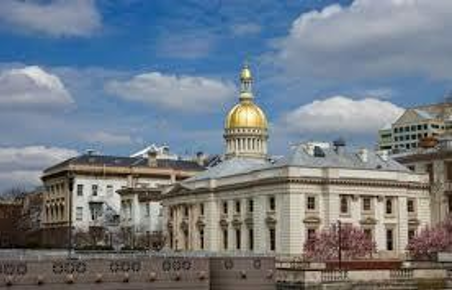
New Jersey State House, Trenton, NJ
Lesson Creator: NJ Center for Civic Education, Rutgers University, Piscataway Lesson Length: Four-Five 40-minute periods
Grade Level: Elementary
New Jersey Student Learning Standards for Social Studies (2020):
6.1.5.CivicsPI.3: Explain how the United States functions as a representative democracy and describe the roles of elected representatives and how they interact with citizens at local, state, and national levels
6.1.5.CivicsPI.4: Describe the services our government provides the people in the community, state and across the United States.
6.1.5.CivicsPI.5: Explain how government functions at the local, county, and state level. 6.1.5.CivicsPI.6: Distinguish the roles and responsibilities of the three branches of the national government.
6.1.5.CivicsPI.7: Explain how national and state governments share power in the federal system of government.
6.1.5.CivicsPI.8: Describe how the United States Constitution defines and limits the power of government.
6.1.5.Civic.DP.1: Using evidence, explain how the core civic virtues and democratic principles impact the decisions made at the local, state, and national government (e.g., fairness, equality, common good).
Common Core ELA Standards
RI.5.1 Quote accurately from a text when explaining what a text says explicitly and when drawing inferences from the text.
RI.5.4 Determine the meaning of general academic and domain-specific words and phrases in a text
W.5.2 Write informative/explanatory texts in which they introduce a topic. Use facts and definition to develop points and provide a concluding statement
W.5.7 Participate in shared research and writing projects
W.5.8 Gather information from provided sources to answer a questionSL.5.1 Engage effectively in a range of collaborative discussions, building on others’ ideas and expressing their own clearly
SL5.2 Summarize a written text read aloud or information presented in diverse media
Objectives: Student will be able to:
- Identify the concept of federalism as one of the major principles of the United States Constitution.
- Explain the reason for the inclusion of this concept in the United States Constitution.
- Compare and explain the different powers held by the federal government and those held by the states.
- Analyze whether certain issues should be addressed by the federal government, by state government, or concurrently.
Focus questions:
- Why do we need government?
- What is democracy?
- What is a republic?
- What is a constitution?
- How does our Constitution limit what the government can do?
- What are the problems with a dictatorial government?
- What is federalism?
- What powers does the national government have? What are reserved to the states? What powers are held by both?
- What other ways are power limits? What is separation of powers?
- How are New Jersey’s state and local government organized?
Why do we need government?
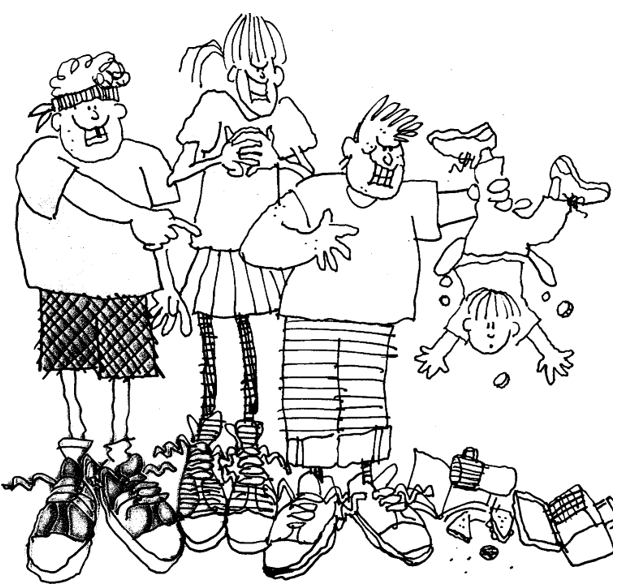
Day One, Activity 1 - Why do we need rules and laws?: Begin the activity by asking students to look at Handout 1 and respond to the following questions:
- What is happening in the picture? (Potential answer: Students may respond that the bigger kids are bullying or hurting the smaller boy - literally shaking him down for money).
- How could this be prevented? (Potential answer: With rules or laws and someone in authority to enforce them)
Continue activity 1 by asking students, why do we need rules or laws?
(Potential answers)
- To protect the weak from the strong
- To protect individual rights
- To keep us safe
- To help us keep order
- To settle arguments
- To help us share things in a fair way
Teachers may want to supplement this activity with the following video developed by iCivics and Nickelodeon 'Rules & Laws' Full Song ⚖️ Well Versed Episode 2 | Nickelodeon
Day one, Activity 2 - The Difference Between Power and Authority -
Help students understand the difference between power and authority. Power refers to the ability to use force. Authority is the power to use force combined with the right to use that power. Refer back to handout, Ask students the following questions:
- Does the bully in the picture have power?
- Does the bully have authority?
- Why or why not?
Then ask students to identify who has the authority to enforce rules or laws? Potential answers may include:
- Teachers
- Principals
- Crossing Guards
- Policemen and women
- Parents
- Governmental officials
Complete the activity 2 by asking students to identify whether power or authority in described in the following examples (Teachers are encouraged to add to or alter the list of examples in ways that are identifiable and relatable to their students::
- A thief robs you at gunpoint
- A parent tells her children to brush their teeth
- A teacher assigns homework to his students
- Jimmy forces Susie to leave the playground
- The legislature bans smoking in restaurants
More examples and activities can be found in Who has Authority Over Me, a comprehensive lesson developed by the Center for Civic education CIFD L2 Authority Lesson Plan
Day One, Activity 3: Now that students have been introduced to the need for rules and law and the difference between power and authority, engage them is a discussion about different kinds of government that can make and enforce rules and laws with authority.
What is a democracy?
- Democracy is a system of governance where the power is vested in the people.
- The United States is a democracy, as is Canada, France, Germany and Britain. Britain may have a queen but the power resides with the people who elect representatives to make decisions for them.
- In a direct democracy, everybody is involved in making decisions.
- In most democracies, decisions are made by elected representatives (see republic)
For more information and a deeper understanding of democracy see: Democracy - A short introduction and 'Our Voices' Full Song 🗣 Well Versed Episode 7 | Nickelodeon
What is a republic?
- A republic is a form of government in which representatives are elected to make governmental decisions for the general public and are responsible to the electorate.
- The United States has a republic because in most cases decisions about government are made by representatives serving in governmental institutions rather than by direct vote of the people.
For more information and for the difference between a democracy and a republic see: Democracy Vs Republic | What's the difference between a Democracy and Republic? Democracy Explained
What is a constitution and what does it do?
- Constitutions are the means used to state the powers that the government shall have. By defining these powers, constitutions limit the powers of government both in what it does and how it acts (due process).
- The United States has a constitutional government because the U.S. Constitution is the supreme law that everyone must obey including those serving the government.
- Government is limited to acting within the law and subject to judicial review as to whether its actions are within the Constitution.
- In a dictatorial government there are no limits on those who run the government. When the United States Constitution was created in 1787 most governments were run by hereditary monarchs who had absolute power to do whatever they wanted.
For additional information and a more complete understanding, see The Constitution Explained - YouTube, developed by iCivics and the Center for Civic Education. Each video is very student friendly and approximately two minutes long. Teacher can review the entire series and select those best suited for their students’ understanding
Day Two: Federalism
Background class discussion: What is Federalism?
- A federal system is one in which the national and state government share power.
- The Constitution established a federal system of government with power shared between the state and federal government.
- The Constitution lists specific roles of the federal government, including declaring war and printing money.
- The Tenth Amendment to the Constitution specifically states that “The powers not delegated to the United States by the Constitution, nor prohibited by it to the States, are reserved for the States respectively, or to the people.”
- Some powers not listed and therefore reserved to the states include the power to regulate intrastate trade and issue licenses. Students will explore this topic in Activity 4.
For additional information and a more complete understanding of federalism, see Foundations of the Constitution - Teaching Federalism, Separation of Powers, and Checks and Balances and States' Rights - Teaching the Tenth and Eleventh Amendments
Day Two, Activity 4: How Does Federalism Work?
Prepare cards (see Handout 2) with government activities, such as:
- Establish post offices
- Raise an army
- Conduct elections
- Establish local governments
- Take measures for public safety
- Collect taxes
- Build roads
- Coin money
- Establish courts
- Regulate commerce with foreign nations
- Make and enforce laws
- Declare war
- Regulate commerce within the state
Put students in groups of three: National Government, States and the People. Share Handout 3 (a simplified version of the U.S. Constitution, Art. 1, Sec. 8) with your students. Have students determine which of the following powers have been given to Congress, which have been reserved to the states (by not being delegated to Congress), and which powers the state and national governments share. Have them give the cards to the entity that has the authority (See Handout 2).
- What are the “States”, “the People” and “the National Government” doing?
- Who is holding most of the “power” cards? The people.
- So where does the power come from in our federal system of government? The people.
- To whom is power delegated: To the federal and state governments.
- Why do you think the Framers chose a federal system of government? They wanted to limit the power of the federal government and keep issues which did not have to be decided nationally at a more local level of decision-making.
- What are some of the advantages of a federal system of government? State and national governments each have limited powers.
- What are some of the disadvantages? Sometimes the authority of the two governments overlaps, for example environmental issues and this can be confusing.
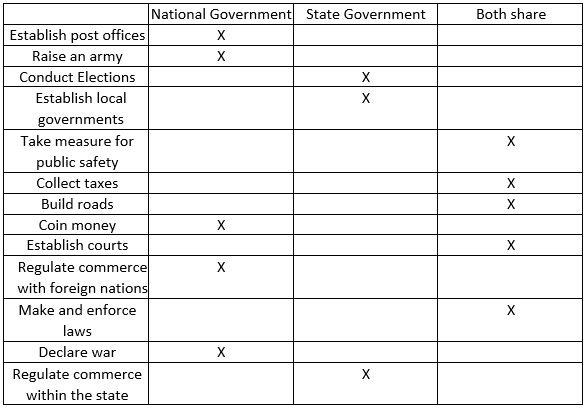
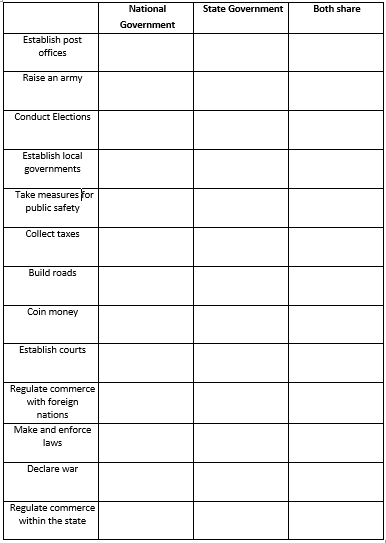
Day Two, Activity 5: Who Has the Power? As a formative assessment, have students complete the chart in Handout 4: Who Has the Power? Which Government has the Power to:
- Establish post offices
- Raise an army
- Conduct elections
- Establish local governments
- Take measures for public safety
- Collect taxes
- Build roads
- Coin money
- Establish courts
- Regulate commerce with foreign nations
- Make and enforce laws
- Declare war
- Regulate commerce within the state
A completed chart Who has the Power?:
Day Three: Separation of powers
Background: The concept of separation of powers was developed by baron de Montesquieu, an 18th century French social and political philosopher. Under his model, the political authority of the government is divided into legislative, executive and judicial powers. He asserted that, to most effectively promote liberty, these three powers must be separated and act independently.
Separation of powers, therefore, refers to the division of government responsibilities into distinct branches to limit any one branch from exercising the core functions of another. The intent is to prevent the concentration of power and provide for checks and balances.
- The legislative branch is responsible for enacting the laws of the state and appropriating the money necessary to operate the government.
- The executive branch is responsible for implementing and administering the public policy enacted and funded by the legislative branch.
- The judicial branch is responsible for interpreting the constitution and laws and applying their interpretations to controversies brought before it.
Most state constitutions, including New Jersey’s, specify that government be divided into three branches: legislative, executive and judicial.
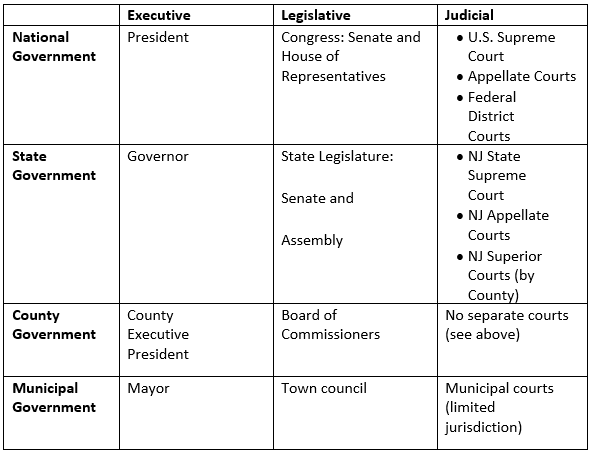
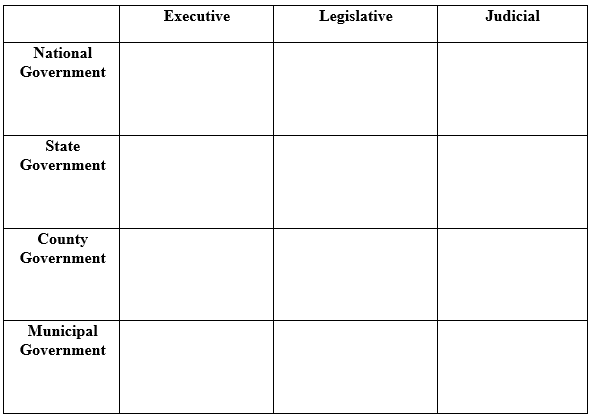
Day Three, Activity 5: Divide your class into small groups of students. Have the small groups of students complete the chart (Handout 5: Separation of Powers at National, State and Local Levels) to identify how executive, legislative and judicial powers are separated at the national, state and local levels.
- The Governor holds the executive position in the state, similar to the president of the country.
- The State Legislature, which consists of a State Senate and State Assembly hold the legislative positions, much like the U.S. Senate and House of Representatives.
- The County Freeholders are empowered with a broad scope of authority, some of which is designated to them by the State of New Jersey, including, but are not limited to, law enforcement, welfare, education, roads, and economic development. They share these functions with local (municipal) governments, which are also empowered by the state.
- At the local government level, the executive and legislative functions are not as clearly defined, although some counties have moved to having a county executive with clear executive functions.
- States also have three levels of judicial review (NJ Superior Courts, Appellate Courts and a State Supreme Court) much like the national government (federal District Courts, federal Appellate Courts and the U.S. Supreme Court). Municipal courts are courts of limited jurisdiction, having responsibility only for motor vehicle and parking tickets, minor criminal-type offenses (for example, simple assault and bad checks), municipal ordinance offenses (such as dog barking or building code violations) and other offenses,
A completed chart: Separation of Powers
Day Four: Local Government: How and when was your town and county organized?
Historical Background: As a colony, New Jersey was governed by two groups of proprietors as two distinct provinces, East Jersey and West Jersey, between 1674 and 1702. New Jersey's first counties were created as administrative districts within each province, with East Jersey split in 1675 into Bergen, Essex, Middlesex and Monmouth counties, while West Jersey's initial counties of Burlington and Salem date to 1681. New Jersey's county names derive from several sources, although most of its counties are named after place names in England and prominent leaders in the colonial and revolutionary periods. These original counties then broke into additional units as their populations grew. See the lesson, “New Jersey’s Counties”.
New Jersey’s Municipalities
Background: New Jersey has 564 municipalities—a lot for a small state. There have been over 600—the state has been encouraging regionalizing towns and school districts.
Traditional forms of local government developed over centuries include:
- Borough (mayor and council elected at large)
- City (strong mayor)
- Township (mayor (weak) selected by the committee each year)
- Town (mayor elected at large, council by wards)
- Village (weak mayor, strong council--village form of local government was ended by legislation in 1989—now township but can still say “Village of…”)
What is the basis of these differences? History. Some have strong mayor; others stronger committee members. So executive and legislative functions depend on the form of local government.
Day Four: Local Government: How and when was your town organized?
The New Jersey State League of Municipalities is a voluntary association created by a New Jersey statute in 1915 to serve municipalities and local officials and has a lot of information about NJ municipalities.
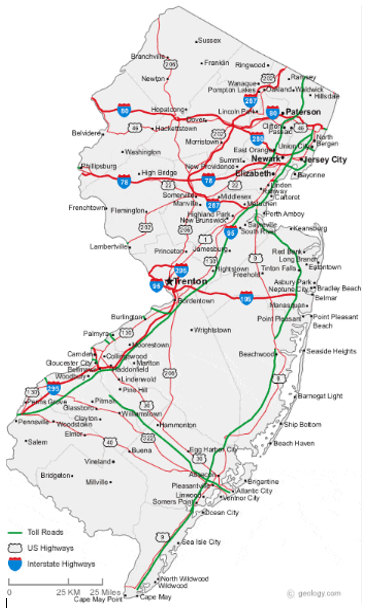
Day Four, Activity 6: Identify your town on a map of New Jersey (Handout 6) and conduct a short research project to discover when they were incorporated and what type of local government (borough, town, township, city) you have.
Day Four: School Districts
Local Boards of Education are made up of members of the community who are elected by their neighbors. The role of the school board is to set policies for the district—it is essentially the “legislative branch”. School Superintendents are the executive branch and carry out the policies set by the board. Challenges to school district policies are brought to Superior Court.
Unlike many other states where educational policy (start and end dates for the school year, school curriculum, etc.) is almost totally set by the state, there is a great deal of local control by local school boards in NJ.
Day Five: Critical thinking activity: Have students consider why we should know about our local government? Have them think about a normal day in their life. Water, roads, schools are all locally controlled. Local government probably has the most influence over our lives. And we have the most control over our local government and school boards because it is run by our neighbors, ourselves. And New Jersey is a very local control state.
Assessment
- Students find three articles (in newspaper, magazines, online, etc.) that represent federalism in the United States today. They should summarize the articles and explain why the issue is controlled by the federal or state government.
- Students conduct a short research project to identify a problem that they think needs to be addressed in your community. Since numerous problems will be identified, have them distinguish which level of government would address each of the problems/issues raised.
Handout 1
From We the People: The Citizen and the Constitution (Center for Civic Education)
Handout 2
Who has the power? The federal or state government?
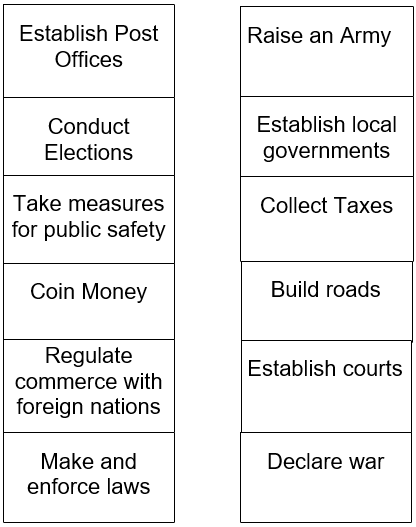
From We the People: The Citizen and the Constitution (Center for Civic Education)
Handout 3
Excerpt from the U.S. Constitution
Article I Section. 8.
The Congress shall have Power
To lay and collect Taxes, Duties, Imposts and Excises, to pay the Debts and provide for the common Defence and general Welfare of the United States; but all Duties, Imposts and Excises shall be uniform throughout the United States;
To borrow Money on the credit of the United States;
To regulate Commerce with foreign Nations, and among the several States, and with the Indian Tribes;
To establish a uniform Rule of Naturalization, and uniform Laws on the subject of Bankruptcies throughout the United States;
To coin Money, regulate the Value thereof, and of foreign Coin, and fix the Standard of Weights and Measures;
To establish Post Offices and post Roads;
To constitute Tribunals inferior to the supreme Court;
To define and punish Piracies and Felonies committed on the high Seas, and Offences against the Law of Nations;
To declare War, grant Letters of Marque and Reprisal, and make Rules concerning Captures on Land and Water;
To provide and maintain a Navy;--And
To make all Laws which shall be necessary and proper for carrying into Execution the foregoing Powers, and all other Powers vested by this Constitution in the Government of the United States, or in any Department or Officer thereof.
Amendment X
The powers not delegated to the United States by the Constitution, nor prohibited by it to the States, are reserved to the States respectively, or to the people.
Handout 4: Who has the Power?
Handout 5:
Separation of Powers at National, State and Local levels
Handout 6: Map of New Jersey: Find your town
New Jersey Women
Lesson creator: The New Jersey Center for Civic Education, Rutgers University, Piscataway, NJ
Grade level: Elementary
Objectives: Students will be able to:
- Explain changes in societal attitudes towards the role of women
- Analyze and evaluate how New Jersey women have contributed to the improvement of society
New Jersey Student Learning Standards for Social Studies (2020):
6.1.5.CivicsPI.1: Describe ways in which people benefit from and are challenged by working together, including through government, workplaces, voluntary organizations, and families.
6.1.5.CivicsPD.2: Explain how individuals can initiate and/or influence local, state, or national public policymaking (e.g., petitions, proposing laws, contacting elected officials).
6.1.5.Civic.DP.1: Using evidence, explain how the core civic virtues and democratic principles impact the decisions made at the local, state, and national government (e.g., fairness, equality, common good).
6.1.5.CivicsDP.2: Compare and contrast responses of individuals and groups, past and present, to violations of fundamental rights (e.g., fairness, civil rights, human rights).
6.1.5.CivicsCM.1: Use a variety of sources to describe the characteristics exhibited by real and fictional people that contribute(d) to the well-being of their community and country.
6.1.5.CivicsCM.5: Investigate the lives of New Jersey individuals with diverse experiences who have contributed to the improvement of society.
6.1.5.HistoryCC.9: Evaluate the impact of ideas, inventions, and other contributions of prominent figures who lived in New Jersey.
6.1.5.HistoryCA.1: Craft an argument, supported with historical evidence, for how factors such as demographics (e.g., race, gender, religion, and economic status) affected social, economic, and political opportunities during the Colonial era.
Essential Questions:
- How have attitudes about women changed?
- How have New Jersey women contributed to the improvement of society?
- How have individuals or groups taken actions to promote the dignity and rights of people?
- How does understanding multiple perspectives help us to make more informed decisions?
- How have events of the past shaped the present?
Procedures/Activities:
Brainstorming Activity. Brainstorm women’s responsibilities through United States history, from colonial times to today. Teachers may use paintings or photos to help students formulate their ideas. Responses may include cooking, cleaning, shopping, taking care of children, nursing, educating children, etc. During the colonial period, the country was primarily agricultural and women worked on the farms alongside men, feeding animals, growing food, making clothing (weaving and sewing) in addition to taking care of the house and children. During the American Revolution, women maintained the farm and the home and children as well as protecting their family, supporting the troops and nursing injured soldiers. As the market economy grew and women no longer made everything for themselves at home, opportunities to work outside the home grew and many women, especially young women and even young girls, supported their family’s income by working in factories, particularly textile factories, weaving and sewing with machines, as well as teaching in schools and working in offices. Follow this activity with a discussion question: In an “information” society with instant communication, how has the role of women changed?
Timeline of New Jersey Women Chart: Share Handout 1 with your students. Have them place the women on a timeline. They may draw representations of the various women, or use symbols, or use images to indicate each woman. Also, have students indicate the overlapping timeframes of some of the lives of some of the women listed. When the the timeline is complete, deepen the students understanding with the following discussion questions;
- Which two 19th century women lived almost contemporaneous lives? (Harriet Tubman and Clara Barton). How were their lives alike? (E.g - They both helped people in need) How were they different? (Answers could relate to race, status, conditions, etc.) Though they lived contemporaneous lives, were there more similarities or differences? What explains that?.
- What trend do you see on the chart?
- There were many New Jersey women born around the turn of the twentieth century who did exceptional things as they grew into adulthood. Why do you think that happened?
Critical thinking activity: Divide students into small groups. Have each group read and become familiar with one of the ten New Jersey women showcased in the lesson. Then have each group share what they learned with the rest of the class. Use the following questions to guide their answers.
- Who is your New Jersey woman? When did she live? What was her connection to New Jersey?
- How did she contribute to society? In your opinion, what was her greatest contribution?
- What were her greatest characteristics? (Teachers may want to provide a list of positive characteristics.)
- Can you picture yourself doing what she did? Why or why not?
- How may you have helped her with her cause?
- How was her life similar or different to the lives of women today? Alternate activity: the teacher may read the background to the full class. Then the teachers can guide discussion with the full class using the same questions.
Design and Presentation of an Award: In small groups of students choose one woman who they feel deserves an Award for Excellent Service to their community. Option 1: Students may use Handout 2: Certificate of Excellence for their award. Have students consider the following suggestions for their Certificate of Excellence:
- On the line under “We hereby present” students write the woman’s name.
- On the line in the middle section of the certificate, students should write WHY this woman deserves the Award of Excellent Service to the Community, explaining in complete sentences specific things she has accomplished.
- On the line after “Awarded on this” students insert the day, month and year.
- The “sponsoring” student or group of students signs the bottom of the certificate.
- If time allows, students may decorate the certificate with a ribbon before presenting it to the class. Option 2: Students may design their own special award. Have students consider the characteristics of the woman and symbolism of her achievement in their design. Finally, have students consider and plan their presentation ceremony. Do they want to have a posthumous ceremony, honoring the person after their death; or do they want to role-play a ceremony that honors the woman while she was alive. For either ceremony, encourage all students to contribute in a significant way to the design of the award and/or to the planning and presentation of the ceremony.
Historical Background:
1. Annis Boudinot Stockton
Born in 1736, Annis Boudinot married Richard Stockton, an attorney from an elite Princeton, New Jersey family. Annis was one of the first women to be published in the Thirteen Colonies. She wrote and published her poems in leading newspapers and magazines of the day and was part of a Mid-Atlantic writing circle. She was the author of more than 120 works, but it was not until 1985, when a manuscript copybook long held privately was given to the New Jersey Historical Society, that most of her works became known. Before that, she was known to have written 40 poems. Annis became known as the "Duchess of Morven", the name of the Stockton estate in Princeton, New Jersey. They entertained prominent guests, including George Washington, with whom she had a correspondence, including numerous poems. She died in 1801.

Portrait of Annis Boudinot Stockton
For additional information see, Annis Boudinot Stockton | George Washington's Mount Vernon); or read My Story: Annis Boudinot Stockton, November 1776 – njcssjournal
2. Molly Pitcher
“Molly Pitcher” was a nickname given to a woman said to have fought in the American Revolutionary War Battle of Monmouth. The name itself may have originated as a nickname given to women who carried pitchers and buckets of water to men on the battlefield during the war. It is generally believed that the woman at the Battle of Monmouth was Mary Ludwig Hays McCauley.
Mary Ludwig was born in 1754, on a farm near Trenton, New Jersey. In 1768, she moved to Carlisle, Pennsylvania, where she met William (also known as John) Hays, a local barber. They married the following year. At the Battle of Monmouth on June 28, 1778, Mary Hays spent much of the early day carrying water to soldiers and artillerymen, often under heavy fire from British troops. The weather was hot, over 100 degrees. Sometime during the battle, William Hays collapsed, either wounded or suffering from heat exhaustion. As her husband was carried off the battlefield, Mary Hays took his place at the cannon. For the rest of the day, in the heat of battle, Mary continued to "swab and load" the cannon using her husband's ramrod. At one point, a British musket ball or cannonball flew between her legs and tore off the bottom of her skirt. Mary supposedly said something to the effect of, "Well, that could have been worse," and went back to loading the cannon. Mary Ludwig Hays McCauley died in 1832.
For additional information, watch the 90-second video about Molly Pitcher at http://youtu.be/QfS7FPP4bNg; or read, Molly Pitcher | American Battlefield Trust)
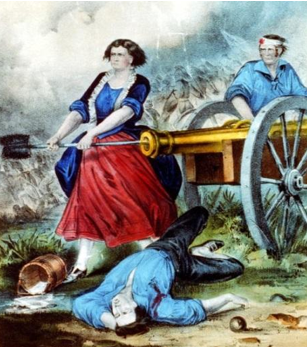
Molly Pitcher at the Battle of Monmouth, Currier and Ives lithograph, Library of Congress
Extension activity: What other roles did New Jersey women play during the American Revolution? Other women helped as spies (Patience Lovell Wright), nurses (Ann Cooper Whitall), and providing housing for soldiers (Theodosia Ford). For more information, go to Meet Your Revolutionary Neighbors at Meet Your Revolutionary Neighbors - Crossroads of the American Revolution.
3. Harriet Tubman
Harriet Tubman was the most famous conductor of the Underground Railroad. Born into slavery around 1820 in Dorchester County, Maryland, Tubman escaped and fled to Pennsylvania in 1849. She worked summers in Cape May, NJ and returned to Maryland and rescued members of her family and others. She made 19 trips into the South and, over a period of ten years, conducted approximately 300 people to freedom in the North across New Jersey to New York City or to Canada, without ever losing any of her charges.
Her formula for success was quite simple: although she frequently changed her routes leading to the North, Ms. Tubman always began the escapes on Saturday nights. This was significant for two reasons. First, slaves were often not required to work on Sunday. Therefore, their owners might not notice their absence until Monday morning. Secondly, newspapers would not be able to report runaway slaves until the beginning of the week. These two facts often gave Tubman and the escapees enough time to get a head start to their destination in the free states. During the Civil War Tubman worked for the Union as a cook, a nurse, and even a spy. After the war she settled in Auburn, New York, where she would spend the rest of her long life. She died in 1913.
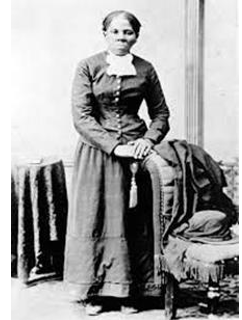
Harriet Tubman
For additional information watch The Life of Harriet Tubman for Kids | Learn facts about Harriet Tubman | Black History Month or read a short biography at Harriet Tubman
4. Abigail Goodwin
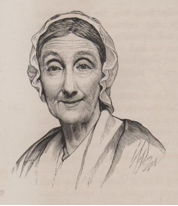
Abigail Goodwin
Less well-known than Harriet Tubman, Abigail Goodwin was responsible for helping hundreds if not thousands of slaves find freedom in the north through the Underground Railroad in New Jersey. Abigail Goodwin (1793-1867) was the daughter of a Quaker farmer in Salem, New Jersey, who had freed his slaves during the American Revolution. She and her sister, Elizabeth, were fervent abolitionists. Abigail was thrown out of the Orthodox Quaker Meeting in Salem for joining a group of radical Quakers fighting for the total abolition of slavery.
Amy Reckless, a slave for one of Salem County’s wealthiest families, first set herself free then returned to Salem. Reckless partnered with the Goodwin sisters in collecting goods and financial contributions to help fugitive slaves escape. By the 1830s, Abigail had emerged as an active figure in the Underground Railroad movement and the Goodwin home became a key station on the Underground Railroad. She often raised money and sent it to abolitionists to purchase slaves in the Carolinas and free them. She provided lodging, food, clothing and money to the fugitives who came to her home to continue their journey.
Due in part to her efforts many slaves living in Delaware, Maryland, and Virginia were aware of this region as a safe haven for runaways. Abigail Goodwin devoted her life to helping runaway slaves and encouraging the end of slavery and she has been noted as one of the most important Underground Railroad agents.
For more information about Abigail Goodwin go to Abigail Goodwin, Quaker Abolitionist | Salem County Cultural & Heritage Commission
5. Clara Barton
Clarissa "Clara" Barton was born in 1821 in Massachusetts. She became an educator in 1838. Barton became interested in providing a good education for all children in the community while visiting a friend in Bordentown, NJ. Although laws existed in New Jersey for free public education, they were never implemented. There were private schools for the wealthy and pauper schools for others. Barton started the nation’s first free public school in Bordentown in 1852 with six children and a one-room school house. By the following year, there were over 600 children in the program, receiving lessons from teachers housed in locations all over the city.
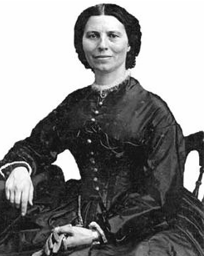
Clara Barton, c. 1866
Clarissa "Clara" Barton was born in 1821 in Massachusetts. She became an educator in 1838. Barton became interested in providing a good education for all children in the community while visiting a friend in Bordentown, NJ. Although laws existed in New Jersey for free public education, they were never implemented. There were private schools for the wealthy and pauper schools for others. Barton started the nation’s first free public school in Bordentown in 1852 with six children and a one-room school house. By the following year, there were over 600 children in the program, receiving lessons from teachers housed in locations all over the city.
In 1855, Barton moved to Washington D.C. and began work as a clerk in the U.S. Patent Office. This was the first time a woman had received a substantial clerkship in the federal government and at a salary equal to a man's salary. Subsequently, under political opposition to women working in government offices, her position was reduced to that of copyist, and then eliminated entirely. At a time when relatively few women worked outside the home, Barton never married and built a career helping others. With the outbreak of the Civil War, Barton set up a system of procurement getting food and comfort to both sides of the conflict. In 1864 she was appointed by the Union as “lady in charge" of the hospitals at the front along the James River in Virginia. She became known as the "Angel of the Battlefield."
After the war, Barton ran the Office of Missing Soldiers and created a network to help families find and reunite with their loved ones. As the war ended, she helped locate thousands of missing soldiers, including identifying the dead at Andersonville prison in Georgia. Barton lobbied for U.S. recognition of the International Committee of the Red Cross, and became president of the American branch when it was founded in 1881. Barton continued her humanitarian work throughout several foreign wars and domestic crises before her death in 1912.
For additional information, visit Clara Barton Biography; or watch a short video at Clara Barton - Famous Nurse | Mini Bio | BIO
6. Elizabeth White
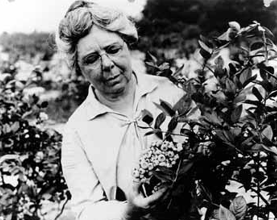
Elizabeth White
Elizabeth Coleman White (1871-1954) grew up on her father's cranberry farm in Whitesbog, an agricultural community in the Pine Barrens in Pemberton Township, New Jersey. Whitesbog was the largest cranberry farm in the state and its founder (her father) was a nationally recognized leader in the cranberry industry. At the time, people did not believe that blueberries could be domesticated. In 1911, Elizabeth White became interested in blueberry propagation and, using her father's farm, she collaborated with Dr. Frederick Coville, a U.S. Department of Agriculture botanist, to identify wild blueberry plants with the most desirable properties, crossbreed the bushes and create vibrant new blueberry varieties based on wild varieties. By 1916, they had developed blueberry plants that could be grown and sold commercially. In 1927, she helped to start the New Jersey Cooperative Blueberry Association. Thanks to Elizabeth White, blueberries are now produced in 38 states, with only Michigan producing more than in New Jersey!
For additional information on Elizabeth White, see Elizabeth Coleman White - New Jersey Women's History; or read and view video at Elizabeth Coleman White – New Jersey Hall of Fame.
7. Alice Paul
Alice Paul was born in 1885 to a Quaker family. Her father was a successful businessman and the family lived at Paulsdale, a 173-acre farm in Mt. Laurel, New Jersey. Her Quaker family supported gender equality and the need to work for the betterment of society. Alice Paul graduated from Swarthmore College and was the commencement speaker. She worked in the settlement movement in New York and went to study social work in England, where she met radical suffragettes, who used public action and protests to bring attention to the secondary status of women. Paul soon joined the movement and was arrested several times.
She returned to the U.S. and joined with Lucy Burns to work for the passage of a constitutional amendment ensuring women’s right to vote in the United States. They organized a publicity event—a parade of several thousand women in Washington, D.C., in March 1913, the day before Woodrow Wilson’s inauguration. Although planned as an elegant progression of symbolically dressed, accomplished, and professional women, the parade quickly devolved into a riot. Paul used this event to rally public opinion to the women's cause. In 1916, Paul stood with other radical suffragists outside the White House holding banners demanding the right to vote and criticizing President Wilson.
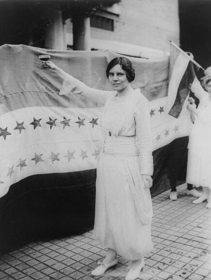
Alice Paul, 1920 LC USZ262-20176
After the U.S. entered World War I in 1917, the picketers began to be arrested and sent to a Workhouse in Virginia. They staged hunger strikes and were beaten and force fed. The growing public support for the women led President Wilson to endorse a Constitutional Amendment to grant women the right to vote in 1917 and the Nineteenth Amendment, which gave the right to vote to women in the United States, was passed in 1919 and became law the following year, thanks to Alice Paul and her fearless colleagues. Paul died in 1977.
For additional information, see the 90-second video about Alice Paul at Alice Paul, Women's Rights Activist; or read at Dr. Alice Paul (U.S. National Park Service)
8. Mary Roebling
Mary Gindhart was born in West Collingswood, New Jersey on July 29, 1905. In 1921, at the age of sixteen, Mary married a young soldier and musician named Arthur Herbert. They had a daughter but Arthur died of blood poisoning in 1924. After the death of her husband, Mary moved in with her parents and became a secretary in a Philadelphia brokerage house while taking night classes in business administration and merchandising at the University of Pennsylvania. At the brokerage house, she met Siegfried Roebling who ran one of the family's businesses, the Trenton Trust Company. They married in 1931 and had a son before tragedy befell Mary and her second husband died in 1936.
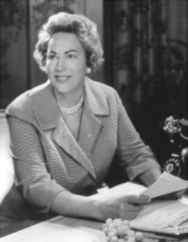
Mary G. Roebling, 1964
Mary Roebling inherited Trenton Trust stock from her husband and assumed his seat on the Trenton Trust Company board. She was elected president of the board on January 21, 1937, becoming the first woman to serve as president of a major American bank. Roebling established innovative practices of public relations and merchandising, as well as drive-in banking and a railroad station branch for Trenton commuters. Under her leadership, Trenton Trust's assets increased from 17 to 137 million in a twenty-eight year period. She served on the board until 1972 when the bank merged with National State and then chaired the combined banks until 1984. Roebling also served as the first female governor of the American Stock Exchange from 1958-1962..
Throughout her life, Mary Roebling was a strong supporter of equal rights for women. Her goal was "equal pay for equal work with equal opportunity for advancement." The promotion of women in business was extremely important to her. She felt that companies were not using women to their fullest advantage, and that women were concentrated in lower-echelon jobs and paid accordingly. She died on October 25, 1994 at her home in Trenton, NJ.
For additional information see and view video at mary-roebling; or read mary-herbert-roebling.
9. Anne Morrow Lindbergh
Writer and aviation pioneer, Anne Morrow was born in 1906 in Englewood, NJ. In 1929 she married famed aviator Charles Lindbergh and much of the early years of their marriage was spent flying. In 1931 they journeyed in a single-engine plane over Canada and Alaska, and on to Japan and China. The flight was the inspiration for Morrow Lindbergh's first book, "North to the Orient." In 1934, the National Geographic Society awarded her its Hubbard Gold Medal for her accomplishment of 40,000 miles of exploration flying over five continents with her husband. In addition, she was awarded the Cross of Honor of the U.S. Flag Association in recognition of her successes in surveying transatlantic air routes. She was also the first licensed female glider pilot in the United States.
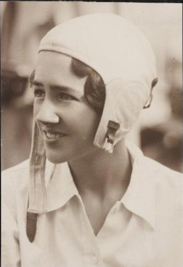
Anne Morrow Lindbergh
Anne Morrow Lindbergh was an acclaimed author whose books and articles spanned the genres of poetry to non-fiction, touching upon topics as diverse as youth and age; love and marriage; peace, solitude and contentment, as well as the role of women in the 20th century. Her 1956 book, Gifts from the Sea, presented eight inspirational essays concerning the meaning of a woman's life and was on the best seller list for months. She died in 2001.
For additional information see and view video at Anne Morrow Lindbergh – New Jersey Hall of Fame; or read at Anne Morrow Lindbergh | American Experience | Official Site | PBS
10. Virginia Apgar
Virginia Apgar was born in 1909 in Westfield, NJ, where she was raised. She graduated from Mount Holyoke College, where she studied zoology with minors in physiology and chemistry, and from the Columbia University College of Physicians in 1933. In 1949, Apgar became the first woman to become a full professor at the Columbia University’s medical college, where she did clinical and research work. In 1953, she introduced the first test, called the Apgar score, to assess the health of newborn babies. The Apgar score is calculated based on an infant's condition at one minute and five minutes after birth.
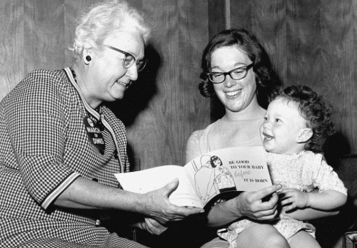
As part of the March of Dimes campaign to prevent birth defects, Dr. Apgar advises mother to “Be Good to Your Baby before It is Born;” c. 1986
In 1959, Apgar left Columbia and earned a Master of Public Health degree from Johns Hopkins University. Also starting in 1959 until her death in 1974, Apgar worked for the March of Dimes Foundation, serving as vice president for Medical Affairs and directing its research program to prevent and treat birth defects. Because gestational age is directly related to an infant’s Apgar score, Apgar was one of the first at the March of Dimes to bring attention to the problem of premature birth, now one of the March of Dimes top priorities. During this time, she wrote and lectured extensively, authoring articles in popular magazines as well as research work.
For additional information, see Virginia Apgar | National Women's History Museum or Apgar, Virginia | Women of the Hall
11. Millicent Fenwick
Millicent Hammond was born in New York City, on February 25, 1910. Her father, Ogden Haggerty Hammond, was a wealthy financier and New Jersey state legislator; her mother, Mary Picton Stevens Hammond, died aboard the U.S.S. Lusitania in 1915. Millicent accompanied her father to Madrid when President Calvin Coolidge appointed him U.S. Ambassador to Spain. She attended Columbia University and later studied at the New School for Social Research. In 1934, she married businessman Hugh Fenwick, and they raised two children. After the Fenwicks divorced in 1945, she modeled briefly for Harper’s Bazaar and then took a job as associate editor on the staff of Condé Nast’s Vogue magazine. In 1948, she wrote Vogue’s Book of Etiquette, a 600–page “treatise on proper behavior,” which sold more than a million copies. Fenwick left Vogue in 1952 and inherited a fortune when her father passed away a few years later.
Fenwick joined the National Conference of Christians and Jews in an attempt to counter anti–Semitic propaganda in the United States after Hitler came to power in Germany in the 1930s and the National Association for the Advancement of Colored People in 1946. She served on the Bernardsville, New Jersey, board of education; and then as a member of the Bernardsville borough council. Her first campaign for state office was in 1970 when she won a seat in the New Jersey State Assembly at the age of 59. Fenwick served several years in the State Assembly before New Jersey Governor William Cahill appointed her the state’s first director of consumer affairs.

Congresswoman Millicent Fenwick
Elected to Congress in 1974, Millicent Fenwick was an outspoken patrician who served four terms; earned the epithet “Conscience of Congress” with her fiscal conservatism, human rights advocacy, and dedication to campaign finance reform. Fenwick’s blueblood mannerisms, which were inspiration for a popular comic strip character, belied her lifelong commitment to liberal activism on behalf of consumers, racial minorities, and women’s rights. Although she was a fiscal conservative, Fenwick supported liberal social issues, such as equal rights, food stamps, abortion, and human rights. Fenwick retired in 1987 and died in 1992.
For additional information watch Millicent Fenwick; or read and view video at NJ Hall of Fame.
Assessment
Students individually write short essays or groups of students work together to orally present an analysis of how one or more New Jersey women had contributed to the improvement of society.
Alternatively, students write or orally report on how the role of women has changed over time.
Additional Resources
For information about these and other New Jersey women go to New Jersey Women's History
Extension
1. Use materials from the Council for Economic Education’s EconEdLink website EconEdLink to:
- Understand that people earn income by exchanging their human resources (physical or mental work) for wages or salaries.
- Explore the education and training requirements for various careers.
- Evaluate interest in various careers.
2. The homes of many of New Jersey’s celebrated women have been maintained as historic sites and may be visited for additional understanding. Take a field trip to one or more of the following:
- Morven. Originally part of a 5,500-acre tract purchased from William Penn in 1701 by the Stockton family, it became the home of Richard and Annis Stockton. Located at 55 Stockton Street, in Princeton, the building has been designated as a National Historic Landmark. From 1944 to 1981 it was the official residence of New Jersey’s Governor. Since then, it has become a museum and garden. See Morven Museum & Garden
- Monmouth Battlefield Park. This was the site of one of the largest battles of the American Revolution, where Molly Pitcher filled the spot of her fallen husband. The battle ended in a standoff. Each year the Friends of Monmouth Battlefield co-sponsors, with the NJ Department of Environmental Protection, an annual reenactment of the battle. The event is usually held on a weekend at the end of June, in commemoration of the anniversary of the battle being fought on June 28, 1778. See Monmouth Battlefield State Park - State Parks, Forests & Historic Sites
- The Goodwin Sisters House was the first site in New Jersey accepted into the National Park Service’s National Underground Railroad Network to Freedom Program. It is privately owned by a direct descendent of the Goodwin family and not regularly open to the public. However, the house is a site on the New Jersey Women’s Heritage Trail. See Abigail Goodwin, Quaker Abolitionist | Salem County Cultural & Heritage Commission
- Whitesbog includes the village and the surrounding 3,000 acres of cranberry bogs, blueberry fields, reservoirs, sugar sand roads and Pine Barren’s forests. It is listed on both the National and State Registers of Historic Sites. Whitesbog Village’s grounds are open 365 days a year as part of the Brendan T. Byrne State Forest. The Village buildings are only opened for scheduled events, pre-arranged tours and by special request. See Whitesbog Preservation Trust
- Paulsdale, in Mt. Laurel, NJ, is the home of Alice Paul. The house has been restored to the condition when Paul lived there. It now serves as a historic house museum and a home for the Alice Paul Institute. Visit – Alice Paul Center for Gender Justice
- The New Jersey Women’s Heritage Trail will lead you to the historic places that tell the collective story of a few of these famous women, and many of the more private women, who contributed to the agricultural, industrial, labor and domestic history of the state. Although women have always comprised over half of the state’s population, the tales of women’s contributions to New Jersey history often have been omitted from our telling of history. The Heritage Trail brings to life the vital role of women in New Jersey’s past and present. nj women's heritage trail - Historic Sites
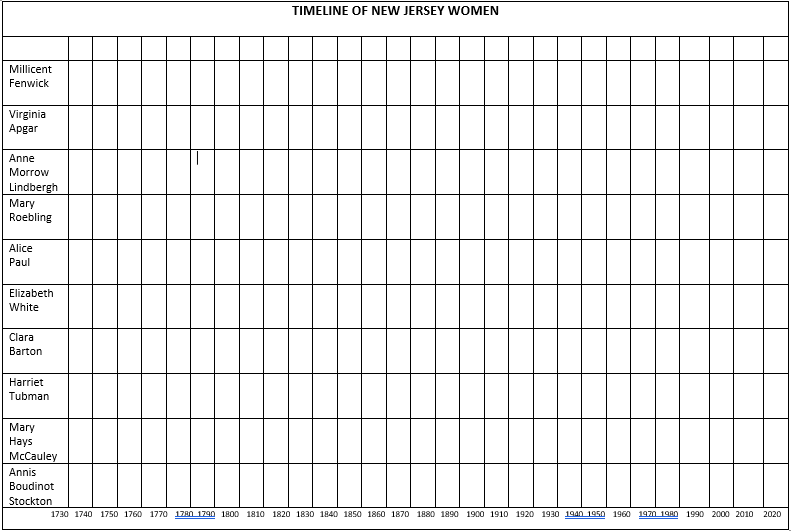
TIMELINE OF NEW JERSEY WOMEN
Millicent Fenwick
Virginia Apgar
Anne Morrow Lindbergh
Mary Roebling
Alice Paul
Elizabeth White
Clara Barton
Harriet Tubman
Mary Hays McCauley
Annis Boudinot Stockton
1730 1740 1750 1760 1770 1780 1790 1800 1810 1820 1830 1840 1850 1860 1870 1880 1890 1900 1910 1920 1930 1940 1950 1960 1970 1980 1990 2000 2010 2020
Certificate of Excellence
We hereby present
____________________________________________
with this certificate of recognition for her contributions to
New Jersey history for:
__________________________________________________________________
__________________________________________________________________
____________________________________________________________________________________________________________________________________
 Awarded on this ____ day of ____________________
Signed __________________
__________________
__________________
__________________
New Jersey’s Judiciary
Scales of Justice
Lesson Creator: The New Jersey Center for Civic Education, Rutgers University, Piscataway, NJ.
Grade Level: Elementary
Objectives: Students will be able to:
- Identify the structure of New Jersey’s court system
- Analyze how procedural due process protects fairness
- Explain why judges must be impartial
- Explain why judicial independence is important
Time Required: Three-four class periods
New Jersey Student Learning Standards for Social Studies (2020):
6.1.5.CivicsPI.2: Investigate different ways individuals participate in government (e.g., voters, jurors, taxpayers)
6.1.5.Civic.DP.1: Using evidence, explain how the core civic virtues and democratic principles impact the decisions made at the local, state, and national government (e.g., fairness, equality, common good).
6.1.5.CivicsDP.2: Compare and contrast responses of individuals and groups, past and present, to violations of fundamental rights (e.g., fairness, civil rights, human rights).
6.1.5.CivicsPR.1: Compare procedures for making decisions in a variety of settings including classroom, school, government, and /or society.
Essential Questions:
- What is the structure of the state court system in New Jersey?
- What is procedural due process and why is it important?
- What is the role of a judge?
- What is the role of a juror?
- Why is judicial independence important in a democracy?
Vocabulary
- Procedural Justice
- Trial
- Jury
- Juror
- Judge
- Impartial
Day One: Background Vocabulary discussion
What is a trial?
A trial is a formal examination of evidence before a judge, and typically before a jury, in order to decide guilt in a case of criminal or responsibility in civil proceedings. The trial must follow due process rules that ensure that it is conducted impartially.
What is the role of a judge?
Judges, who are appointed in New Jersey but elected in most states, preside over court proceedings, including civil and criminal cases. The judge must conduct the trial impartially. The judge gives instructions to the jury and in cases with no juries, decides on the facts and the rulings.
What does “impartial” mean and why is it important?
Impartial means fair, objective unbiased. Court decisions should be based on objective criteria, rather than on the basis of bias, prejudice, or preferring the benefit to one person over another for improper reasons.
Why is it important for judges to be impartial? The Framers and the ratifiers considered that a fair and impartial judiciary — one that followed the law and was not biased, partisan, intimidated or seeking preferment — was central to a republican form of government. They believed that judicial independence was critical to fairness and impartiality. This was important so that the public would have faith in the decisions of the courts.
What is the role of a juror?
A jury is a body of people from the community who are summoned to a trial to consider the evidence introduced and decide the facts in accordance with the principles of law laid down by the judge’s charge to the jury. Juries developed in England during the Middle Ages, and are a hallmark of the British common law legal system.
Day One: The structure of New Jersey’s state court system
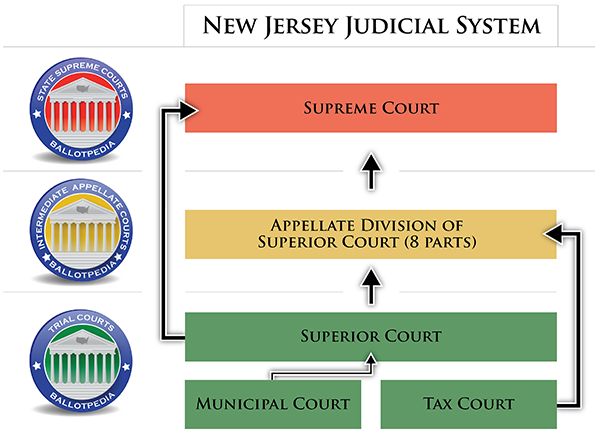
Share Handout 1 with your students. Ask: How many kinds of courts are there in New Jersey? There are several levels are courts in New Jersey: Municipal courts, Trial Courts, Appellate Courts and the New Jersey State Supreme Court. Discuss the scope and function of the various state courts.
Municipal courts
A municipal court is a local court in a city or town. Some smaller towns or townships might share a municipal court. Municipal courts have limited jurisdiction. That means that they only handle certain kinds of court cases. Municipal courts primarily handle parking and traffic tickets, minor criminal offenses and violations of local ordinances. Municipal court cases are decided by judges, not juries.
Trial Courts
A trial helps people who disagree resolve their disagreement without fighting. A trial helps the court find out if someone broke the law or caused harm to someone. Trials are a much better way to deal with a disagreement than fighting. For this reason, trials play an important role in a peaceful society. Trials only work if everyone involved in them agrees that they are fair and just. Otherwise, they might not agree to live with the outcome of the trial. Every trial has a plaintiff, the person or business that brought a complaint to court—an announcement that a person, group or entity has harmed the plaintiff. In criminal cases, the plaintiff is the State of New Jersey representing the people of the state. It is the government's job to make sure people who break the law are caught and punished.
Criminal trials always require a jury. A judge may decide a case alone in certain civil cases such as (1) family matters, such as divorce, adoption, or custody hearings, (2) Tenant/landlord disputes, (3) collections issues, (4) Drinking while driving or other municipal court cases where no injuries took place, (5) juvenile court issues, (6) workers compensation cases, (7) probate or chancery cases.
Appellate courts
The Superior Courts of New Jersey include a Trial Division and an Appellate Division. The judges on the Appellate Division review the cases sent to them from the trial division.
New Jersey State Supreme Court
The state supreme court in New Jersey includes seven justices appointed by the governor. The New Jersey State Supreme Court only hears certain cases:
1. A case about a new law;
2. Where the two or three Appellate Division judges do not agree with each other on how a case should be decided;
3. An inconsistency in decisions;
4. A case that has been appealed and the Supreme Court believes that it is so important that it could affect many of New Jersey’s citizens for years to come.
United States Courts
The U.S. Constitution is the supreme law of the land in the United States. It creates a federal system of government in which power is shared between the federal government and the state governments. Due to federalism, both the federal government and each of the state governments have their own court systems. State courts make the final decisions involve state law and constitution. Federal courts interpret federal laws and the U.S. Constitution. When state courts decisions involve the interpretation of federal law or the U.S. Constitution, they may be appealed to the U.S. appellate courts.
Day Two: Procedural Justice
Procedural justice refers to the fairness of the procedure used to gather information and make decisions. Police often need information about people they think have broken the law. How they get this information is important. Courts have procedures for gathering information and making decisions that include:
- the right to tell your side of the story
- the right to have a friend or lawyer help tell your side of the story
- the right to have witnesses who support you
- the right to question witnesses who testify against you
- the right to an impartial judge and jury
Local school boards, city councils, the president of the United States and Congress all need to gather information and make decisions, using fair procedures.
Procedural justice is important because it:
- increases the chances of getting the information needed to make wise and fair decisions.
- ensures the wise and fair use of the information in making decisions.
- Protects important individual rights, such as freedom, liberty and dignity.
Critical Thinking Activity: Have students identify the procedural justice issue in each of these situations:
1. Rosie thought someone in the class had taken her radio. During recess while everybody was on the playground, Rosie went back into the classroom and searched every desk.
This is not procedural justice. Student desks cannot be secretly searched. And Rosie is not an appropriate authority to search desks.
2. The police arrested Jed for kidnapping. Jed’s lawyer asked for a trial by jury. Twelve juror had e to be chosen from a group of 100 people. Jed’s lawyer had the right to questions each person. She could refuse to accept people she thought might be prejudiced against Jed.
This is part of procedural justice. The lawyer for a defendant in a criminal case has the right to question the potential jurors to eliminate people who might be prejudiced against the defendant.
From Foundations of Democracy: Justice, for elementary grades (4th ed)(Center for Civic Education, 2020)
Assessment:
Ask students to explain orally or in writing one of the following:
- Why is procedural due process important for fairness
- What the role of a jury is
- Why is it important for the judiciary to be independent of the other branches of government.
Extension:
- Have students participate in the New Jersey State Bar Foundations’ annual mock trial law fair for grades 3-6. For information, go to https://njsbf.org/school-based-programs/mock-trial/law-fair-competition-for-grades-3-to-6/
- Engage students in the New Jersey State Bar Foundation’s activities for elementary students at https://njsbf.org/school-based-programs/mock-trial-civics-online-content/
Handout 1
New_Jersey_State_Court_Flow_Chart.png (600 × 464 pixels, file size: 113 KB, MIME type: image/png)
A Mock Trial In New Jersey
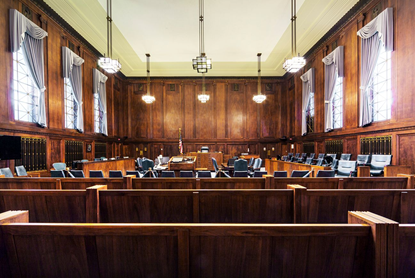
A Courtroom
Lesson Creator: Laura Oliynik, White Rock School, Jefferson Township, NJ
Grade Level: Elementary
Objectives: Students will be able to:
- Explore procedural due process by conducting a mock trial
- Explain how a jury trial is conducted.
Time Required: Two-Three class periods
New Jersey Student Learning Standards for Social Studies (2020):
6.1.5.CivicsPR.1: Compare procedures for making decisions in a variety of settings including classroom, school, government, and /or society.
Essential Questions:
- What is a trial?
- What is a “mock trial”?
- What is the role of a judge?
Materials:
- Judicial Branch reading and vocabulary terms
- 1 mock trial script for each student
- jury duty slips
- juror badges
- classroom set up like a courtroom
- graduation gown (for judge to wear)
- gavel (optional, can usually get a plastic one at a party store or online)
- verdict slips
- props may include a bible or dictionary for witnesses to be sworn in, a lunchbox as evidence
Vocabulary:
- Procedural Justice
- Trial
- Appellate
- Jury
- Juror
- Judge
- Impartial
Day One: Background Vocabulary discussion
What is a trial?
A trial is a formal examination of evidence before a judge, and typically before a jury, in order to decide guilt in a case of criminal or responsibility in civil proceedings. The trial must follow due process rules that ensure that it is conducted impartially.
What is a “mock trial”?
A mock trial is a simulation or enactment of a judicial proceeding in a trial court.
What is the role of a judge?
Judges, who are appointed in New Jersey but elected in most states, preside over court proceedings, including civil and criminal cases. The judge must conduct the trial impartially. The judge gives instructions to the jury and in cases with no juries, decides on the facts and the rulings.
What does “impartial” mean and why is it important?
Impartial means fair, objective unbiased. Court decisions should be based on objective criteria, rather than on the basis of bias, prejudice, or preferring the benefit to one person over another for improper reasons.
Why is it important for judges to be impartial? The Framers and the ratifiers considered that a fair and impartial judiciary — one that followed the law and was not biased, partisan, intimidated or seeking preferment — was central to a republican form of government. They believed that judicial independence was critical to fairness and impartiality. This was important so that the public would have faith in the decisions of the courts.
What is the role of a juror?
A jury is a body of people from the community who are summoned to a trial to consider the evidence introduced and decide the facts in accordance with the principles of law laid down by the judge’s charge to the jury. Juries developed in England during the Middle Ages, and are a hallmark of the British common law legal system.
Day Two: Procedural Justice
Procedural justice refers to the fairness of the procedure used to gather information and make decisions. Police often need information about people they think have broken the law. How they get this information is important. Courts have procedures for gathering information and making decisions that include:
- the right to tell your side of the story
- the right to have a friend or lawyer help tell your side of the story
- the right to have witnesses who support you
- the right to question witnesses who testify against you
- the right to an impartial judge and jury
Day Two and Three: Conducting a Mock Trial:
Prior to the mock trial day, do the following:
- Involve your students in the lesson about New Jersey’s Judiciary at https://civiced.rutgers.edu/nj-
- Discuss court case vocabulary (Handout 1) with students
- Share Handout 4: The Facts, with your students
- Choose 5 students for reading parts- More fluent readers should be attorneys and defendant, less fluent readers could be witnesses. Give them highlighted scripts (Handout 7) ahead of time and make sure they are comfortable with having a reading part. Tell them to read over their parts before mock trial day.
- The rest of the students will be jurors. Hand out “Jury Duty” slips (Handouts 2 and 3) that let them know where and when they will need to report for jury duty.
- Plan for setting up a classroom as a courtroom, and plan for props.
On mock trial day, set up classroom to look like a courtroom.
- Line both sides of the classroom with desks for jurors to sit, and middle should be for attorneys, defendant, and witnesses.
- Jurors will enter. Give them each a badge and a script to follow. They should also have a form to fill out with the verdict choices (Handout 6).
- Once everyone is in their places, go through the mock trial script, with the jurors listening to details. At the end, the attorneys, witnesses, and defendant can sit outside for a few minutes while the jury deliberates. Call everyone back together when they are ready and read the verdict.
At the end of the mock trial, discuss why it is better for a group of people to be on a jury instead of just one person and what “innocent until proven guilty” means? (this can also be written out on the ticket out slip—Handout 8).
Assessment:
Student participation in Mock Trial, Ticket Out Slip Responses
Extension:
- Have students participate in the New Jersey State Bar Foundations’ annual mock trial law fair for grades 3-6. For information, go to https://njsbf.org/school-based-programs/mock-trial/law-fair-competition-for-grades-3-to-6/
- Engage students in the New Jersey State Bar Foundation’s activities for elementary students at https://njsbf.org/school-based-programs/mock-trial-civics-online-content/
Handout 1: COURT CASE GLOSSARY
ATTORNEY- a lawyer
PROSECUTING ATTORNEY- a lawyer who works for the state government that is trying to prove that the criminal is guilty
DEFENSE ATTORNEY- a lawyer who works for the accused criminal who is trying to prove that he/she is not guilty
DEFENDANT- the person who is accused of a crime
WITNESS- Someone who was present at the time of a crime
GUILTY- having committed a crime
NOT GUILTY- NOT having committed a crime
OBJECTION- when someone does not approve of what is being said, something is unfair
SUSTAINED- to support an objection, to agree that something was not fairly said
VERDICT- the decision made by the jury
JUROR/JURY- a group of people who make the decision or verdict in a court case
ADJOURN- to end or postpone a case
Handout 2: Juror Summons
JUROR SUMMONS
The Judiciary welcomes your participation as a juror. Jury service is one of the highest duties of a citizen, and we recognize the sacrifices you are making in terms of your time and energy. We hope that your juror experience will be interesting and that you take satisfaction from your contribution to the administration of justice in New Jersey.
YOU MUST REPORT TO _________________________(classroom location)
ON _______________ (date) AT _______________(time).
N.J.S. 2B:20-14b. Every person summoned as a grand or petit juror who shall either fail to appear or refuse, without reasonable excuse, to serve, shall be liable for a fine not to exceed $500 ... or may be punished for contempt of court.
(Summons created for educational purposes with wording from http://www.judiciary.state.nj.us/pressrel/OFFICIAL%20BUSINESS%20JURY.pdf)
JUROR SUMMONS
The Judiciary welcomes your participation as a juror. Jury service is one of the highest duties of a citizen, and we recognize the sacrifices you are making in terms of your time and energy. We hope that your juror experience will be interesting and that you take satisfaction from your contribution to the administration of justice in New Jersey.
YOU MUST REPORT TO _________________________(classroom location)
ON _______________ (date) AT _______________(time).
N.J.S. 2B:20-14b. Every person summoned as a grand or petit juror who shall either fail to appear or refuse, without reasonable excuse, to serve, shall be liable for a fine not to exceed $500 ... or may be punished for contempt of court.
(Summons created for educational purposes with wording from http://www.judiciary.state.nj.us/pressrel/OFFICIAL%20BUSINESS%20JURY.pdf)
JUROR SUMMONS
The Judiciary welcomes your participation as a juror. Jury service is one of the highest duties of a citizen, and we recognize the sacrifices you are making in terms of your time and energy. We hope that your juror experience will be interesting and that you take satisfaction from your contribution to the administration of justice in New Jersey.
YOU MUST REPORT TO _________________________(classroom location)
ON _______________ (date) AT _______________(time).
N.J.S. 2B:20-14b. Every person summoned as a grand or petit juror who shall either fail to appear or refuse, without reasonable excuse, to serve, shall be liable for a fine not to exceed $500 ... or may be punished for contempt of court.
(Summons created for educational purposes with wording from http://www.judiciary.state.nj.us/pressrel/OFFICIAL%20BUSINESS%20JURY.pdf)
JUROR SUMMONS
The Judiciary welcomes your participation as a juror. Jury service is one of the highest duties of a citizen, and we recognize the sacrifices you are making in terms of your time and energy. We hope that your juror experience will be interesting and that you take satisfaction from your contribution to the administration of justice in New Jersey.
YOU MUST REPORT TO _________________________(classroom location)
ON _______________ (date) AT _______________(time).
N.J.S. 2B:20-14b. Every person summoned as a grand or petit juror who shall either fail to appear or refuse, without reasonable excuse, to serve, shall be liable for a fine not to exceed $500 ... or may be punished for contempt of court.
(Summons created for educational purposes with wording from http://www.judiciary.state.nj.us/pressrel/OFFICIAL%20BUSINESS%20JURY.pdf)
Handout 3: Jurors
Group #1 Juror #____
JUROR
Group #1 Juror #____
JUROR
Group #1 Juror #____
JUROR
Group #1 Juror #____
JUROR
Group #1 Juror #____
JUROR
Group #1 Juror #____
JUROR
Group #1 Juror #____
JUROR
Group #1 Juror #____
JUROR
Handout 4: The Facts
The Facts
A fourth grader at _________ School named Harry Stickyfingers has been accused of stealing lunches from students who bring their lunches to school. He has been committing these crimes while classes have been gone for their morning specials. Last week, he was eating a lunch that was declared stolen earlier that day. Harry claims he just happened to have the same lunch as someone else.
Handout 5: Roles
For this mock trial, I am a: (circle one)
Judge
Juror
Prosecuting Attorney
Defendant
Defense Attorney
Witness
Handout 6: Notes Section for Juror: As you listen to the case, you may list notes below from the case of evidence that Harry is guilty or not guilty.
Evidence Harry is GUILTY Evidence Harry is NOT GUILTY
JUROR VERDICT SECTION:
Based on the evidence of the case, I determine that Harry Stickyfingers is:
GUILTY of stealing the lunchbox*
NOT GUILTY of stealing the lunchbox
*If you chose GUILTY, select one punishment below:
Harry Stickyfingers will have to spend his recess time in the principal’s office for two weeks.
Harry Stickyfingers will have to spend his recess time cleaning the cafeteria for one month.
Harry Stickyfingers will eat his lunch in the office for two weeks, and lose recess for one week.
Name:____________________________________
Handout 7: Mock Trial Script
SCENE: A courtroom. The judge is seated at the front of the room. The prosecutor’s side is in front of the judge to the left and the defendant’s side is in front of the judge to the right. The witnesses are seated behind two sides and the jurors are seated to the side of the court floor.
THE HONORABLE JUDGE (Hit Gavel): This is the case of Harry Stickyfingers versus _________ Elementary School. As I understand the pleadings, the charge against Mr. Stickyfingers is stealing from school property. Now, are there any opening statements?
DEFENDING LAWYER: Your honor, in this case, we will show that on October 10, the defendant Harry Stickyfingers was indeed out of his classroom at the time that the lunches were stolen. However, we have a witness who will testify to prove that there is no way that Harry could have stolen the lunches. He was busy doing other things with his school day. We will show that it is impossible for Harry to have stolen the lunches, and explain where the lunch he was eating came from.
THE HONORABLE JUDGE: Does the Attorney against Mr. Stickyfingers have any opening statement?
PROSECUTING ATTORNEY: Your honor, any suggestion that Mr. Stickyfingers is innocent of this crime is ridiculous. We will show that the lunch that Mr. Stickyfingers was eating was a stolen lunch and not his. Also, we will prove that Mr. Stickyfingers was seen near the classrooms where lunches were stolen at the time of their disappearances. This is just the latest in a long line of inappropriate and downright inconsiderate actions shown by Mr. Harry Stickyfingers.
THE HONORABLE JUDGE: Very well, please call your first witness.
PROSECUTING ATTORNEY: I call Victoria to the stand as my first witness.
VICTORIA (gets up, stands next to seat by the judge to be sworn in):
THE HONORABLE JUDGE: Please raise your right hand. Do you swear that the evidence that you are about to give is the truth, the whole truth, and nothing but the truth?
VICTORIA: I do.
THE HONORABLE JUDGE: Please be seated.
PROSECUTING ATTORNEY: Please state your name.
VICTORIA: My name is Victoria. I am in Mrs. McNeal’s fourth grade class.
PROSECUTING ATTORNEY: And do you bring your lunch to school? Or do you buy lunch?
VICTORIA: Well, I usually buy regular lunch. But earlier this month, it was my birthday, and I got a special lunch packet just for me!
PROSECUTING ATTORNEY: And how was your lunch for your birthday?
VICTORIA (gets emotional): It was…terrible! I never got to eat it! My beautiful lunchbox, my Pringles, my peanut butter and fluff sandwich, my Capri Sun….they were…. STOLEN!
PROSECUTING ATTORNEY: That is awfully unfortunate, Miss Victoria. And when did you notice that your lunch was stolen?
VICTORIA: Right after library at 10:40. I went to put my new books in my backpack, and my lunch was gone from the closet shelf.
PROSECUTING ATTORNEY: And did you ever find your lunch?
VICTORIA: No, but I found my lunchbox out by the swings. It was….. empty.
PROSECUTING ATTORNEY: So Miss Victoria, there is a clear possibility that someone could have stolen your lunch, ON YOUR BIRTHDAY, and eaten it?!
VICTORIA: That could be the only explanation.
PROSECUTING ATTORNEY: Thank you, Miss Victoria. Your honor, for my second witness, I call Mr. Harry Stickyfingers to the stand.
HARRY: (gets up, stands next to the seat by the judge to be sworn in)
THE HONORABLE JUDGE: Please raise your right hand. Do you swear that the evidence that you are about to give is the truth, the whole truth, and nothing but the truth?
HARRY: I do.
THE HONORABLE JUDGE: Please be seated.
PROSECUTING ATTORNEY: Please state your name.
HARRY: My name is Harry Stickyfingers. You can call me Harry… or Sticky.
PROSECUTING ATTORNEY: Um, no thanks. Tell me, Harry, where were you on October 10th between 10:20 and 10:40?
HARRY: I was in my classroom doing centers!
PROSECUTING ATTORNEY: You didn’t leave at ALL?!
HARRY: Well, let me think here…I remember I was REALLY busy that day. I almost forgot to go to my band lesson! So I ran down the hall to my lesson, but it was cancelled anyway.
PROSECUTING ATTORNEY: You didn’t stop anywhere on the way back?
HARRY: Nope.
PROSECUTING ATTORNEY: Not even to STEAL a birthday lunch?
DEFENSE ATTORNEY: OBJECTION!!! The prosecution is bothering my client!
THE HONORABLE JUDGE: Sustained. Please get to the facts, prosecutor.
PROSECUTING ATTORNEY: Well then, Harry, let me ask you this: the lunch you were found eating that day, what color was the lunch bag?
HARRY: Well, it was black- that’s what my lunchbox always looks like!
PROSECUTING ATTORNEY: Annnd did it look like THIS?! (Holds up bag)
HARRY: Why, yes, exactly!
PROSECUTING ATTORNEY: Can you open the lunch bag and tell me what initials are on the inside top flap?
HARRY (opens lunchbox, looks at flap): It says… .V.K.
PROSECUTING ATTORNEY: Thank you, Mr. Stickyfingers. That’s all I have to ask you today. (sits down)
THE HONORABLE JUDGE: Now I invite the defense for Mr. Stickyfingers to question their witnesses beginning with Mr. Stickyfingers.
DEFENSE ATTORNEY: Mr. Stickyfingers, did you say you were doing centers at the time of the crimes?
HARRY: Yes, I did.
DEFENSE ATTORNEY: And what center were you working on?
HARRY: Well, I was doing the research and report center…. It was all about Spiders, it was pretty cool!
DEFENSE ATTORNEY: Did you finish your center in class that day, Harry?
HARRY: Oh yes! I always try to finish my centers in time so I don’t have to do them for homework.
DEFENSE ATTORNEY: So you didn’t really spend much time outside of the classroom?
HARRY: I only left for a minute. Just to check and see if I had a band lesson.
DEFENSE ATTORNEY: Well, you must’ve been pretty busy in class.
HARRY: I was. AND I WOULD NEVER STEAL ANYONE’S LUNCH!
DEFENSE ATTORNEY: And Harry, what does your lunchbox look like?
HARRY: Just like Victoria’s. I wish I could show you but I lost it.
DEFENSE ATTORNEY: When did you lose your lunchbox?
HARRY: On October 10th. Sometime in the morning before school started. But then I found it on the floor in the hall by the bathrooms, or so I thought.
DEFENSE ATTORNEY: How often do you or your friends accidentally lose or drop your lunchboxes?
HARRY: All the time! There’s always at least eight lunchboxes in the lost and found.
DEFENSE ATTORNEY: Thank you, Mr. Stickyfingers. Your honor, for my second witness, I call Mark to the stand.
MARK (gets up, stands next to the seat by the judge to be sworn in)
THE HONORABLE JUDGE: Please raise your right hand. Do you swear that the evidence you are about to give is the truth, the whole truth, and nothing but the truth?
MARK: I do.
THE HONORABLE JUDGE: Please be seated.
DEFENSE ATTORNEY: Please state your name.
MARK: My name is Mark. And don’t you forget it!
DEFENSE ATTORNEY: Where were you between 10:20 and 10:40 on October 10th?
MARK: I was out in the hallway making up a Science test.
DEFENSE ATTORNEY: Did you see anyone in the hall between those times?
MARK: Yeah, a couple of fourth graders passed by.
DEFENSE ATTORNEY: Did you see Harry?
MARK: Yeah, I did! I saw Harry pass by and I tried to say hello… but he was going so fast he didn’t even hear me! He ran straight down the hall and Mrs. Courtney yelled at him to stop running and then he just started walking real fast.
DEFENSE ATTORNEY: And how long was it till he passed by you again on his way back?
MARK: I would say about three and a half minutes.
DEFENSE ATTORNEY: And were you near the doorway to Mrs. McNeal’s room?
MARK: Not really, I was facing the other direction so I couldn’t see that way at all.
DEFENSE ATTORNEY: You’d have to be pretty sneaky though to sneak in an empty classroom without a person in the hallway turning around to notice. Thank you, Mark. Your honor, the defense rests its case.
THE HONORABLE JUDGE: Are there any closing statements?
PROSECUTING ATTORNEY: Your honor, we have shown that on October 10th, Mr. Stickyfingers was indeed outside of his classroom at the time that the lunch was stolen. Mr. Stickyfingers was seen eating out of a lunchbox at lunch that was later found discarded by the swings at recess. That SAME lunchbox was picked up and shown here with the initials V.K. written on it. Mr. Stickyfingers says that he was in a hurry. He was in a hurry to STEAL a school lunch! And this has been happening at least three times a week. It’s time to protect the hungry students at White Rock School and find Mr. Harry Stickyfingers GUILTY! (sits down)
DEFENSE ATTORNEY: Your honor, we have shown that Harry does indeed have the same lunchbox as Victoria. On that day, Harry misplaced his lunchbox. During the time that the lunchbox was stolen, Harry was busy in class and he had only left to see if he had a band lesson. Clearly these are not the behaviors of a criminal, but those of an honest, decent White Rock student who is just trying to learn at school.
THE HONORALBE JUDGE: Thank you. Does that conclude the evidence?
BOTH ATTORNEYS: Yes it does.
THE HONORABLE JUDGE (turns to jury): You have heard the evidence. Now it is your job to decide whether or not Harry is guilty of stealing lunchboxes at White Rock School. Please write your decision on your jury slip and hand it in.
(Jurors are dismissed to fill out their slips. OR the Jurors may meet and discuss the verdict, the judge will count the slips if they are used)
THE HONORABLE JUDGE: Have you reached a verdict?
JUROR: Yes we have, your honor.
THE HONORABLE JUDGE: What is the verdict?
JUROR: The jury has voted and determined that Mr. Harry Stickyfingers is INNOCENT/GUILTY of stealing lunchboxes from White Rock School.
*IF GUILTY* THE JUDGE READS PUNISHMENT
THE HONORABLE JUDGE: Thank you, jury (Comments to Harry).
Court adjourned (HIT GAVEL).
Handout 8
Name:_______________ Date:___________
MY TICKET OUT OF CLASS
Write down two things you learned today from the court case.
It is popular for Americans to say that anyone accused of a crime is “innocent until proven guilty”. Do you think this is fair? Why or why not?
What Happened to the Lenni Lenape
Images of the Lenni Lenape
Grade Level: Elementary
Lesson Creator: Keri C. Orange, Pleasantdale School, West Orange, NJ, and Laura Oliynik, White Rock School, Jefferson Township, NJ
Objectives:
- Students will be able to explain how geography influenced how the Lenni Lenapi lived in New Jersey
- Students will be able to describe the causes and effects relating to why the Lenni Lenape moved away from New Jersey.
New Jersey Student Learning Standards for Social Studies (2020):
- 6.1.5.GeoPP.3: Use geographic models to describe how human movement relates to the location of natural resources and sometimes results in conflict.
- 6.1.5.GeoSV.5: Use geographic data to examine how the search for natural resources resulted in conflict and cooperation among European colonists and Native American resulting in changes to conditions.
- 6.1.5.EconET.3: Explain how scarcity and choice influence decisions made by individuals, communities, and nations.
- 6.1.5.EconEM.4: Compare different regions of New Jersey to determine the role that geography, natural resources, climate, transportation, technology, and/or the labor force play in economic opportunities.
- 6.1.5.HistoryCC.1: Analyze key historical events from the past to explain how they led to the creation of the state of New Jersey and the United States.
- 6.1.5.HistoryCC.6: Use multiple sources to make evidence-based inferences on the impact of European colonization on Native American populations, including the Lenni Lenape of New Jersey.
- 6.1.5.HistoryCC.8: Make evidence-based inferences to describe how the influence of Native American groups, including the Lenni Lenape culture, is manifested in different regions of New Jersey.
- 6.1.5.HistoryUP.2: Compare and contrast forms of governance, belief systems, and family structures among African, European, and Native American groups.
- 6.1.5.HistoryUP.4: Compare and contrast gender roles, religion, values, cultural practices, and political systems of Native American groups.
- 6.1.5.HistoryUP.6: Evaluate the impact of different interpretations of experiences and events by people with different cultural or individual perspectives.
- 6.1.5.HistoryUP.7: Describe why it is important to understand the perspectives of other cultures in an interconnected world.
Common Core ELA Standards:
- RI.4.3 Explain events, procedures, ideas, or concepts in a historical, scientific, or technical text, including what happened and why, based on specific information in the text.
- RI.4.4 Determine the meaning of general academic and domain-specific words or phrases in a text relevant to a grade 4 topic or subject area.
- RI.4.5 Describe the overall structure (e.g., chronology, comparison, cause/effect, problem/solution) of events, ideas, concepts, or information in a text or part of a text.
Common Core ELA Standards:
- RI.4.2 Determine the main idea of a text and explain how it is supported by key details; summarize the text.
- RI.4.3 Explain…ideas or concepts in a historical…text
- RI.4.4 Determine the meaning of general academic and domain-specific words or phrases in a text
- RI.4.7 Interpret information presented visually, orally or quantitatively and explain how the information contributes to an understanding of the text in which it appears.
- RI.4.9 Integrate information from two texts on the same topic in order to write or speak about the subject knowledgeably.
- RI.4.10 Read and comprehend informational texts…
- W.4.2 Write informative/explanatory texts to examine a topic and convey ideas and information clearly
- W.4.4 Produce clear and coherent writing in which the development and organization are appropriate to task, purpose and audience
- W.4.7 Conduct short research project that builds knowledge through investigation of different aspects of a topic
- W.4.9 Draw evidence from …informational texts to support analysis, reflection and research
- SL.4.1 Engage effectively in a range of collaborative discussions (one-on-one…)
- SL.4.2 Paraphrase …information presented in diverse media,…including orally
Essential/Focus questions:
How does geography influence how people live?
- How did Native American of New Jersey and the Northeast region interact with the environment?
- Describe the ways in which Native Americans of the Northeast and Euro-Americans differed in how each group viewed and used the environment.
- How have landforms, climate and weather, and availability of resources impacted where and how people live and work in in New Jersey and the Northeast region?
- How do people make choices about using natural resources? (lumbering, shipbuilding, fishing and whaling, use of water power for textiles, farming, dairy farming)
- How does where people lived in the past influence how those people lived?
- How does where people live today influence how they live and what jobs they might do?
- How does where people live today influence how they live and what job they might do in different areas of the world today?
How and why do people use and change the environment?
- How do people’s choices about how they use natural resources modify the environment?
- How does the type of community you live in (rural, urban, suburban) affect the way you interact with environment (five themes of geography)?
- What are the causes and effects of human movement to New Jersey and the Northeast region?
- How has transportation and innovations changed people’s use of the environment?
- Why is it important to take care of the earth?
- How do physical features of the land affect people and their use of the land?
How has the region changed overtime? What caused those changes?
- How and why have communities in New Jersey and the Northeast region changed over time, and explain the reasons for changes? What was life like for those who lived in the region long ago?
- Describe the influence of the Lenni Lenape culture on different regions of New Jersey.
- What impact did European colonization have on Native American populations, including the Lenni Lenape of New Jersey, and the Northeast regions?
- What are a few turning points in the history of the region? What changed and what was the impact of those changes?
- How did science and technology help to change the region?
- When we retell the past (history), who’s story are we telling?
- What are primary sources and how do we use them to learn about the past/history?
Who are the Lenni Lenape?
Before European colonization, the New Jersey landscape was a mosaic of upland forests and shrublands, freshwater swamps and marshes, coastal plains inhabited by Lenni Lenapi Indians. You may want to have your students watch the Lenapi Lifeways at https://youtu.be/4E01oDW5ssc.
Activity: Archeological Team
To your students: You are a member of an archeology team that has been commissioned by the New Jersey Historic Trust Foundation to find and present information about the Lenni Lenape culture in New Jersey. Your information will be compiled into a magazine and the winning publication will be used in a new travel and tourism brochure for New Jersey! Good Luck with your research. May the best archeological team win!
Each archaeologist is placed into a group and each group will research, design, and create a magazine on The Lenni Lenape Indians. Each member will do research and gather factual information on their assigned topic. As a group, it is your goal to find and share various aspects of the lives of the Lenape Indians during their early days in New Jersey. It is up to your group to select who will research each of the categories about the Lenni Lenape.
Materials: http://www.bigorrin.org/lenape_kids.htm
Process:
- Archaeologists will be assigned to a team/group by the teacher.
- Each group will assign each member of your team one of the four topics to research:
- Food and Clothing: Group member #1 will find information about food and clothing of the tribe.
- Location and Climate: Group member #2 will find information about location and climate of the tribe.
- Housing and Tools: Group member #3 will find information about housing tools of the tribe.
- Rituals and Customs: Group member #4 will find information about rituals and cultures of the tribe.
- Use the resources and links to research information about your assigned topic.
- Take notes about the information you find.
- Each person will complete a graphic organizer with their information. Each person is responsible for writing at least 2 paragraphs that describe the facts that are being presented for their category. You are to include at least 4 facts related to your category. These facts can be handwritten or typed in your own words with correct spelling, grammar and punctuation. Each person will also be responsible for having two pictures or illustrations to accompany their writing.
- Have the groups work together to complete the chart, “Who were the Lenni Lenape? Share and discuss.
- Create a magazine, with each person submitting their information with illustrations
- Each group will give a presentation of their magazine and findings.
What happened to the Lenni Lenape?
Materials:
- People of Twelve Thousand Winters by Trinka Noble
- Handout 2: “What Happened to the Lenni Lenape?”
- Handout 3: Glossary
- Dictionary (online or for student groups to look up words together)
- Handout 4: Cause/Effect Chart
Background
For background on the Lenni Lenape in New Jersey, have students read People of Twelve Thousand Winters by Trinka Hakes Noble. The book tells the story of Walking Turtle, a ten-year old Lenni Lenape native living along the Passaic River in northern New Jersey in the 1600s before Europeans settled.

The Lenni Lenape were original people of the mid-Atlantic area (New Jersey, New York, Pennsylvania and Delaware). “Lenni Lenape” was what they called themselves. They were called the “Delaware” tribe by the colonists. The Lenape and other eastern tribes had sided with the French against the English settlers in the French and Indian War. Lenape tribesmen in New Jersey sued for peace, agreeing to give up their land rights provided that the legislature gave them a settlement area. In 1758, the British colonials and the chiefs of 13 Native American nations, representing the Iroquois, Lenape (Delaware) and Shawnee tribes signed the Treaty of Easton of 1758. The tribes agreed not to support the French in the colonial conflict and to leave their eastern lands in exchange for a British promise to stop incursions into Indian territory west of the Alleghenies.
Many Lenape natives were driven out of their homeland by the British. While some chose to leave New Jersey, a few who had converted to Christianity stayed.
Brotherton
During the French and Indian War, the Lenni-Lenape (or Delaware) Indians of New Jersey were among the tribes that signed the Treaty of Easton of 1758. The tribes agreed not to support the French in the colonial conflict and to leave their eastern lands in exchange for a British promise to stop incursions into Indian territory west of the Alleghenies. While many Lenapes chose to leave New Jersey, a few who had converted to Christianity stayed.
New Jersey set aside its first Indian reservation, known as "Brotherton," near present-day Indian Mills in Burlington County. Presbyterian minister and missionary Reverend John Brainerd joined the community, which he called “Brotherton” for the brotherhood he hoped it would engender. Approximately 200 Native Americans settled at Brotherton and established a community around grist- and sawmills.
The reservation never became self-sufficient, and after Brainerd left in 1777, circumstances became increasingly difficult. Most of the Lenape left to join the Oneida in upstate New York in 1802, after selling their Indian Mills property back to the state. A few Lenape stayed in New Jersey, mostly assimilating with their white and African American neighbors. Ultimately, what happened to them?
Where did the Lenni Lenape go?
Handout 2 shows a partial map of the forced travels of the Lenape Indians. The Lenape, like other Native tribes, were relocated to Oklahoma, where there are two federally recognized Lenape tribes: the Delaware Tribe of Indians and the Delaware Tribe of Western Oklahoma. There are also some small Lenape communities remaining in New Jersey and Pennsylvania. The total Lenape population is around 16,000.
- Distribute the “What Happened to the Lenni Lenape?” handout.
- Have students examine the map (Handout 2) and answer the question about how the arrows are moving.
- Before reading the rest of the worksheet, define the glossary words together and have students take short notes for the definitions (Handout 3).
- Read the worksheet together as a class or have the students read in small groups.
- Have students discuss their thoughts about the fairness of the situation.
- After the class discussion, have students complete Handout 4, the Cause/Effect chart.
- Where are the Lenni Lenape today?
There are two federally recognized Lenape tribes in Oklahoma: the Delaware Tribe of Indians and the Delaware Tribe of Western Oklahoma. Like most Native American tribes, the Delaware Indian tribes are autonomous. That means each tribe has its own government, laws, police, and services, just like a small country. However, the Delawares are also United States citizens and must obey American law.
Assessment:
Student participation in class discussion and apply knowledge from the reading to the Cause/Effect chart.
What about the Lenni Lenape still in New Jersey?
The Nanticoke Lenape are a tribal confederation of Nanticoke of the Delmarva Peninsula and the Lenape of southern New Jersey and northern Delaware. They are recognized by the state of New Jersey, having reorganized and maintained elected governments since the 1970s. However, they are not a federally recognized tribe. The tribe is made up of descendants of Algonquian-speaking Nanticoke and Lenape who remained in, or returned to, their ancient homeland at the Delaware Bay. Many of their relatives suffered removals and forced migrations to the central United States and Canada. The Nanticoke and Lenni-Lenape peoples were among the first in what is now the United States to resist European encroachment upon their lands, among the first to sign treaties in an attempt to create a peaceful co-existence, and among the first to be forced onto reservations on the Delmarva Peninsula and in New Jersey. The tribe's current headquarters is in Bridgeton, NJ.
The Ramapough (also spelled Ramapo) Indians or Ramapo Mountain people, are a group of approximately 5,000 people living in and around the Ramapo Mountains of Bergen and Passaic counties in northern New Jersey and Rockland County in southern New York, about 25 miles from New York City. They were recognized in 1980 by the state of New Jersey as the Ramapough Lenape Nation but are not recognized federally. The Ramapough Lenape Indian Nation descends largely from the Lenape, but also absorbed people with varying degrees of Tuscarora, African, and Dutch and other European ancestry.
The Powhatan Renape Nation was also recognized by the State of New Jersey in 1980 but is not recognized by the federal government. The Powhatan had been a large nation in the Northeastern area, primarily Virginia, at the time of colonization. Today, only a smattering remain. The state leases a portion of Rancocas State Park, near Mt. Holly in Burlington County, to the Powhatan Renape (See (https://www.cbsnews.com/philadelphia/video/native-american-group-starts-to-reclaim-land-that-once-belonged-to-ancestors-in-nj).
New Jersey created a Commission on American Indian Affairs in 1995 to ensure that American Indian tribal members and communities have full opportunities for their own cultural, educational, social and economic welfare, and to promote understanding about the history and culture of the American Indian communities in the state (See https://nj.gov/state/njcaia.shtml). The Ramapough Lenape Nation, the Nanticoke Lenni-Lenape Tribal Nation, and the Powhatan Renape Nation have a history of working togethers
What is the lasting influence of the Lenni Lenape in New Jersey?
Have students consider this question. Many will answer the names of places. Have students list the names of rivers and towns in New Jersey based on Lenape language. For example: Allamuchy, Batsto, Communipaw, Cohasey, Hackensack, Hoboken, Ho-Ho-Kus, Lopatcong, Mahwah, Metuchen, Passaic, Piscataway, Raritan, Rahway, Ramapo, Secaucus, Sahmong, Succasunna, Totowa, Wanaque, Weehawken, Weequahic, Wyckoff. For full list, see “List of New Jersey placenames of Native American origin” in Wikipedia.
In addition to names of towns and rivers, foot trails used by the Lenni Lenape became colonial roads, and after several centuries, major highways across New Jersey.
Extension
Visit the replica of a Powhatan Indian village from the 1600s in Rancocas State Park (https://www.stateparks.com/rancocas_state_park_in_new_jersey.html) or Winakung, a native woodland forest with exhibits and hands-on activities about wilderness skills, woodland resources, forest food, and Lenape village at Waterloo Village in Sussex County (https://www.nj.gov/dep/parksandforests/historic/waterloovillage.html).
Handout 1: Who are the Lenni Lenape?
| Category | Facts |
| Food and Clothing | |
| Location and Climate | |
| Housing and Tools | |
| Rituals and Customs |
Handout 2: Where did the Lenni Lenape from New Jersey go?

Directions: Study the map. Describe the direction that the arrows are moving on the map.
When the colonists came to America from Europe, they brought diseases with them that the Lenni Lenape couldn’t recover from. Many died from diseases. The Lenni Lenape that survived eventually had more and more land taken away from them as more colonists came to America.
Today, many Lenni Lenape live on the reservations in Oklahoma.
Some stayed in Pennsylvania, but have married into other cultures. These ancestors hid their Native American culture to protect their children from persecution, and at times, death.
In Native American culture, it was important to make decisions that would keep their future generations safe. They cut their hair, spoke English, went to school, changed their religion, and changed who they were.
Only in recent times has it been possible for descendents of those ancestors to begin to practice their religion and culture again. Many children with Native American heritage have to learn about their culture since so much time has passed and a lot has been forgotten.
Throughout history, Native Americans have changed or hid their culture to keep their children safe from persecution. Because of this, many say, "There are no Indians here in the East." The truth is, there are still some Native Americans here and they have begun to relearn their heritage.
Handout 3: Glossary
ancestors-____________________________________________________________________
autonomous-__________________________________________________________________
descendents-__________________________________________________________________
generations-__________________________________________________________________
heritage-____________________________________________________________________
persecution-__________________________________________________________________
reservations- _________________________________________________________________
Information from: http://www.anthro4n6.net/lenape/#Today
Handout 4: Causes and Effects
Name:__________________________________ Date:___________________________
Directions: Use what you learned from the reading and class discussion to fill in the blank causes and effects on the chart below.
| Cause | Effect |
|
The European colonists brought diseases to America that the Lenni Lenape couldn’t fight. |
____________________________________ ____________________________________ ____________________________________ |
|
____________________________________ ____________________________________ ____________________________________ |
The Lenni Lenape moved off of their land and moved north to Canada, or west to Pennsylvania and Oklahoma. |
|
The Lenni Lenape were persecuted by the colonists because of their culture, and they did not feel safe. |
____________________________________ ____________________________________ ____________________________________ |
|
The Lenni Lenape cut their hair, spoke English, went to school, changed their religion, and changed who they were. |
____________________________________ ____________________________________ ____________________________________ |
|
____________________________________ ____________________________________ ____________________________________ |
Today, descendants of the Lenni Lenape have begun to re-learn their culture. |