
Redistricting New Jersey’s Congressional Districts

New Jersey’s 12 Congressional Districts
Lesson Creator: New Jersey Center for Civic Education, Rutgers University, Piscataway, NJ
Grade Level: Secondary
Objectives: Students will be able to:
- Describe New Jersey’s unique bipartisan commission processes for both congressional and state legislative redistricting, including the composition and roles of the Redistricting Commission (congressional districts) and the Apportionment Commission (legislative districts).
- Explain the main constitutional and legal criteria that guide district drawing in New Jersey (equal population / “one person, one vote,” contiguity, compactness, respect for municipal and county boundaries where possible, and compliance with the Voting Rights Act).
- Analyze how gerrymandering techniques can influence election outcomes, representation, and the competitiveness of districts, using historical or recent New Jersey examples.
- Evaluate the strengths and potential limitations of New Jersey’s commission-based system compared with legislative-controlled redistricting used in many other states.
- Apply their understanding by examining sample district maps (or creating simplified ones) and assessing them for fairness, compactness, and potential partisan advantage.
New Jersey Student Learning Standards for Social Studies (2020):
6.1.12.CivicsPI.14.a: Draw from multiple perspectives to evaluate the effectiveness and fairness of the processes by which local, state, and national officials are elected.
6.1.12.CivicsPI.14.c: Analyze how the Supreme Court has interpreted the Constitution to define and expand individual rights and use evidence to document the long-term impact of these decisions on the protection of civil and human rights.
6.1.12.CivicsPD.16.a: Construct a claim to describe how media and technology has impacted civic participation and deliberation.
6.1.12.CivicsCM.14.a: Use a variety of evidence, including quantitative data, to evaluate the impact community groups and state policies have had on increasing the youth vote.
6.3.12.CivicsPD.1: Develop plan for public accountability and transparency in government related to a particular issue(s) and share the plan with appropriate government officials.
Background
Under Article I, Section 2 of the United States Constitution (the “Apportionment” clause), seats in the House of Representatives are apportioned among the states by population, as determined by the census conducted every ten years. The Apportionment Clause requires that all districts be as nearly equal in population as practicable. There are currently 435 voting members of Congress. Based on the 2020 Census, the ideal (average) population for each of the 435 U.S. congressional districts is 761,169.
This figure is used for the entire decade (2020s maps) until the next census in 2030. Actual district populations must be as equal as practicable (usually within a very small deviation of this ideal). New Jersey’s ideal congressional district size after the 2020 Census was about 773,585.
Each state is entitled to at least one representative, however small its population. Seven states have only one Representative (Alaska, Delaware, Montana, North Dakota, South Dakota, Vermont and Wyoming).
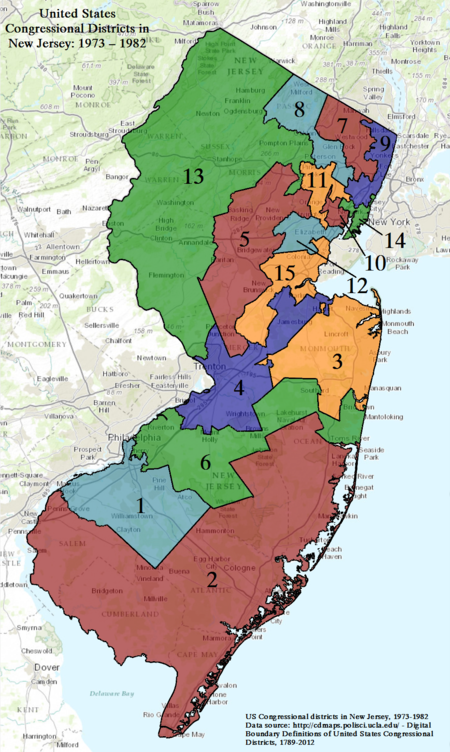
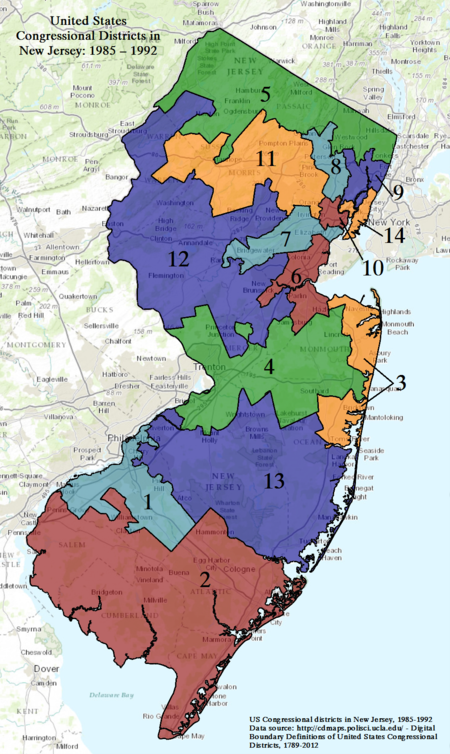
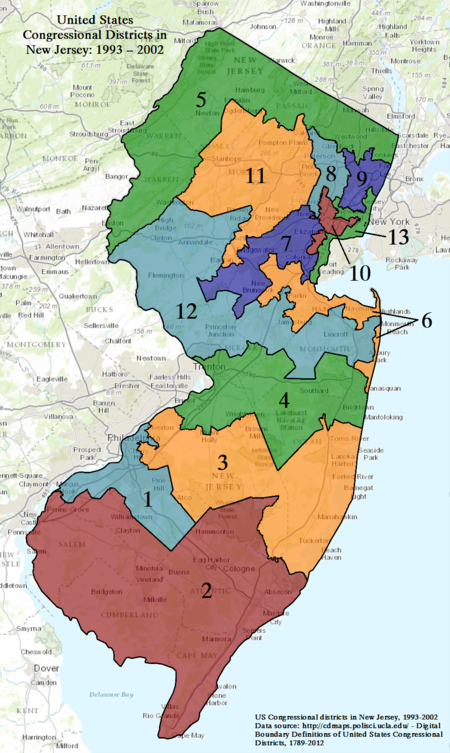
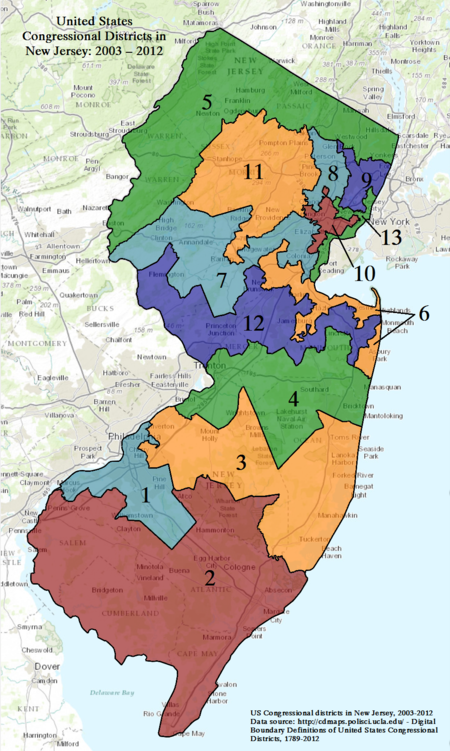
New Jersey (based on the 2020 census) has 12 Congressional Districts. Attached are charts of New Jersey’s Congressional Districts since 1973, when New Jersey had 15 Congressional Districts (See Handouts 2-6). As the population of other states grew faster than that of New Jersey over the last 50 years, the state lost Congressional districts. The 15th Congressional district became obsolete with the 1980 census; the 14th Congressional district became obsolete with the 1990 census, and the 13th Congressional district became obsolete with the 2010 census.
The process for determining the boundaries for each congressional district is set by each state. After the 2020 census was finalized, each state reviewed and revised its congressional districts. Currently, 21 states have some form of non-partisan or bipartisan redistricting commission. Of these 21 states, 13 use redistricting commissions to draw electoral district boundaries exclusively. A 14th state, Iowa, has a special redistricting process that uses neither the state legislature nor an independent redistricting commission to draw electoral district boundaries. New Jersey has a redistricting commission that is basically bipartisan. The New Jersey Redistricting Commission has 13 members: The Senate President and Assembly Speaker each name two members; the minority leaders of each house each name two members; and the state’s Democratic and Republican party chairpersons each name two members. The 12 members then select a 13th “tie-breaker” member to chair the commission. If they cannot agree on the 13th member, then each party submits a name to the state’s Supreme Court, which chooses one of the submissions as the 13th member. (See New Jersey Constitution, Article II, Section II attached as Handout One).
Since the make-up of the New Jersey (and most other) State Redistricting Commission is highly partisan, the possibility of partisan gerrymandering is inherent. Gerrymandering is a practice intended to establish an unfair political advantage for a particular party or group by manipulating district boundaries. “Gerrymandering” was named for Elbridge Gerry, one of the signers of the Declaration of Independence. As Governor of Massachusetts (1810–1812), Gerry approved a redistricting plan for the state senate that gave the political advantage to the Democratic-Republicans over the Federalists. It worked: the freakishly shaped district elected three Democratic-Republicans that year, 1812, breaking up the county’s previous delegation of five Federalist senators. A map of the district looked like a salamander, with claws and a snake-like head on its long neck. It was suggested instead that it was a “Gerry-mander” (See Handout Seven: Gerry-mandered Districts), a name which has stuck.
Partisan gerrymandering is an issue that has vexed the federal courts for more than three decades. In Reynolds v. SimsReynolds v. Sims, 377 U.S. 533 (1964) the U.S. Supreme Court held that states need to redistrict in order to have state legislative districts with roughly equal populations: "The Equal Protection Clause requires substantially equal legislative representation for all citizens in a State regardless of where they reside.” Section 2 of the Voting Rights Act of 1965 prohibits redistricting plans that are intended to, or have the effect of, discriminating against racial or language minority voters. However, aside from malapportionment and discrimination against racial or language minorities, federal courts have allowed state legislatures to engage in gerrymandering to benefit political parties or incumbents.
In a 1984 case, Davis v. Bandemer, the Supreme Court held that gerrymandered districts could be struck down based on the Equal Protection Clause, but the Court did not articulate a standard for when districts are impermissibly gerrymandered. In Shaw v. Reno, 509 U.S. 630 (1993), the United States Supreme Court ruled in a 5-4 decision that redistricting based on race must be held to a standard of strict scrutiny under the Equal Protection Clause. The Davis decision was implicitly overruled by the Supreme Court in Vieth v. Jubelirer, 51 U.S. 267 (2004) where a plurality opinion determined that partisan gerrymandering claims were nonjusticiable because there was no discernible and manageable standard for "adjudicating political gerrymandering claims."
In Rucho v. Common Cause, 588 U.S. ___ (2019), voters and other plaintiffs in North Carolina and Maryland filed suits challenging their state’s congressional districting maps as unconstitutional partisan gerrymanders. The North Carolina plaintiffs claimed that the State’s districting plan discriminated against Democrats, while the Maryland plaintiffs claimed that their State’s plan discriminated against Republicans. The plaintiffs alleged violations of the First Amendment, the Equal Protection Clause of the Fourteenth Amendment, the Elections Clause, and Article I, §2. The 5–4 decision, divided along partisan and ideological lines, held that gerrymandering claims present political questions beyond the reach of the federal courts and left in place North Carolina's congressional districts, which favor the Republican Party, and Maryland's congressional districts, which favor the Democratic Party.
In Louisiana v. Callais, 608 U.S. Materials Docket No. 24-109 (decided April 29, 2026), a challenge to Louisiana’s congressional redistricting map, specifically focused on District 6, alleging that the map was an impermissible racial gerrymander. The map was created in response to a previous lawsuit, Robinson v. Ardoin, where plaintiffs argued that the prior map violated Section 2 of the Voting Rights Act by diluting minority votes. To address these issues, the Louisiana Legislature adopted a new map (Senate Bill 8) that included a second majority-Black district. However, the plaintiffs in this case claimed that this new map violated the Equal Protection Clause of the Fourteenth Amendment by prioritizing race in its creation. A three-judge panel concluded that District 6 of the new map did indeed violate the Equal Protection Clause, leading the court to issue an injunction against using this map in future elections. In a 6-3 decision, the Court ruled that Louisiana’s creation of a second majority-Black congressional district was an unconstitutional racial gerrymander. The majority held that Section 2 did not require a second majority-minority district in this case, so there was no compelling interest in justifying the predominant use of race. The decision significantly narrows when and how states can use race in redistricting under the Voting Rights Act.
According to calculations made by Burt Neuborne, Professor of Civil Liberties at New York University School of Law and the founding legal director of the Brennan Center for Justice, using criteria set forth by the American Political Science Association, about 40 seats, less than 10% of the House membership, are chosen through a genuinely contested electoral process, given partisan gerrymandering.
The National Council of State Legislatures suggests the following traditional districting principles (or criteria), which have been adopted by many states:
- Compactness: Having the minimum distance between all the parts of a constituency (a circle, square or a hexagon is the most compact district).
- Contiguity: All parts of a district being connected at some point with the rest of the district.
- Preservation of counties and other political subdivisions: This refers to not crossing county, city, or town, boundaries when drawing districts.
- Preservation of communities of interest: Geographical areas, such as neighborhoods of a city or regions of a state, where the residents have common political interests that do not necessarily coincide with the boundaries of a political subdivision, such as a city or county.
- Preservation of cores of prior districts: This refers to maintaining districts as previously drawn, to the extent possible. This leads to continuity of representation.
- Avoiding pairing incumbents: This refers to avoiding districts that would create contests between incumbents.
They also note the following emerging criteria, which have been considered and adopted in a few states since 2000:
- Prohibition on favoring or disfavoring an incumbent, candidate or party. The prohibition in a given state may be broader, covering any person or group, or it may be limited to intentionally or unduly favoring a person or group. Details on these prohibitions are included in the state descriptions below.
- Prohibition on using partisan data: Line drawers, whether they be commissioners (California and Montana), nonpartisan staff (Iowa), or legislators (Nebraska), are prohibited from using incumbent residences, election results, party registration, or other socio-economic data as an input when redrawing districts.
- Competitiveness: Districts having relatively even partisan balance, making competition between the two major parties more intense. This criterion typically seeks to avoid the creation of “safe” districts for a particular party. For instance, the Arizona constitution (cited below) states that “to the extent practicable, competitive districts should be favored where to do so would create no significant detriment to the other goals.” (See https://www.ncsl.org/
Activity #1
Conduct a Simulated New Jersey Redistricting activity:
New Jersey will need to redistrict after the 2030 census is finalized.
- Review the NJ Congressional Districts since 1973 (Handouts 2-7) and compare them with the Gerry-mandered map (Handout 8). Identify which, if any, New Jersey districts look like they were “Gerrymandered”? Are there any noticeable patterns or drastic changes on the maps over the last 50 years?
- Read the attached article Partisan Redistricting NJ.com, which provides different perspectives on New Jersey’s most recent redistricting map. Identify an argument that supports the map as fair and identify an argument that believes it isn’t.
- Divide your class into two groups. Assume that the state will continue to have 12 congressional districts or assume that the state will lose one seat and only have 11 congressional districts.
- Have one group consider the criteria suggested above by the National Council of State Legislatures, as well as past and current New Jersey congressional districts (Handouts 2-7). Use the state map with counties and county seats identified (Handout 9) and the map of New Jersey municipalities (Handout 10) and their populations (which can be found at https://en.wikipedia.org/wiki/List_of_municipalities_in_New_Jersey) and determine what would be appropriate Congressional Districts for New Jersey.
- For the other group, assign roles for members of the Redistricting Commission:
- Senate President (2 votes)
- Assembly Speaker (2 votes)
- Senate Minority leader (2 votes)
- Assembly Minority Leader (2 votes)
- Chairman of the NJ State Democratic Committee (2 votes)
- Chairman of the NJ State Republican Committee (2 votes)
- NJ State Supreme Court Justice (chairman with one vote)
Have the students use the state map with counties and county seats identified (Handout 9) and the map of New Jersey municipalities (Handout 10) and their populations (which can be found at https://en.wikipedia.org/wiki/List_of_municipalities_in_New_Jersey to determine Congressional Districts for New Jersey.
- Class Discussion:
- What are the differences between the plans that each group developed?
- Which districts look gerrymandered?
- Which party might benefit from the gerrymandered districts?
- What would be appropriate criteria for the New Jersey Redistricting Commissions to use in the future to prevent gerrymandering?
Activity #2
Redistricting and Community Mapping in NJ
The emergence of browser-based tools has enhanced citizens' ability to create districts and build community coalitions. Districtr (https://districtr.org/) is a free browser-based tool for drawing districts and mapping your community. This activity involves students working in groups of 2 to 3 to develop their own New Jersey Congressional district map. Using the tools provided in the program, groups can access current population dynamics, draw colored-coded districts, and submit their plan for inspection based on rules of contiguity. Groups should also answer the following questions when submitting their maps.
- Briefly describe the map you created. What was your main goal when drawing the lines (e.g., equal population, competitiveness, keeping communities together, compactness)?
- What was the hardest part of drawing the districts? What trade-offs did you have to make?
- How close did you get to the ideal population size for each district in your state? Why is equal population so important?
- How does your map compare to the actual congressional map currently used in your state? What is similar? What is different?
- The program provides population layer data to identify communities based on race. To what extent did your group consider race when creating districts? Do you believe that districts should be created to concentrate the particular interests of ethnic or racial groups?
- Should mapmakers prioritize keeping cities, counties, or communities of interest together, even if it means districts are less competitive? Explain your reasoning.
- If your map were used in a real election, which party or groups of voters might benefit the most? Which might be disadvantaged?
- Imagine you are presenting your map to a redistricting commission or the state legislature. Write a short (3–5 sentence) statement defending why your map should be adopted.
Background
Smithsonian Magazine (July 20, 2017): https://www.smithsonianmag.com/history/where-did-term-gerrymander-come-180964118/
New Jersey Constitution, Art. II, Sec. II https://www.njleg.state.nj.us/lawsconstitution/constitution.asp
Reynolds v. Sims (1964) https://www.oyez.org/cases/1963/23
Davis v. Bandemer (1984) https://www.oyez.org/cases/1985/84-1244
Shaw v. Reno (1993) https://www.oyez.org/cases/1992/92-357
Viet v. Jubelirer (2004) https://www.oyez.org/cases/2003/02-1580
Rucho v. Common Cause (2019) https://www.oyez.org/cases/2018/18-422
Louisiana v. Callais (2026) https://www.oyez.org/cases/2025/24-109
National Council of State Legislatures https://www.ncsl.org/research/redistricting/redistricting-criteria.aspx
HANDOUT ONE: NEW JERSEY STATE CONSTITUTION
ARTICLE II, SECTION II
1. (a) After each federal census taken in a year ending in zero, the Congressional districts shall be established by the New Jersey Redistricting Commission.
The commission shall consist of 13 members, none of whom shall be a member or employee of the Congress of the United States. The members of the commission shall be appointed with due consideration to geographic, ethnic and racial diversity and in the manner provided herein.
(b) There shall first be appointed 12 members as follows:
(1) two members to be appointed by the President of the Senate;
(2) two members to be appointed by the Speaker of the General Assembly;
(3) two members to be appointed by the minority leader of the Senate;
(4) two members to be appointed by the minority leader of the General Assembly; and
(5) four members, two to be appointed by the chairman of the State committee of the political party whose candidate for the office of Governor received the largest number of votes at the most recent gubernatorial election and two to be appointed by the chairman of the State committee of the political party whose candidate for the office of Governor received the next largest number of votes in that election.
Appointments to the commission under this subparagraph shall be made on or before June 15 of each year ending in one and shall be certified by the respective appointing officials to the Secretary of State on or before July 1 of that year.
Each partisan delegation so appointed shall appoint one of its members as its chairman who shall have authority to make such certifications and to perform such other tasks as the members of that delegation shall reasonably require.
(c) There shall then be appointed one member, to serve as an independent member, who shall have been for the preceding five years a resident of this State, but who shall not during that period have held public or party office in this State.
The independent member shall be appointed upon the vote of at least seven of the previously appointed members of the commission on or before July 15 of each year ending in one, and those members shall certify that appointment to the Secretary of State on or before July 20 of that year. If the previously appointed members are unable to appoint an independent member within the time allowed therefor, they shall so certify to the Supreme Court not later than that July 20 and shall include in that certification the names of the two persons who, in the members' final vote upon the appointment of the independent member, received the greatest number of votes. Not later than August 10 following receipt of that certification, the Supreme Court shall by majority vote of its full authorized membership select, of the two persons so named, the one more qualified by education and occupational experience, by prior public service in government or otherwise, and by demonstrated ability to represent the best interest of the people of this State, to be the independent member. The Court shall certify that selection to the Secretary of State not later than the following August 15.
(d) Vacancies in the membership of the commission occurring prior to the certification by the commission of Congressional districts or during any period in which the districts established by the commission may be or are under challenge in court shall be filled in the same msanner as the original appointments were made within five days of their occurrence. In the case of a vacancy in the membership of the independent member, if the other members of the commission are unable to fill that vacancy within that five-day period, they shall transmit certification of such inability within three days of the expiration of the period to the Supreme Court, which shall select the person to fill the vacancy within five days of receipt of that certification.
2. The independent member shall serve as the chairman of the commission.
Article II, section II added effective December 7, 1995.
HANDOUT TWO: NJ CONGRESIONAL DISTRICTS 1973-82
HANDOUT THREE: NJ CONGRESSIONAL DISTRICTS 1985-1992
HANDOUT FOUR: NJ CONGRESSIONAL DISTRICTS 1993-2002
HANDOUT FIVE: NJ CONGRESSIONAL DISTRICTS, 2003-2012
HANDOUT SIX: NJ CONGRESSIONAL DISTRICTS SINCE 2013
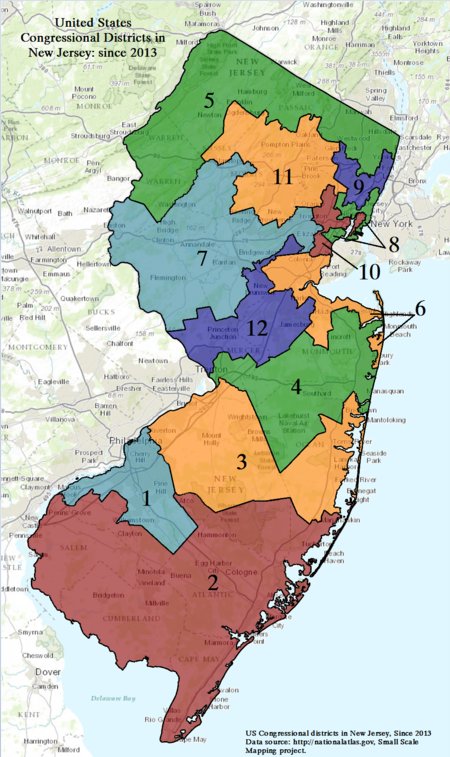
HANDOUT SEVEN: NJ CONGRESSIONAL DISTRICTS SINCE 2022
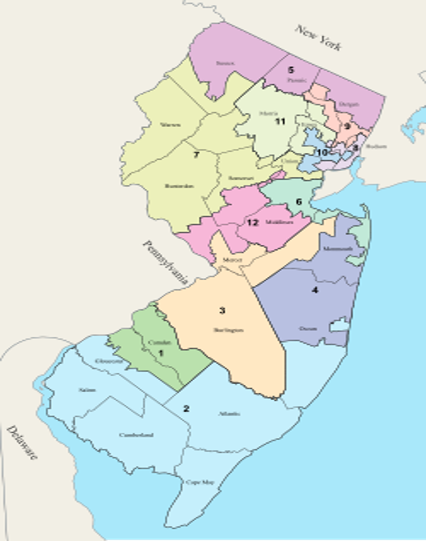
HANDOUT EIGHT: GERRYMANDERED DISTRICT
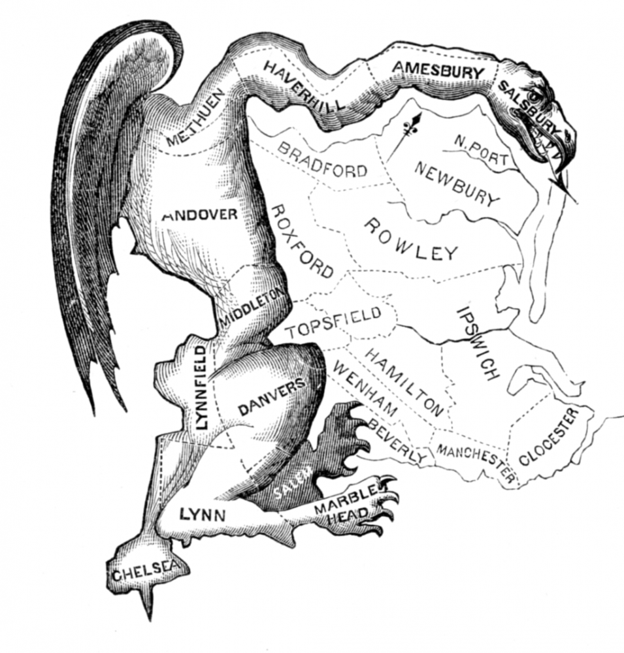
The misshapen Massachusetts Congressional District approved by Governor Gerry in 1812 that earned the name “Gerrymandered”
HANDOUT NINE: NEW JERSEY COUNTIES AND COUNTY SEATS
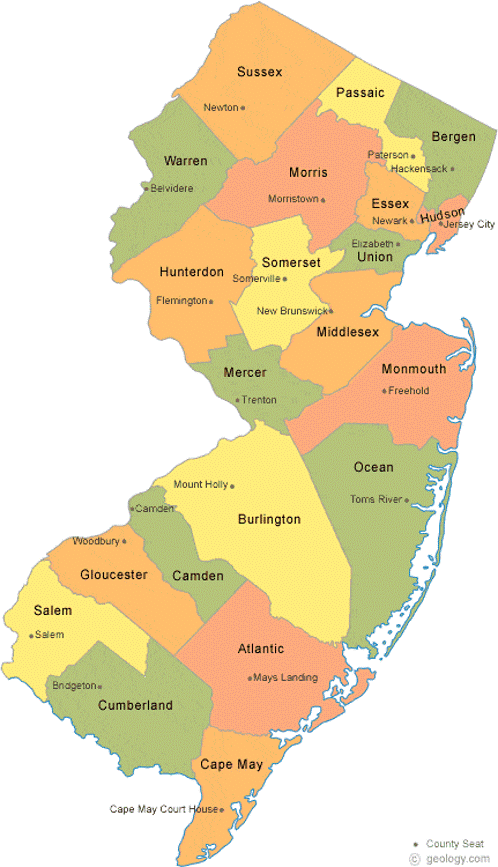
HANDOUT TEN: NJ MUNICIPALITIES WITH COUNTY LINES
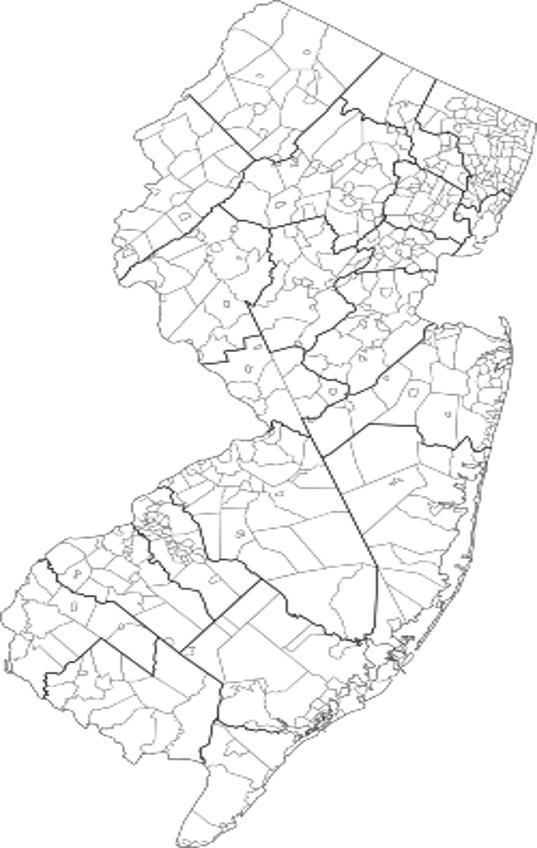
“This Land is Your Land: This Land is My Land”: Land Use in New Jersey

Source: The Meadowlands: A National Climate Park - High Meadows Environmental Institute
Prepared by: New Jersey Civic for Civic Education, Rutgers University, Piscataway, NJ Lesson Grade Level: Secondary Lesson Length: 4 – 5 days
New Jersey Social Studies Standards:
6.1.12.GeoHE.13.a: Construct an argument on the effectiveness of environmental movements, their influence on public attitudes, and the efficacy of the government’s environmental protection agencies and laws.
6.1.12.EconNE.6.a: Analyze the impact of money, investment, credit, savings, debt, and financial institutions on the development of the nation and the lives of individuals
6.1.12.HistoryCC.8.a: Make evidence-based inferences to explain why the Great Migration led to heightened racial tensions, restrictive laws, a rise in repressive organizations, and an increase in violence
6.1.12.GeoPP.13.a: Make evidence-based inferences to determine the factors that led to migration from American cities to suburbs in the 1950s and 1960s and describe how this movement impacted cities.
6.1.12.EconNE.13.b: Evaluate the effectiveness of social legislation that was enacted to end poverty in the 1960s and today by assessing the economic impact on the economy (e.g., inflation, recession, taxation, deficit spending, employment, education).
6.1.12.CivicsPI.14.c: Analyze how the Supreme Court has interpreted the Constitution to define and expand individual rights and use evidence to document the long-term impact of these decisions on the protection of civil and human rights.
6.1.12.CivicsPI.14.d: Use primary sources representing multiple perspectives and data to determine the effectiveness of the federal government in addressing health care, income equality, and immigration.
6.1.12.CivicsDP.14.a: Draw from multiple perspectives and cite evidence to determine the extent to which nongovernmental organizations, special interest groups, third party political groups, and the media affect public policy.
6.1.12.GeoHE.14.a: Evaluate the impact of individual, business, and government decisions and actions on the environment and climate change and assess the efficacy of government policies and agencies in New Jersey and the United States in addressing these decisions
6.1.12.HistorySE.14.c: Analyze the use of eminent domain in New Jersey and the United States from the perspective of local, state, and the federal government as it relates to the economy
6.1.12.GeoHE16.a: Explain why natural resources (i.e., fossil fuels, food, and water) continue to be a source of conflict and analyze how the United States and other nations have addressed issues concerning the distribution and sustainability of natural resources and climate change.
6.1.12.HistoryCC.16.b: Determine past and present factors that led to the widening of the gap between the rich and poor, and evaluate how this has affected individuals and society
6.3.12.CivicsPD.1: Develop plan for public accountability and transparency in government related to a particular issue(s) and share the plan with appropriate government officials.
Objectives: Students should be able to:
- Identify the source of the right to own property
- Identify the source of the government’s authority to take property for a public purpose
- Explain the term “eminent domain” and how it works
- Analyze the varying perspectives on the issue of eminent domain.
- Describe the current state of eminent domain law in New Jersey
- Explain why government should sometimes encourage the preservation of certain land
- Analyze the varying perspectives regarding the government’s preservation of open spaces
- Explain the NJ Supreme Court’s decision in Mt. Laurel and the varying perspectives on land development
Compelling question: When should the government limit individual use of private property for public purposes?
The right to hold property without interference by the government is enshrined in the Fifth Amendment to the U.S. Constitution (“nor be deprived of life, liberty or property without due process of law”) and applied to states in the Fourteenth Amendment (“nor shall any state deprive any person of life, liberty, or property, without due process of law”).
The New Jersey State Constitution includes the right to property in the first paragraph in the list of rights: “All persons are by nature free and independent, and have certain natural and unalienable rights, among which are those of enjoying and defending life and liberty, of acquiring, possessing, and protecting property, and of pursuing and obtaining safety and happiness.” (NJ Const., Art. I, para. 1). Yet, clearly the right to own private property is not without its limitations since the federal and state governments have often imposed many limitations for the common good.
Land use and zoning laws regulate the use and development of public and private real estate. Three lessons involving the regulation of private land for public purposes are included:
- The use of eminent domain
- The state’s efforts to protect environmentally sensitive areas
- Exclusionary zoning
Teachers may want to use only one or two or all of the lessons.
I. The use of Eminent Domain
Background
While drafting the U.S. Constitution, conflicting ideas about private property and public uses resulted in a compromise: the final clause of the Fifth Amendment provides that private property shall not be taken “for public use, without just compensation”. The New Jersey Constitution repeats this requirement: “Private property shall not be taken for public use without just compensation. Individuals or private corporations shall not be authorized to take private property for public use without just compensation first made to the owners.” (NJ Const., Art. I, Para. 20—see Handout 1). Both provisions make it clear that the government MAY take private property for public use but that the owner must be paid just compensation. This process is called “eminent domain”.
The practice of eminent domain came to the American colonies as part of British common law. The use of eminent domain to seize private property for public use has been upheld by the Supreme Court. (See United States v. Gettysburg Electric Railway Co., 160 U.S. 668 (1896), where a railway was seized for Gettysburg Battlefield historic preservation). Over the years, municipal, state and federal governments have taken land needed for roads, post offices, parks, town halls, schools and other public uses, paying the property owner the fair market value, without much dispute. A 1954 Supreme Court decision in Berman v. Parker upheld the government’s power to use eminent domain to ensure that the community is not only healthy, clean, and safe, but that it is also beautiful, spacious, and well balanced. Although takings that are not "for public use" would likely violate due process rights under the Fourteenth amendment, the term “public use” could properly be construed to include anything in the public’s interest, or for the public’s welfare.
The government entity seeking to take land from a private owner and use it for a public purpose first tries to negotiate fair compensation with the property owner. If such negotiations fail, the government entity will institute a lawsuit in a New Jersey Superior Court to determine if the government entity has the authority to exercise eminent domain. If the court determined that the proposed purpose is a public use, the judge will then appoint three commissioners to determine the compensation to be paid.

Source: http://ij.org/wp-content/uploads/2006/08/long-branch-nj-eminent-domain-lori-featured.jpg
Activity 1: What is eminent domain?
Students should use Handout 1: the United States Constitution and Article I of the New Jersey Constitution and Handout 2: Hypothetical case involving eminent domain: Rita is a 78 year old retired grandmother who was born and raised in New Jersey. In fact, Rita has lived in the same house in Old Style, New Jersey for over fifty years. Although the area is run down, she loves where she lives and enjoys her frequent walks to downtown Old Style. She knows most of her neighbors and even knows some of the local politicians.
One day, Rita starts to hear rumors that the city government wants to tear down some of the houses within her development to build a highway connecting Old Style with New Style. She is frightened by the prospect of losing her home and her identity, but is sure that she has some rights.”
Questions for Class Discussion:
- Does Rita have any legal rights to stay in her home?
- What are Rita’s rights under the U.S. Constitution?
- What are Rita’s rights under the New Jersey Constitution?
- Is building a highway a legitimate reason for the state to take private property?
- Do you think that the following should be considered “public use”?● The city government wants to take a house to build a new high school● The city government wants to take a store from a recently arrived immigrant to build a new public parking lot in the business district● The county government wants to take a place of worship to build a county jail● The state government wants to remove graves from a portion of a cemetery to construct a highway
- Can the government take private property even if the owner has no desire to part with it?
- How should “just compensation” for the property be determined?
- Do you think that it is fair that the government can take someone’s private property?
Student answers may vary according to their ideas on public use. Both Constitutions explain that the government can take private property for public use. Public use is not defined by either Constitution, but rather has been left up to the Courts. The development of a highway would meet the standard for public use since it will benefit the public by providing a more direct route between Old and New Style. A strict reading of the federal and state Constitutions would suggest that if the government provides you with just compensation and the land is used for public use, they can take private property even if the owner does not want to give it up. “Just compensation” is supposed to leave the homeowner in the same relative position, insofar as this is possible, as if the taking had not occurred. This is often determined by reference to the fair market value of the property at the date of the taking. Fair market value is the price for which the property would sell if there was a willing buyer who was under no compulsion to buy and a willing seller under no compulsion to sell. A comparable sale approach is often used when the subject property is similar to other properties which have been sold, or perhaps are currently for sale in the subject property neighborhood. This method works well for residential properties and for vacant land. “Just compensation” is supposed to leave the homeowner in the same relative position, insofar as this is possible, as if the taking had not occurred. This is often determined by reference to the fair market value of the property at the date of the taking. Fair market value is the price for which the property would sell if there was a willing buyer who was under no compulsion to buy and a willing seller under no compulsion to sell. A comparable sale approach is often used when the subject property is similar to other properties which have been sold, or perhaps are currently for sale in the subject property neighborhood. This method works well for residential properties and for vacant land.
Activity 2: How expansive is the term “public use”?
Background
Beginning in the 1950s, states and municipalities began to use eminent domain to redevelop run-down urban areas. For example, homes in an impoverished neighborhood in San Francisco were replaced with cosmopolitan hotels and other modern edifices, evicting more than 4,000 poverty-stricken residents, and over 700 businesses. Such actions were approved by the courts.

In a 5/4 decision in Kelo v. City of New London, 545 U.S. 469 (2005), the U.S. Supreme Court permitted the taking of private property and transferring it to a private developer. In that case, the Court concluded that economic redevelopment met the constitutional mandate of public use. The plan was to raze a run-down area of New London, Connecticut in order to revitalize the neighborhood and attract large companies, bringing with them much-needed jobs. Pfizer Pharmaceutical expanded to New London, and an upscale hotel, athletic center, conference center, and office park were planned to further update the area. However, the pharmaceutical company packed up and left town a mere five years after the ruling, taking with it its more than 1,000 jobs. The 70-acre stretch of land remains mostly empty since the plan for more than 100 rental condominiums to take the place of the previously planned buildings has been held up in a contract dispute.
Kelo v. New London: Expanding the Parameters of Eminent Domain: After reviewing the basic facts (Handout 3) and decision (Handout 4) in the Supreme Court case, Kelo v. New London, 545 U.S. 469 (2005), have students complete Handout 5: Defining the Parameters of Eminent Domain (completed chart is below) and then discuss whether they think that the government’s acquisition of the property serves a “public use” or whether this is an unnecessary expansion of the taking clause
Kelo v. New London: Expanding the Parameters of Eminent Domain
QUESTIONS ANSWERS
- For what purpose did the government attempt to take the private property? The government wanted to take the private property to economically revive this area in Connecticut. According to the government, this area was not thriving and therefore improving the area could help develop the city.
- Do you think that the government’s reason for taking the land was to benefit the public? Explain. Answers will vary. Students may argue that taking the land would benefit the community by reviving a struggling economy and providing more jobs. On the other hand, students may recognize that the requested action would not benefit the public in the same way as building a school or a highway. Rather, the taking of this property would merely benefit the private companies and not the entire community.
- Did the homeowners want to move? Why did they oppose the government’s use of power? No, some homeowners did not want to move. They asserted that the government’s attempted acquisition of their property was not Constitutional. They further averred that economic development and revitalization is not a “public use” as mandated by the Fifth Amendment.
- What additional questions would you want answered to determine whether this was a valid exercise of the government’s power? Answers will vary but may include the following:1. How many new jobs would be created? 2. Could this lead to a slippery slope where the government seized land to “revitalize” it? 3. Did the people of New London agree with the government’s actions? 4. Where would the poor people who live in the area be able to live?
- What was the major issue raised before the United States Supreme Court? Could the government constitutionally take property and sell it to a private company to revitalize an area? Does this action fall within the meaning of the Fifth Amendment’s “public use” requirements?
- Based on the information provided, what is your opinion? Do you think that the government acted properly in acquiring the private property? Answers will vary. Some may argue that the government should be able to take the property because this area was blighted and struggling economically. By using the power of eminent domain, the area could improve dramatically and create new jobs and increased wealth. On the other hand, some students may see a potentially dangerous slippery slope issue. If the government has the right to seize this property for economic revitalization, what is to stop the government from taking almost any property to make it more economically valuable.
Activity 3: New Jersey’s struggle to define eminent domain
Background
The U.S. Supreme Court decision in Kelo v. New London that it was consistent with the U.S. Constitution for the government to take private property for economic development and revitalization was a surprise for much of the nation. Many states responded by enacting laws to afford property owners greater protection against the wrongful seizure of their property through eminent domain; others created or tightened restrictions on the use of eminent domain for any purpose other than “traditional” purposes such as roads, schools, parks and other typical government purposes.
New Jersey is a state that has traditionally welcomed the powers of eminent domain. Not only does Article I, Clause 20 of the New Jersey Constitution allow the government to take private property “for public use” and pay the owner “just compensation”; Article VIII, Section 3, Clause 1 further explains that “The clearance, replanning, development or redevelopment of blighted areas shall be a public purpose and public use, for which private property may be taken or acquired”. The question, therefore, became: would this decision embolden the New Jersey government to use their power to take more property and potentially revitalize areas or would the legislature try to curtail the government’s actions?
The New Jersey Legislature first defined the term “blighted” in 1949 and has since expanded its definition. The most significant change came in 1992 when the New Jersey Legislature changed the term “blighted” to an “area in need of redevelopment.” Blight came to be land that is “underutilized” or “not fully productive” or “consistent with smart growth planning principles.” (See Public Advocate Ronald Chen’s Remarks, May 18, 2006). However, since the Kelo decision, efforts have been made to limit the government’s power of eminent domain. After several tries, a bill was finally enacted in New Jersey in 2013 to set a higher bar for municipalities to use eminent domain laws to claim underutilized properties as part of a redevelopment plan. Municipalities would need to prove with substantial evidence that the building meets the criteria of blight, which is “deterioration or stagnation that negatively affects
surrounding properties.”
Activity 3A: Compare the New Jersey Superior Court decision in Casino Reinvestment Development Authority v. Birnbaum with Kelo v. City of New London.
The Atlantic City Reinvestment Development Authority wanted to take Charlie Birnbaum’s three-story brick walkup in Atlantic City that his family has owned for 45 years through eminent domain as part of a redevelopment project slated near the vacant Revel Casino Hotel. After reconsideration in light of the uncertainty surrounding Atlantic City and fear that the property might lie idle, a New Jersey Superior Court asked for reasonable assurances that the casino redevelopment project will actually be built before approving eminent domain in 2016. The case is on appeal.
Ask students: What do you think?
- Does the Kelo decision give the government too much power by allowing the government to look at land and think how it could be better utilized? Support your opinion.
- Does the Birnbaum decision better balance the rights of private property owners and the governmental desire to more productively use property in areas in need of redevelopment?
- How would you balance the rights of property owners and the government’s interest in redeveloping areas that are blighted and economically struggling?
II. Protecting Environmentally Sensitive Land
New Jersey is the most densely populated state in the nation, crisscrossed by highways, railroads, industry, commercial property and sprawling suburbs. In spite of its name as the ‘Garden State,” a large amount of the land area is paved over and developed. Yet, the state is also the site of environmentally sensitive meadowlands and pinelands, which protect our water and provide routes for migratory birds and animals. Even before the Environmental Protection Agency was created by the federal government in 1970, New Jersey began efforts to protect its fragile natural resources. One method of protection is to use eminent domain to purchase environmentally sensitive areas to preserve them from development. Another method is to establish procedures for land use that private owners must comply with in order to maintain environmentally sensitive areas.
Teachers may want to divide students into three groups to consider the environmentally protected areas in New Jersey’s Meadowlands, Pinelands, and Highlands. After the small groups have come to their conclusions, teachers may want to have the three groups jigsaw and share their responses and reasoning with the other two groups or present their responses and reasons to the whole class.
The Meadowlands

Derkote Park at the Meadowland, Source: Parks and Trails | New Jersey Sports and Exposition Authority
Background
According to a report by the New Jersey Audubon Society, the Meadowlands is a major part of the Atlantic Flyway migration route. Two hundred and sixty-five species of birds, including great and snowy egrets, tree swallow, peregrine falcon, osprey, black-crowned night heron, ruddy duck, red-tailed hawk, double-crested cormorant, and American bald eagle, have been spotted in the Meadowlands. But the area had been used as a dumping ground, and the Hackensack River and its marshes were often seen as places to fill for commercial and industrial development. Bordered by Route 46 on the north; Routes 1 and 9 (also known as Tonnelle Avenue) and the freight lines owned by Norfolk Southern and CSX Corp. on the east; the Port Authority of New York and New Jersey’s Trans-Hudson (PATH) commuter rail lines and the Pulaski Skyway on the south; and Route 17, the Pascack Valley rail line and the Kingsland rail line on the West, the Meadowlands is an area of wetlands in 14 municipalities in Hudson and Bergen counties. In 1969, the New Jersey Meadowlands Commission (NJMC) was created as a regional zoning, planning and regulatory agency to protect the delicate balance of nature, provide for orderly development, and manage solid waste activities in the New Jersey Meadowlands District. The NJMC has acquired more than 1,800 acres of the remaining wetlands in the Meadowlands District for preservation and enhancement. The research performed by the Natural Resources Management Department has developed ways to improve and protect vital natural resources in the Meadowlands District. The Commission operated as an independent state agency between 1969 and 2015, loosely affiliated with the New Jersey Department of Community Affairs. In 2015, it was merged with the New Jersey Sports and Exposition Authority through legislative action but continues to protect the Meadowlands area.
Activity 4: Have your class identify the advantages and disadvantages of having a regional authority to coordinate zoning, planning and regulation in an environmentally delicate area.
Advantages/Disadvantages
Activity 5: For Small Group #1: New Jersey would like to sell 400 acres of the protected 1,800 acres regulated by the New Jersey Meadowlands Commission to a private university for a research facility similar to Woods Hole in Massachusetts. The sale of the land could bring over $100 million in revenue to New Jersey and provide important scientific research for the future. An estimated 5,000 people would be employed in this facility. Determine if this proposal should be placed on the ballot for voters to decide.
The Pinelands

Source: http://www.nj.gov/pinelands/cmp/summary/
Background
New Jersey’s Pinelands include over a million acres of pine oak forests, tea-colored streams and rivers, spacious farms, crossroad hamlets, and small towns stretched across southern New Jersey. In the country's early years, the area was a source of lumber, iron and glass. Although it continues to be a site for growing cranberries and blueberries, as these early industries died out and major roads bypassed the area, the "Pine Barrens" gradually became a remote part of New Jersey with local legends, such as the "Jersey Devil". By the end of the 1960s, the area was being considered for potential housing and other development, which would have compromised this unique environmental asset. In 1978 Congress created the Pinelands National Reserve, the country's first. The Reserve was to be a place where governments at every level -- from Washington to local planning boards -- could help shape the Pinelands' future in keeping with some basic guidelines. The state was to take the lead in evaluating the Pinelands' resources and planning how best to balance their protection with new development. Governor Brendan T. Byrne established the Pinelands Commission by executive order on February 8, 1979 and gave it responsibility for these tasks. At Governor Byrne’s request, the New Jersey Legislature passed the Pinelands Protection Act in June, 1979, affirming the temporary limitations on development that the Governor had put into effect while a plan to protect the Pinelands was being created. It also established a requirement that county and municipal master plans and land use ordinances be brought into conformance with the Comprehensive Management Plan that the Commission developed.
The Pinelands Protection Act (NJSA 13:18A-2) at PINELANDS PROTECTION ACT, provides that:
“…a certain portion of the pinelands area is especially vulnerable to the environmental degradation of surface and ground waters which would be occasioned by the improper development or use thereof; that the degradation of such waters would result in a severe adverse impact upon the entire pinelands area; that it is necessary to designate this portion as a preservation area, wherein more stringent restrictions on the development and use of land should be utilized and public acquisition of land or interests therein should be concentrated; and, that in order to facilitate such acquisition, and otherwise to effectuate the provisions of this act and the Federal Act, it is further necessary to establish certain notice requirements and procedures for the purchase of land or interests therein in such area. “
“…the current pace of random and uncoordinated development and construction in the pinelands area poses an immediate threat to the resources thereof, especially to the survival of rare, threatened and endangered plant and animal species and the habitat thereof, and to the maintenance of the existing high quality of surface and ground waters; that such development and construction increase the risk and extent of destruction of life and property which could be caused by the natural cycle of forest fires in this unique area; and, that, in order to effectuate the purposes and provisions of this act and the federal act, it is necessary to impose certain interim limitations upon the local approval of applications for development in the preservation area, and upon certain State and local approvals in the pinelands area…”
Land Acquisition in the Pinelands
The Commission proposed that the state acquire about 100,000 acres in the Pinelands, adding to the then current total of 265,000 acres of publicly owned open space in the area. This would be done through negotiation with the private owners or eminent domain. The estimated cost was $81 million, which would be obtained from various federal and state sources. The federal government approved the plan and a $8.25 million federal acquisition expenditure for 11,000 acres in Ocean County's environmentally critical Cedar Creek watershed. Governor Christine Todd Whitman signed the Garden State Preservation Trust Act in June 1999, which allocated nearly $1 billion over ten years to purchase one million mostly rural acres. As of June 2016, nearly half of the Pinelands Area (460,000 acres) has been permanently preserved, the majority through purchases using state and federal funds.
Local implementation
The 1979 Pinelands Protection Act envisioned that local governments would be primarily responsible for implementing the Plan. The Act set forth a procedure under which county and municipal master plans and land use ordinances would be made consistent with the Plan, including mandatory density limitations and the requirement that growth areas accept development credits. All seven counties and 53 Pinelands Area municipalities have completed the ordinance revision process. Anyone who wants to undertake any form of development as defined by the Plan must file an application with both the Commission and municipality. Applications are first reviewed by Commission staff to determine whether they are complete. Once the Commission has reviewed a project, the normal municipal review process begins. Municipal authorities are required to notify the Commission when they are scheduled to consider an application and when it receives preliminary or final local approval. These local approvals are then subject to Commission review to ensure that they are consistent with the Pinelands Comprehensive Management Plan.
Sounds like a great idea! Where is the controversy? As NJ Monthly Magazine explained in a 2008 article about the Pinelands: “Developers itch to transform the Northeast’s last seaboard wilderness, especially with the U.S. Census showing the state’s largest 1970s population spurts in Monmouth and Ocean counties. Among their proposed “improvements”: a supersonic jetport four times larger than Newark, LaGuardia, and JFK combined. (30 and Counting: the Pinelands Protection Act
Activity 6: Have your class discuss how the desire to develop land can be balanced against the need to protect fragile ecosystems.
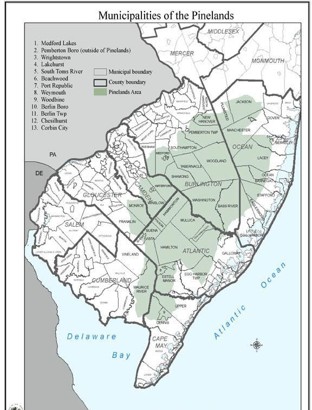
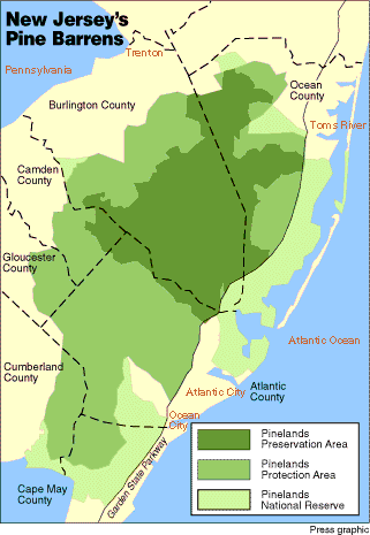
Activity 7: For Small Group #2: A private wind energy company has made a proposal to purchase 4,000 acres of protected land in the Pinelands to create a wind farm of 5,500 wind turbines to provide safe and clean energy for the 10 counties south of the Raritan River. Each wind turbine can produce electricity for about 400 homes. The cost to purchase the land would be $80,000 per acre, for a total gain of $320 million to the State of New Jersey. In addition, there would be continuing annual income to the state from property and corporate taxes, as well as clean energy and lower energy costs for approximately 2.2 million people. The advantage of the location in the Pinelands Protection Area is both its proximity to offshore winds and a longitudinal distance of some 75 miles.
The Pinelands Commission needs to approve or disapprove of this development request in the Pinelands Protected Area before submitting it to the 53 municipalities in the Pinelands area. Their decision will also establish a precedent for other requests for developmental use including a large airport, ecotourism, and a research facility. The economic needs of New Jersey have changed since the Pinelands Protection Act was passed in 1979 and revenue from the sale of land and income from development is needed by local and state governments. Should the Pineland Commission approve or disapprove this development request
Protecting the Highlands

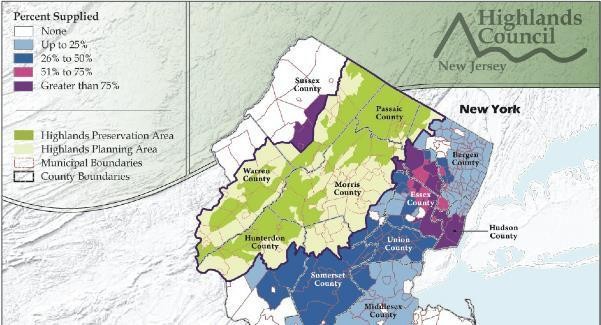
The Highlands Water Protection and Planning Act, N.J.S.A. 13:20-1 et seq. was signed in 2004 to protect drinking water for over 5.4 million people (more than half the population of the state) and to help preserve New Jersey's dwindling open space. New Jersey Highlands Region includes over 800,000 acres in 88 municipalities in seven counties (Bergen, Hunterdon, Morris, Passaic, Somerset, Sussex and Warren).The Highlands Commission has developed rules for land use, water resource and environmental protection and established a consolidated Highlands permitting review and approval process for activities constituting major Highlands development proposed in the Preservation Area. The regulations do not apply to the Highlands Planning area.
Unlike the Meadowlands or the Pinelands, which were not highly developed before the imposition of regulations, the Highlands region was a well-developed suburban area. The act grandfathered in existing homes, houses of worship, mining, quarrying, or recycling, federal military installations, or approvals for land development that existed in 2004. The act requires approval from the Department of Environmental Protection for “Major Highlands development,” which includes (1) any non-residential development in the preservation area; (2) any residential development in the preservation area that requires an environmental land use or water permit or that results in the ultimate disturbance of one acre or more of land or a cumulative increase in impervious surface by one-quarter acre or more; (3) any activity undertaken or engaged in the preservation area that results in the ultimate disturbance of one-quarter acre or more of forested area or a cumulative increase in impervious surface by one-quarter acre or more on a lot; or (4) any capital or other project of a State entity or local government unit in the preservation area that requires an environmental land use or water permit or that results in the ultimate disturbance of one acre or more of land or a cumulative increase in impervious surface by one-quarter acre or more.
Instead of the state or local government exercising eminent domain and purchasing the private property of landowners in the Highlands region, the property owner’s ability to expand, change or revise its use is subject to regulation. Some homeowners and builders protested that this reduced the value of their private property to the point where it constituted a taking without compensation.
Activity 8: What is Fair? Balancing Needs and Rights
Have students consider the following: There are 244 municipalities in 16 New Jersey counties, most of them outside of the Preservation area, that rely on the Highlands for part of their water supply (See Handout 6 or for an Interactive Map go to: Highlands ERI
"In the Upper Passaic River Watershed Management Area, encompassing parts of Morris, Sussex and Essex counties, the deficit could grow from the current 2 million gallons per day to 5 million daily by 2020. The Arthur Kill WMA is estimated to double its deficit by 2020. And “masked” within larger watershed areas are smaller watersheds – for example, in the Highlands – that are also in deficit as documented by the Highlands Regional Master Plan.
According to the report, total peak water demands are currently estimated at about 1.3 billion gallons of water per day, leaving a water supply surplus of 212 million gallons. But a surplus in Sussex County doesn’t help Cape May. Water supplies are not often readily transportable to places with water deficits. And the surplus will quickly dwindle. By 2020, demand for potable water will rise by an additional 120 million gallons a day, cutting the surplus by more than half." OPINION: Can New Jersey protect its water supply? Should the owners of private property in the Highland Preservation area be restricted in their use of their property in order to make sure that clean water is available for New Jersey residents who live outside the Preservation area?
Activity 9: For Small Group #3:
In 1980, you bought a small house on a 100-acre piece of property that is now in the Highlands Preservation area. You want to sell your property to a developer and retire now. For the last several years, you have been negotiating with a developer to purchase your property. Since the developer is limited in the number of houses he can place on the property, the selling price has been reduced in half, greatly reducing your profit, which is what you were planning on living on during your retirement.
- Do you think this is fair?
- How restrictive can regulations be before they constitute a taking by the state that should be compensated under the U.S. and N.J. Constitutions?
- Do you think the plan for the Highlands should be revised to include fair compensation for lost property values?
III. “Not in My Backyard”: Exclusionary Zoning and Mt. Laurel
Background
Public and private efforts to keep out “undesirables”—often people of color, other ethnicities, or those with little wealth--have existed for many years, including restrictive deeds, redlining and exclusionary zoning. These policies have resulted in a state that has wealthy-- primarily white--suburbs with public amenities and high-quality schools, and poor--primarily black and Hispanic—cities often with failing schools and high crime rates. Although the U.S. Supreme Court held in Buchanan v. Warley, 245 U.S. 60 (1917) that a city ordinance prohibiting the sale of real property to blacks violated the Fourteenth Amendment, it only dealt with public statutes. Instead, the practice of private, racially restrictive covenants or deeds evolved as a way to require residential segregation in response to the Great Migration of Southern blacks to the North during the period 1910-1960. A restriction written into a deed to a home could require a homebuyer to abstain from selling to certain categories of people. E.g.: "This lot shall be owned and occupied by people of the Caucasian race only." The imposition of private restrictions on real estate is a concept that had been in use for centuries. At common law, the right to own and enjoy real estate was considered to include, as an element of ownership, the right to restrict how that property might be used in the future. Therefore, it was not uncommon for a landowner to convey his or her property subject to any one of a number of possible restrictions. Such covenants or deed restrictions were legally binding on the buyer. In 1948, the U.S. Supreme Court ruled that states could not enforce such racial restrictions. In 1968, Congress outlawed them altogether. But for a century after the Civil War, such practices were legal and resulted in the exclusion of unwanted immigrant groups--but primarily African- Americans--from large parts of northern cities and towns, including many in New Jersey.
Redlining is the practice by lenders of denying or limiting financial services to specific neighborhoods, generally because its residents are people of color or are poor. While discriminatory practices existed in the banking and insurance industries well before the 1930s, the New Deal’s Home Owners' Loan Corporation (HOLC) instituted a redlining policy by developing color-coded maps of American cities that used racial criteria to categorize lending and insurance risks. New, affluent, racially homogeneous housing areas received green lines while black and poor white neighborhoods were often circumscribed by red lines denoting their undesirability. Banks and insurers soon adopted the HOLC's maps and practices to guide lending and underwriting decisions. In addition, the Federal Housing Administration, created in 1934, used the HOLC's methods to assess locations for federally insured new housing construction, legalizing and institutionalizing racism and segregation by denying mortgages based upon race and ethnicity. See Handout 7 for the HOLC’s map of Essex County, New Jersey, in the 1930s showing the western part (indicated in blue) as low insurance risk (because of high income in the area), the green area indicating parkland, the yellow area indicating industrial areas and the red area indicating a high insurance risk because of the existence of large numbers of African-Americans and/or poor people.
Although Title VIII of the Civil Rights Act of 1968 (Fair Housing Act) outlawed discrimination in the sale, rental and financing of dwellings based on race, color, religion, sex or national origin (amended in 1988 to include disability or familial status), and enabled the Justice Department to bring suits on behalf of victims in federal district courts, the practice still exists. A real estate broker may “forget” to show an African-American family house in certain areas. A bank may decline to provide a mortgage.
Zoning is the most common form of land-use regulation, used by municipalities to control local property development. Zoning regulations typically divide a municipality (such as a city) into residential, commercial, and industrial zones in order to keep each zone optimized for its intended purpose. For example, zoning laws reassure homeowners that a factory or department store will not open across the street. Zoning laws also regulate specific requirements for the types of buildings allowed in each zone (height restrictions, etc.), location of utility lines, parking requirements, and other regulations. Zoning laws began in this country around the turn of the 20th century with the concentration of populations in cities and the development of automobiles, roads and rapid transit. States and municipalities developed laws and regulations based on their police powers to regulate behavior and enforce order for the betterment of the health, safety, morals, and general welfare of their inhabitants. The courts have generally supported ordinances forbidding the erection in designated residential districts of businesses, retail stores, and other like establishments. They have also supported municipal zoning ordinances that excluded apartment houses in single-family areas as within the police powers of the municipality to protect public health, safety, morals, or general welfare. In Village of Euclid v.
Ambler Realty Co., 272 US 365 (1926), the U.S. Supreme Court affirmed that the use of zoning was constitutional so long as it was for a public purpose. See: VILLAGE OF EUCLID, OHIO, et al. v. AMBLER REALTY CO. | Supreme Court | US Law | LII / Legal Information Institute
In 1927, an amendment was added to the 1844 New Jersey Constitution authorizing the legislature to permit municipalities to enact zoning ordinances. Starting after World War II, many growing suburban New Jersey communities regulated the use of land in their borders to specifically prevent the development of housing affordable to lower income households. By the late 1960s, such regulations, commonly known as exclusionary zoning, had become extremely widespread. The zoning ordinances employed by municipalities to accomplish this goal included minimum lot sizes, homes with minimum square footage, and prohibitions against multifamily housing or mobile homes. The legality of such zoning requirements was routinely upheld by the New Jersey courts until the Mt. Laurel decision by the New Jersey Supreme Court in 1975.
The Mt. Laurel decision
During the 1960s, while the mostly white, middle-class residents of Camden, NJ, were fleeing to the suburbs, primarily Cherry Hill; nearby Mt. Laurel Township, mostly farmland less than 20 miles away in Burlington County, was attempting to transform itself into an affluent suburb with more than 10,000 new homes, industrial parks and commercial centers. A black community had resided in Mt. Laurel since the Revolutionary War, with many residents tracing their lineage to slaves who escaped from the South and came North by way of the Underground Railroad. Mt. Laurel was both a railroad stop and a destination point. Black residents were being forced from their homes to make way for the planned development, which did not include any plans for low-income housing. A group of low-income African- Americans, many of them longtime residents, and the Southern Burlington County NAACP joined forces with the Camden County NAACP and black and Hispanic residents of the City of Camden to file class action litigation against Mt. Laurel Township. The case reached the New Jersey State Supreme Court by 1975.
In South Burlington County N.A.A.C.P. v. Township of Mount Laurel, 67 NJ 151 (1975)(Mt. Laurel I), the court held that zoning ordinances which make it physically and economically impossible to provide low and moderate-income housing violated the New Jersey Constitution and set forth important guidelines for implementing its decision The decision was controversial from the start. The court was accused by political leaders of violating the separation of powers clause. Local municipalities refused to yield their home rule powers. The decision initially produced more litigation than lower cost housing because many municipalities refused to implement it. Eight years later in South Burlington County N.A.A.C.P. v. Township of Mount Laurel, 92 N.J. 158 (1983) (Mt. Laurel II), the Supreme Court put teeth in the original decision by creating a fair share formula to measure each municipality's obligation to provide affordable housing, and by fashioning a "builder's remedy" to force municipalities to fulfill that obligation. The responsibility for working out the details of this decision was assigned to three specially designated trial judges.
The New Jersey Legislature responded in 1985 by passing the Fair Housing Act. Accepting the premise that there was a constitutional obligation for municipalities to foster the development of some degree of affordable housing, this legislation created an administrative agency--the Council on Affordable Housing (COAH)--to establish regulations whereby the obligation of each municipality in terms of the number of units and how the obligation could be satisfied. A municipality which elected to participate in COAH's administrative process prior to being sued was provided with protection from litigation and especially the builder's remedy. The Supreme Court upheld the Fair Housing Act in Hills Development Corp. V. Bernards Township, 103 NJ 1 (1986) and most cases previously being heard by designated judges were transferred to COAH. In 1986, COAH released the First Round rules (1987-1993), which required 10,849 low- and moderate-income homes per year statewide. In 1994, COAH released the Second Round rules (1993-1999 extended to 2003), which required 6,465 low- and moderate-income homes per year statewide. Forced by the Court to adopt new rules, COAH did so in 2005 but cut the housing obligations of NJ’s municipalities in half—to 3,515 units per year—and permitted municipalities to restrict half of their units to seniors and transfer half of their obligation to poor municipalities. An appeal was filed by the Fair Share Housing Center, the New Jersey Builders Association, the Coalition on Affordable Housing and the Environment, and ISP Management Co., Inc. on the grounds that COAH’s rules were unconstitutional. The New Jersey State League of Municipalities and New Jersey Institute of Local Government Attorneys supported the regulations. In 2007, the New Jersey Appellate Division found that the regulations violated the constitutional mandate of Mt. Laurel and the statutory requirements of the Fair Housing Act. The Court required a check on municipal discretion, writing that “If municipalities with substantial amounts of vacant land and access to infrastructure can decide for themselves whether and how much to grow, it is highly likely that housing opportunity will fall far short of identified housing need.” The Court prohibited COAH from allowing municipalities to restrict half of their units for seniors, finding that doing so “discriminates against low- and moderate-income households with children.” COAH missed the deadline to adopt revised regulations set for it by the Appellate Division and finally adopted them on October 20, 2008.
The New Jersey Supreme Court’s 1983 ruling in the Mount Laurel fair-housing case is regarded as one of the most important civil rights decisions of modern times. The ruling, which greatly influenced fair- housing policy across the nation, limited the use of exclusionary zoning as a means of preventing the construction of affordable housing in wealthy communities. However, NJ Governor Chris Christie tried to abolish COAH twice and ultimately was told by the courts that he did not have the authority to do so. Legislators have sought to do the same, but have not been able to agree with Christie on a new mechanism to replace the COAH process. The council has met only once since the court ordered its reinstatement in 2015. And, while COAH has not been functioning, little affordable housing has been built.
Municipalities had been arguing before Superior Court judges — who are setting the housing obligations for communities — that because the FHA only specifies that towns are required to provide for past unfilled needs, present units in poor condition and projected future needs, they should not have to provide homes for people who couldn’t afford housing between 1999 and 2015. During that time, called the “gap period,” the state had no housing rules because COAH was unable to adopt regulations that were constitutional in the eyes of the courts. The New Jersey Supreme Court ruled in 2017 that New Jersey municipalities must build thousands more units for its low-income residents to make up for the 16 years that the state didn't address those needs. The New Jersey Legislature is current (in 2024) reviewing the Fair Housing law.

Mt. Laurel law and moderate-income housing
Will Affordable-Housing Decision Be Derailed by Judge’s Ties to Developer? | NJ Spotlight News
Support and Opposition
Opposition to Mt. Laurel rests on fears that opening the doors to the poor will result in suburban sprawl, more traffic on roads, destruction of historic New Jersey small town architecture, an influx of school age children, an increase in crime, and a reduction in property values. Some of these fears are based on fact. For example, higher density low-income housing may affect the tax rate and the character of the community. However, many of the fears are unfounded. According to a report from Princeton University, the Mt. Laurel approach has led to the creation of 60,000 homes for low- and moderate- income working families, with another 40,000 units in the pipeline. Comparing current and former residents of a Mt. Laurel development that opened in 2000, with similar families who had applied for housing but wound up elsewhere, the study found that the development’s residents had higher rates of employment and family income and significantly lower rates of welfare dependency. They were also more closely involved in educating their children, who did well academically, even though they had moved to more competitive schools. Surrounding property values did not go down, and taxes did not go up. The development blended in so well with the surrounding area that many people were not aware that it existed.
A 2017 Quinnipiac University poll found that two-thirds of New Jerseyans favor the placement of low and moderate-income housing in their communities, with only 14 percent having an unfavorable view. However, 53 percent also said they think their community has “the right amount” of affordable housing. Voters applaud the decision, but they say their own community has the right amount of affordable housing, meaning they might not be happy to see any more.”
Activity 10: Have students read Handout 8: Background and Handout 9 Directions and hold the planning board hearing.
Fact Pattern
Hidden Hills is a quiet, scenic, up-scale residential community in New Jersey. Most of its residents (population 5000 in the 2000 census) live on several acre lots and small farms. It is approximately 15 miles from highly urbanized Rock City (population 60,000). The population of Hidden Hills remained fairly stable until recently when the construction of a major highway directly connected Hidden Hills and Rock City to the cities in the east and the farmland to the west. New office buildings have sprung up along the highway and old farms have been broken up causing the population of Hidden Hills to increase to 12,000 by 2015. Many Rock City residents work in the stores and office buildings along the highway. Hidden Hills has a one-acre minimum lot requirement. Houses sell for $500,000 to $3 million.
In 2017, the Slimprofit Corporation, which has an excellent reputation for building good quality, aesthetically pleasing moderate-income housing in the northeast, proposed to build 300 townhouse condominiums in Hidden Hills. The Slimprofit proposal includes 240 market rate houses, which will sell for $400-500,000 and 60 Mt. Laurel units, which would sell for $120-200,000. Access to the proposed townhouses would be off of a busy road, Raceway Road, which currently runs through one to four acre lots, surrounded by a few remaining farms. Slimprofit’s expert, Jim Jump, a planner, has estimated that the proposed development would generate approximately 150 school-age children for Hidden Hills, as well as $4 million in additional taxes and $4.5 million in additional annual local spending.
Many of the residents of Hidden Hills are outraged and vehemently opposed to the proposed development. Slimprofit’s application is scheduled for a hearing before the Hidden Hills Planning Board. The board is composed of five members: Dave Dental, a local dentist; Larry Love, an attorney who works in Rock City and lives on a two-acre lot in Hidden Hills; Hilda Hip, a real estate broker with Hidden Hills Homes; Ali McGee, a manager at a new office building that recently opened along the new highway; and Sam Shoemaker, who owns an upscale shoe store in Hidden Hills and is the board’s chairperson. Sandy Bates, who lives in a $2 million house on two acres around the corner from the proposed development, objects that it will lower the value of her house, which she has owned since 1980. Bates recently wrote an article in the local newspaper arguing that a regional contribution agreement with Rock City would be a better way for Hidden Hills to meet its Mt. Laurel obligation. Manny Mumford, who recently moved into a nearby house on Racetrack Road objects that the proposed development will create terrible traffic jams and accidents. Mumford is also concerned that expanding the sewer capacity will create more pressure for development in the area and that the alternative of an on-site sewer system will be unsightly and smelly.
Nick Nevermore, who has four school-aged children and a large mortgage on his $800,000 house in Hidden Hills, objects that the proposed development will place a heavy burden on the local school system and local taxpayers.
The Rock City NAACP, led by its president, Ida Known, supports Slimprofit’s proposed development because it will provide much needed housing opportunities for poor and moderate-income families in the region, and enable them to improve their lives and the lives of their children.
Directions for Conducting a Planning Board Hearing
- Share Handouts 9 and 10 with your students and have them read the fact pattern and discuss any questions.
- Assign students to roles: Depending on the number of students in your class, you might have several groups of 11 working simultaneously or assign only 11 students and have the rest of the class observe as a goldfish bowl and answer questions.1. Matt Finish2. Jim Jump3. Dave Dental4. Hilda Hip5. Larry Love6. Ali McGee7. Sam Shoemaker8. Sandy Bates9. Manny Mumford10. Nick Nevermore11. Ida Known
- Preparation: If there is more than one group doing a planning board meeting, have the individuals playing the same roles meet to identify their interests, questions they might want to ask or have answered or what they might say at the Planning Board Hearing. Make sure everyone is on task.
- The Hearing (est. 30 mins.)1. The chairperson of the Planning Board calls the meeting to order and announces that they will be hearing an application from the Slimprofit Corp.2. Matt Finish, president of Slimprofit Corp., presents the company’s proposal.3. Jim Jump, the expert for the Slimprofit Corp., testifies.4. Objecting neighbors make their objections and ask questions of the president and expert witness for Slimprofit Corp.5. Supporters state their reasons for support and ask questions.6. The members of the Planning Board ask questions of any and all witnesses.7. The Planning Board deliberates and decides, giving specific reasons for its decision.8. The chairperson thanks everybody.
- Invite an outside resource person familiar with land use law to join your class to enhance the lesson and talk with the students afterwards.
- Debrief the activity: Questions for discussion1. Do you think the Planning Board of Hidden Hills made the right decision? Why or why not?2. What did you learn about the local planning process?3. What did you learn about Mt. Laurel decisions and the Fair Housing Act?4. What does Mt. Laurel decision required of municipalities?5. Do you think the requirements of the Mt. Laurel decision and the Fair Housing Act are fair?6. Do you think that the Mt. Laurel decisions and the Fair Housing Act can change the pattern of segregated housing in New Jersey?7. Do you think that the government should be involved in changing the housing patterns in the state? Connecting to you community: Have your students research the existence and location of Mt. Laurel (low and moderate-income) housing in your community and the community’s Mt. Laurel plan. (See: New Jersey Housing Resource Center or Affordable Homes New Jersey)
- Identify the area designated for affordable housing in your community.
- Is it in a desirable location within your community?
- How many houses or units are there?
- What are the costs for purchasing or renting?
- What are the eligibility requirements for purchasing affordable housing in New Jersey?
Assessment
Have students write an essay explaining how eminent domain, land preservation or Mt. Laurel represents a challenge between providing for the common good over that of one class of citizens or one person. Students should raise and discuss the following concerns:
- Many property owners fear they will not be fully compensated for the seizure of their land.
- Many taxpayers feel that the requirement of paying for land acquired through eminent domain places a monetary burden too great for the perceived benefit of the project.
- Who decides what is in the public interest?
Extension
- Have students write a letter to their member of the New Jersey Legislature explaining their position on eminent domain, Mt. Laurel or other land use issue and any proposed legislation.
- Students research a particular area in New Jersey that may be affected by the government’s taking of private property and write either in support or against the local government’s proposed taking of private property.
- Write an editorial to the local paper either in support or against the government’s use of their eminent domain power, Mt. Laurel requirements or other land use issue.
- Invite a speaker representing the interests of the homeowners or a developer in an area where the local government has attempted to take property or has failed to develop a Mt. Laurel plan.
- Invite a local attorney or judge to speak on the issues of eminent domain, Mt. Laurel, or other land use issue.
- Have students identify possible locations for Mt. Laurel housing in your community and share these ideas with the town council and mayor.
Handout 1: Constitutional Provisions Protecting Private Property
U.S. Constitution, Fifth Amendment:
“No person shall be….deprived of life, liberty or property without due process of law; nor shall private property be taken for public use, without just compensation.”
Applied to states in the Fourteenth Amendment, Sec. 1.
…“nor shall any state deprive any person of life, liberty, or property, without due process of law”.
New Jersey State Constitution, Article I:
“All persons are by nature free and independent, and have certain natural and unalienable rights, among which are those of enjoying and defending life and liberty, of acquiring, possessing, and protecting property, and of pursuing and obtaining safety and happiness.” (NJ Const., Art. I, Para. 1). “Private property shall not be taken for public use without just compensation. Individuals or private corporations shall not be authorized to take private property for public use without just compensation first made to the owners.” (NJ Const., Art. I, Para. 20).
“The clearance, replanning, development or redevelopment of blighted areas shall be a public purpose and public use, for which private property may be taken or acquired.” (NJ Const., Art. VIII, Sec. 3, Para. 1)
Handout 2: Hypothetical case involving eminent domain: Rita is a 78 year old retired grandmother who was born and raised in New Jersey. In fact, Rita has lived in the same house in Old Style, New Jersey for over fifty years. Although the area is run down, she loves where she lives and enjoys her frequent walks to downtown Old Style. She knows most of her neighbors and even knows some of the local politicians.
One day, Rita starts to hear rumors that the city government wants to tear down some of the houses within her development to build a highway connecting Old Style with New Style. She is frightened by the prospect of losing her home and her identity, but is sure that she has some rights.
- Does Rita have any legal right to stay in her home?
- What are Rita’s rights under the U.S. Constitution?
- What are Rita’s rights under the New Jersey Constitution?
- Is building a highway a legitimate reason for the state to take private property?
- Do you think that the following should be considered “public use”?● The city government wants to take a house to build a new high school● The city government wants to take a store from a recently arrived immigrant to build a new public parking lot in the business district● The county government wants to take a place of worship to build a county jail● The state government wants to remove graves from a portion of a cemetery to construct a highway
- Can the government take private property even if the owner has no desire to part with it?
- How should “just compensation” for the property be determined?
- Do you think that it is fair that the government can take someone’s private property?
Handout 3: Background to KELO V. NEW LONDON
Susette Kelo lived in New London, Connecticut. She resided with her husband in the working-class section of Fort Trumbull where she bought her pink house in 1997 for $50,000. She loved her house and admired its waterfront view. The area overlooked the Thames River and the Long Island Sound. As Ms. Kelo stated, "It was like I'd been here all my life. It was just a warm and inviting feeling.”
City officials did not agree with Ms. Kelo’s outlook on the area. According to the government, the area of Fort Trumbull suffered economically. In fact, it was zoned as an industrial area since 1929 even though there were several private homes. As a local government official stated, “"This area had a junkyard, which had to be cleaned up at great expense. They had oil tanks, commercial big storage tanks…[t]here is a railroad yard down there." The city of New London decided that they wanted to improve the economic stability of New London and the Fort Trumbull area in particular. They hoped to build a conference center, hotel complex, offices, condominiums and eventually an aquarium. It was
projected that this “revitalization” would create over 1,000 jobs. The city and state of Connecticut would give millions of dollars to this project. They would use their eminent domain power to take the private property and then sell the land to a private company who would economically revive the area. The government offered compensation for the private homes within the Fort Trumbull area, yet fifteen owners refused to move. These owners were informed that if they did not sell their property, the government would take their land through the eminent domain provision.
The homeowners challenged the government’s use of the eminent domain clause. They argued that the government did not have the right to take their private property to economically develop the area. The case was appealed to the United States Supreme Court where they examined the major issue, whether the government’s taking of private property would violate the Fifth Amendment’s public use restriction. In other words, could the government take private property so that a private company could economically revitalize the neighborhood?
Handout 4: Kelo v. City of New London, 545 U.S. 469 (2005)
SUPREME COURT OF THE UNITED STATES
KELO et al. v. CITY OF NEW LONDON et al.
CERTIORARI TO THE SUPREME COURT OF CONNECTICUT
No. 04—108.Argued February 22, 2005–Decided June 23, 2005
After approving an integrated development plan designed to revitalize its ailing economy, respondent city, through its development agent, purchased most of the property earmarked for the project from willing sellers, but initiated condemnation proceedings when petitioners, the owners of the rest of the property, refused to sell. Petitioners brought this state-court action claiming, inter alia, that the taking of their properties would violate the “public use” restriction in the Fifth Amendment’s Takings Clause. The trial court granted a permanent restraining order prohibiting the taking of the some of the properties, but denying relief as to others. Relying on cases such as Hawaii Housing Authority v. Midkiff, 467 U.S. 229, and Berman v. Parker, 348 U.S. 26, the Connecticut Supreme Court affirmed in part and reversed in part, upholding all of the proposed takings.
Held: The city’s proposed disposition of petitioners’ property qualifies as a “public use” within the meaning of the Takings Clause.
(a) Though the city could not take petitioners’ land simply to confer a private benefit on a particular private party, see, e.g., Midkiff, 467 U.S., at 245, the takings at issue here would be executed pursuant to a carefully considered development plan, which was not adopted “to benefit a particular class of identifiable individuals,” ibid. Moreover, while the city is not planning to open the condemned land–at least not in its entirety–to use by the general public, this “Court long ago rejected any literal requirement that condemned property be put into use for the … public.” Id., at 244. Rather, it has embraced the broader and more natural interpretation of public use as “public purpose.” See, e.g., Fallbrook Irrigation Dist. v. Bradley, 164 U.S. 112, 158—164. Without exception, the Court has defined that concept broadly, reflecting its longstanding policy of deference to legislative judgments as to what public needs justify the use of the takings power. Berman, 348 U.S. 26; Midkiff, 467 U.S. 229; Ruckelshaus v. Monsanto Co., 467 U.S. 986.
(b) The city’s determination that the area at issue was sufficiently distressed to justify a program of economic rejuvenation is entitled to deference. The city has carefully formulated a development plan that it believes will provide appreciable benefits to the community, including, but not limited to, new jobs and increased tax revenue. As with other exercises in urban planning and development, the city is trying to coordinate a variety of commercial, residential, and recreational land uses, with the hope that they will form a whole greater than the sum of its parts. To effectuate this plan, the city has invoked a state statute that specifically authorizes the Handout 4: Kelo v. City of New London use of eminent domain to promote economic development. Given the plan’s comprehensive character, the thorough deliberation that preceded its adoption, and the limited scope of this Court’s review in such cases, it is appropriate here, as it was in Berman, to resolve the challenges of the individual owners, not on a piecemeal basis, but rather in light of the entire plan. Because that plan unquestionably serves a public purpose, the takings challenged here satisfy the Fifth Amendment.
(c) Petitioners’ proposal that the Court adopt a new bright-line rule that economic development does not qualify as a public use is supported by neither precedent nor logic. Promoting economic development is a traditional and long accepted governmental function, and there is no principled way of distinguishing it from the other public purposes the Court has recognized. See, e.g., Berman, 348 U.S., at 24. Also rejected is petitioners’ argument that for takings of this kind the Court should require a “reasonable certainty” that the expected public benefits will actually accrue. Such a rule would represent an even greater departure from the Court’s precedent. E.g., Midkiff, 467 U.S., at 242. The disadvantages of a heightened form of review are especially pronounced in this type of case, where orderly implementation of a comprehensive plan requires all interested parties’ legal rights to be established before new construction can commence. The Court declines to second-guess the wisdom of the means the city has selected to effectuate its plan. Berman, 348 U.S., at 26. 268 Conn. 1, 843 A. 2d 500, affirmed.
Stevens, J., delivered the opinion of the Court, in which Kennedy, Souter, Ginsburg, and Breyer, JJ., joined. Kennedy, J., filed a concurring opinion. O’Connor, J., filed a dissenting opinion, in which Rehnquist, C. J., and Scalia and Thomas, JJ., joined. Thomas, J., filed a dissenting opinion. Summary from Cornell University Legal Institute at https://www.law.cornell.edu/supct/html/04- 108.ZS.htmlhttps://www.law.cornell.edu/supct/html/04- 108.ZS.html
Handout 5: Kelo v. New London: Expanding the Parameters of Eminent Domain
QUESTIONS ANSWERS
- For what purpose did the government attempt to take the private property?
- Do you think that the government’s reason for taking the land was to benefit the public? Explain.
- Did the homeowners want to move? Why did they oppose the government’s use of power?
- What additional questions would you want answered to determine whether this was a valid exercise of the government’s power?
- What was the major issue raised before the United States Supreme Court?
- Based on the information provided, what is your opinion? Do you think that the government acted properly in acquiring the private property?
Handout 6: NEW JERSEY’S HIGHLANDS
For an Interactive Map go to: Highlands ERI
- There are 244 municipalities in 16 New Jersey counties, most of them outside of the Preservation area, that rely on the Highlands for part of their water supply. Should the owners of private property in the Highland Preservation area be restricted in their use of their property in order to make sure that clean water is available for New Jersey residents who live outside the Preservation area?
- In 1980, you bought a small house on a 100-acre piece of property that is now in the Highlands Preservation area. You want to sell your property to a developer and retire now. For the last several years, you have been negotiating with a developer to purchase your property. Since the developer is limited in the number of houses he can place on the property, the selling price has been reduced in half, greatly reducing your profit, which is what you were planning on living on during your retirement.
Do you think this is fair? How restrictive can regulations be before they constitute a taking by the state that should be compensated under the U.S. and N.J. Constitutions?
Handout 7: Home Owners Loan Corp. redlining map of Essex County from the 1930s

BLUE = indicated good insurance risk because high income area
GREEN = designated park land
YELLOW = designated industrial or commercial areas
RED = indicated poor insurance risk area because high percentage of African-Americans or poor people living there
Handout 8: Mt. Laurel Exclusionary Zoning Fact Pattern
Hidden Hills is a quiet, scenic, up-scale residential community in New Jersey. Most of its residents (population 5000 in the 2000 census) live on several acre lots and small farms. It is approximately 15 miles from highly urbanized Rock City (population 60,000). The population of Hidden Hills remained fairly stable until recently when the construction of a major highway directly connected Hidden Hills and Rock City to the cities in the east and the farmland to the west. New office buildings have sprung up along the highway and old farms have been broken up causing the population of Hidden Hills to increase to 12,000 by 2015. Many Rock City residents work in the stores and office buildings along the highway. Hidden Hills has a one-acre minimum lot requirement. Houses sell for $500,000 to $3 million.
In 2017, the Slimprofit Corporation, which has an excellent reputation for building good quality, aesthetically pleasing moderate-income housing in the northeast, has proposed to build 300 townhouse condominiums in Hidden Hills. The Slimprofit proposal includes 240 market rate houses, which will sell for $400-500,000 and 60 Mt. Laurel units, which would sell for $120-200,000. The access to the proposed townhouses would be off of a busy road, Raceway Road, which currently runs through one to four acre lots, surrounded by a few remaining farms. Slimprofit’s expert, Jim Jump, a planner, has estimated that the proposed development would generate approximately 150 school-age children for Hidden Hills, as well as $4 million in additional taxes and $4.5 million in additional annual local spending.
Many of the residents of Hidden Hills are outraged and vehemently opposed to the proposed development. Slimprofit’s application is scheduled for a hearing before the Hidden Hills Planning Board. The board is composed of five members: Dave Dental, a local dentist; Larry Love, an attorney who works in Rock City and live on a two-acre lot in Hidden Hills; Hilda Hip, a real estate broker with Hidden Hills Homes; Ali McGee, a manager at a new office building that recently opened along the new highway; and Sam Shoemaker, who owns an upscale shoe store in Hidden Hills and is the board’s chairperson.
Sandy Bates, who lives in a $2 million house on two acres around the corner from the proposed development, objects that it will lower the value of her house, which she has owned since 1980. Bates recently wrote an article in the local newspaper arguing that a regional contribution agreement with Rock City would be a better way for Hidden Hills to meet its Mt. Laurel obligation.
Manny Mumford, who recently moved into a nearby house on Racetrack Road objects that the proposed development will create terrible traffic jams and accidents. Mumford is also concerned that expanding the sewer capacity will create more pressure for development in the area and that the alternative of an on-site sewer system will be unsightly and smelly.
Nick Nevermore, who has four school-aged children and a large mortgage on his $800,000 house in Hidden Hills, objects that the proposed development will place a heavy burden on the local school system and local taxpayers.
The Rock City NAACP, led by its president, Ida Known, supports Slimprofit’s proposed development because it will provide much needed housing opportunities for poor and moderate-income families in the region, and enable them to improve their lives and the lives of their children.
Handout 9: Directions for Conducting a Planning Board Hearing
- Read the fact pattern
- Assign roles1. Matt Finish2. Jim Jump3. Dave Dental4. Hilda Hip5. Larry Love6. Ali McGee7. Sam Shoemaker8. Sandy Bates9. Manny Mumford10. Nick Nevermore11. Ida Known
- Preparation: If there is more than one group doing a planning board meeting, have the individuals playing the same roles meet to identify their interests, questions they might want to ask or have answered or what they might say at the Planning Board Hearing. Make sure everyone is on task
- The Hearing (est. 30 mins.)1. The chairperson of the Panning Board calls the meeting to order and announces that they will be hearing an application from the Slimprofit Corp.2. Matt Finish, president of Slimprofit Corp., presents the company’s proposal.3. Jim Jump, the expert for the Slimprofit Corp., testifies.4. Objecting neighbors make their objections and ask questions of the president and expert witness for Slimprofit Corp.5. Supporters state their reasons for support and ask questions.6. The members of the Planning Board ask questions of any and all witnesses.7. The Planning Board deliberates and decides, giving specific reasons for its decision.8. The chairperson thanks everybody.
- Debrief the activity1. Do you think the Planning Board of Hidden Hills made the right decision? Why or why not?2. What did you learn about the local planning process?3. What did you learn about the Mt. Laurel decisions and the Fair Housing Act?4. What does the Mt. Laurel decision require of municipalities?5. Do you think the requirements of Mt. Laurel and the Fair Housing Act are fair?6. Do you think that the Mt. Laurel decision and the Fair Housing Act can change the pattern of segregated housing in New Jersey?7. Do you think that the government should be involved in changing the housing patterns in the state?
New Jersey Citizens Making Change: Improving Your Community

Grade Level: 6-8
Lesson Creator: New Jersey Center for Civic Education, Rutgers, the State University of NJ
Objectives: Students will be able to:
- describe the role of the citizen in the American system of republican democracy
- explain what public policy is and how citizens can influence it
- identify, analyze, select and promote a solution to a local community problem.
New Jersey Student Learning Standards for Studies Standards (2020):
6.3.8.CivicsPD.1: Deliberate on a public issue affecting an upcoming election, consider opposing arguments, and develop a reasoned conclusion.
6.3.8.CivicsPD.2: Propose and defend a position regarding a public policy issue at the appropriate local, state, or national level.
6.3.8.CivicsPD.3: Construct a claim as to why it is important for democracy that individuals are informed by facts, aware of diverse viewpoints, and willing to take action on public issues.
6.3.8.CivicsDP.1: Identify an issue of inequality, develop multiple solutions, and communicate the best one to an appropriate government body.
6.3.8.CivicsPR.3: Take a position on an issue in which fundamental ideals and principles are in conflict (e.g., liberty, equality).
6.3.8.CivicsPR.4: Use evidence and quantitative data to propose or defend a public policy related to climate change.
6.3.8.CivicsPR.5: Engage in simulated democratic processes (e.g., legislative hearings, judicial proceedings, elections) to understand how conflicting points of view are addressed in a democratic society.
6.3.8.CivicsPR.6: Seek the perspectives of multiple stakeholders with diverse points of view regarding a local budget issue and take a position on proposed policy.
6.3.8.CivicsPR.7: Compare how ideas become laws at the local, state, and national level.
6.3.8.EconET.1: Using quantitative data, evaluate the opportunity cost of a proposed economic action, and take a position and support it (e.g., healthcare, education, transportation)
Essential Questions:
- What is the role of the citizen in the American system of republican democracy?
- What is public policy and how can citizens influence it?
- Why is it important for citizens to work for the common good?
- What is the role of the citizen in the American system of republican democracy?
Activity/Procedures:
1. Vocabulary: Civic Concepts
- What is the “common good”?
Have students discuss what they think is the “common good”. The class will (or should) come up with a definition such as actions or activities that are shared and beneficial for all or most members of a given community. Although the United States economic system of capitalism protects an individual’s use of private property, sometimes an individual’s (or corporation’s) use of his or her private property may be contrary to the environmental needs (air, water, transportation, safety) that affect all members of a community and requires a decision for the “common good”. That’s why we have regulations to help us try to keep our air or water clean. Local and state issues often have a greater impact on the lives of most people than national issues.
The common good or general welfare does not mean that a law or policy is good for every person—that would be almost impossible—but rather that it is good for society—like building a road, or requiring taxes to pay for infrastructure improvements.
- Have students complete Handout 1: What is the Common Good?
- Where do we find reference to “the common good” in our Constitution? Have students look at a copy of the U.S. Constitution to find the answer and fill in the chart.
“The common good” is the same as the “general welfare”. It is mentioned both in the Preamble as one of the goals or purposes for setting up the government of the United States.
It is also mentioned in Article I of the U.S. Constitution, which lays out the powers of the national government: “to lay and collect Taxes, Duties, Imposts and Excises, to pay the Debts and provide for the common Defense and “General welfare.”
That is the purpose of government—to make decisions for the common good—to improve our society– while protecting individual rights and safety. The tension between guarding individual rights and interests and maintaining a strong sense of shared purpose and common destiny is inherent in our constitution and has been debated over the past 230 years and continues to be debated.
- How do we decide what is “for the common good”?
In a representative democracy, like the United States, we vote. Individuals also have the opportunity to influence decisions by speaking with their representatives, individually, through the media, or most commonly by organizing with other individuals who have similar interests or views to “lobby” those who are making the decisions at local, state and national levels.
We elect representatives who are supposed to enact and carry out laws that improve society for the benefit of all.
This concept of the common good is based on Classical Republicanism—from the Greek and Roman Republics which were the historical examples that the founders followed. The common good requires placing the needs of the community above those of the individual: the need for each citizen to balance his or her self-interest with the common good.
Democracy depends on ALL people—not just elected leaders—recognizing and supporting the common good.
A completed chart should look like this:
What is the common good?
Actions or activities that are shared and beneficial for all or most members of a given community
Where do we find mention of the common good in the Constitution?
“The common good” is the same as the “general welfare”. It is mentioned both in the Preamble as one of the goals or purposes for setting up the government of the United States.
It is also mentioned in Article I of the U.S. Constitution, which lays out the powers of the national government: “to lay and collect Taxes, Duties, Imposts and Excises, to pay the Debts and provide for the common Defense and “General welfare.”
How do we decide what is for the common good?
In a representative democracy, like the United States, we vote. Individuals also have the opportunity to influence decisions by speaking with their representatives, individually, through the media, or most commonly by organizing with other individuals who have similar interests or views to “lobby” those who are making the decisions at local, state and national levels.
We elect representatives who are supposed to enact and carry out laws that improve society for the benefit of all.
Why is it important in a democratic society for citizens and elected officials to work for the common good? This concept of the common good is based on Classical Republicanism—from the Greek and Roman Republics which were the historical examples that the founders followed. The common good requires placing the needs of the community above those of the individual: the need for each citizen to balance his or her self-interest with the common good.
Democracy depends on ALL people—not just elected leaders—recognizing and supporting the common good.
- What is public policy? (Suggested elements to answers are italicized below)
- Public policy is the concept or idea that guides a course of action or procedure in dealing with public issues or problems.
- It includes the decisions, commitments and actions made by those who hold or affect government positions. So public policy is made by school board members and school superintendents, as well as town council members, mayors, governors, members of the state legislature, heads and members of state and local agencies. State agencies include DEP, State Dept. of Ed., Attorney General, etc. Local agencies include the local police, local health department, local recreation department, etc.
- Public policies resolve conflicts, are authoritative and are usually embodied in laws, rules or regulations.
- Why is it important to learn about public policy making? (Suggested elements to answers are italicized below)
- Ignorance about the public policymaking process leaves us without the tools to get things done.
- There is confusion about who does what in the policymaking arena.o Knowledge, practical experience and citizenship skills empower citizens to influence public policy.
- What is “civil society”? (Suggested elements to answers are italicized below)
- Civil society is the sum of non-governmental organizations and institutions that manifest the interests and will of its citizenso Individuals come together (associate) to pursue interests they share and these associations monitor and influence governmento Initiatives affecting the general welfare, such as soup kitchens, used clothing, etc., are sometimes undertaken by “civil society,” that is, self-organized private groups such as the Chamber of Commerce, PTAs, unions, religious organizations, etc.
- Progress is often the result of countless citizens engaging in their own spheres of influence and coming together with others to create ferment and criticism for change.
- Have students identify some local efforts by civil society organizations to improve the communityo Have students identify some public policies implemented to improve the community
- What advantages does public policy have? (Suggested elements to answers are italicized below)o Civil society solutions depend on the voluntary efforts of individuals and may end.o Public policy solutions are authoritative and continue until changed.
2. Citizens making decisions for the common good
- Read and discuss the decision-making process and its impact in Letting Swift River Run by Janet Yolen. (An read aloud version can be found at Letting Swift River Go | read-aloud).
- The residents of a town make a decision for the common good to let Swift River be dammed and turned into a reservoir to supply drinking water for the larger community. Have students complete Handout 2:
- What were the trade-offs?
- How was the decision made?
- Who was responsible for the decision?
- Were the people living in the area included in the decision making process?
- How were the lives of the Swift Valley residents changed following the building of the reservoir?
- What did the people in the towns receive in compensation for giving up their homes?
- Do you think that the decision to let Swift River be dammed was for the common good?
- Are there any situations in New Jersey similar to Swift River? (One example is Tocks Island)
- The controversy over the Tocks Island Dam Project
- Vocabulary:
- Hydroelectric power: power from the production of electricity by waterpower
- Reservoir: a man-made lake where water is kept for use
- Displaced—removed from one’s homeo Background: A proposal to build a dam at Tocks Island to create a huge reservoir six miles upstream from the Delaware Water Gap had been around for a long time. It had four purposes: flood control, water supply, hydroelectric power and recreation. The most exciting spin-off was that the project would have created a national recreation area serving both New York and Philadelphia metro areas including New Jersey. It would have been the largest dam project east of the Mississippi River. The project involved the purchase of 70,000 acres of land and the construction of a reservoir that would be 40 mile long and a mile wide. Some 600 families and property owners whose land would be flooded had to be displaced. Some of these families had lived on and worked the land for centuries. Construction was to begin in 1967 and by 1972 the reservoir was to begin filling and be fully operational by 1975. Opposition to the project began almost immediately among landowners on both sides of the Delaware whose properties were to be taken by the government. o Gather research regarding the Tock Island Dam project:
- Origin Story: The Tocks Island Dam Controversy - Delaware Water Gap National Recreation Area (U.S. National Park Service)
- Tocks Island Project
- Based on the research, develop responses to the following questions (Use Handout 3: Graphic Organizer):
- What were the trade-offs?
- How was the decision made?
- Who was responsible for the decision?
- Were the people living in the area included in the decision making process?
- How were the lives of the residents on either side of the Delaware River changed following the condemnation of their property?
- What did the people in the towns receive in compensation for giving up their homes?
- Do you think that the decision to build a huge dam was for the common good? Explain your conclusion.
- Do you think the decision to ultimately NOT build the dam was for the common good? Explain your conclusion.
- Based on the research, develop responses to the following questions (Use Handout 3: Graphic Organizer):
3. Citizens take Action for the Common Good
A River Ran Wild: Read and discuss the history, action taken and results in A River Ran Wild by Lynne Cherry (1992), a true story about the pollution and ultimate cleaning of the Nashua River in Massachusetts. A read aloud version can be found at A RIVER RAN WILD - Read Aloud:
- Have students work in pairs or small groups to complete a sequencing graphic organizer and a cause and effect graphic organizer (Handout 4)
- How did the Native Americans treat the land and the Nashua River?
- What impact did the Industrial Revolution have on the Nashua River?
- What role did citizen participation play in the history of the Nashua River?
- What would daily life be like along the Nashua River if concerned citizens had not taken action to clean up the river?
- Consider the connections between land use and the conflicts between Native Americans and European colonists in the 1700s.
- Are there any situations in New Jersey similar to Swift River? (Numerous rivers in New Jersey, most notably the Passaic River, have been the site of industrial pollution and hazardous waste for years. Students could investigate and report about how the river became polluted, what progress has been made cleaning it up, and what they think, based on their research, needs to be done.)
The Lorax: Read or watch (the original version, not the 2012 movie) The Lorax by Dr. Seuss, a fable where the Onceler ruins the environment by cutting down the beautiful Truffula trees to make “thneeds” and the Lorax, who speaks for the trees, calls upon a young boy who lives in town and has visited him to do something about the situation. (The original version of The Lorax can be found at The Lorax (original):
- Compare A River Ran Wild with The Lorax by Dr. Seuss
- Involve your students in a mock hearing before the EPA using The Lorax characters.
- Give Handout 5: Directions for and EPA Hearing with The Lorax to your students:
- Count off by sixes and assign the following roles:
- 1s = The Lorax
- 2s = Brown Bar-ba-loots
- 3s = Humming Fish
- 4s = Swomee-Swans
- 5s = The Once-ler
- 6s = The EPA Commissioners
- Prepare for the hearing:
- The witnesses (everyone but the EPA commissioners) prepare a statement from the perspective of its members:
- A statement of the problem
- Details about how the group has been injured
- A request for some relief or improvement of the situationo The EPA Commissioner prepares questions to ask the injured parties and select a chief commissioner.
- Each character testifies before the board about the problems caused by the Onceler and what might be a good solution.
- Conducting the hearingo The EPA Commissioners should sit at a table at the front of the room.
- There should be a table facing the Commissioners for the witnesses who are testifying.
- Each witness will make a 1-2 minute statement; each commissioner may ask up to 3 questions.
- After the commissioners have heard all the testimony, they will hold an open, public hearing in which they will discuss possible actions they might take.
- After 10 minutes of deliberations, the chief commissioner will announce a decision and the reasons for the decision.
- Debriefing the Hearing, Discuss the following with your students:
- What happened at the hearing?o What were the possible solutions suggested?
- Were the solutions workable?
- Do you agree or disagree with the EPA commission’s decision?
- Is the solution feasible? Will it work?
4. Community Service versus changing public policy
Students identify several local problems. Perhaps there are poor people in the community who need assistance with adequate food or clothing, or elderly people who need help shoveling the snow in the winter.
For each problem identified, students consider possible solutions.
- What would be a solution that can be done by civil society?
- What would be a solution that can be done through public policy?
- Which would provide a more long-lasting solution?
5. Students Take Action: Address a Local or State Problem
Have students identify and address a community problem in depth:
- Students identify several potential problems to address. Students may brainstorm from scratch with each student identifying a problem or the students could select from a list provided by the teacher, including local or state issues such as:
- Antibiotics and pesticides in our foodo Climate change and its impact
- Diminishing farmland
- Eroding beaches
- Growing inequality
- Growing Obesity
- Lack of awareness and support for the arts
- Lack of awareness and support for those with disabilities
- Lack of jobs for young people
- Lack of local recreational facilities
- Lack of town/state pride
- Limited summer camp opportunities
- Limited use of library facilities and programs
- Local historical sites unknown and/or falling into disrepair
- Local water pollution
- Low youth voter turnout
- No coordination of community service needs/opportunities
- Pedestrian safety crossing streets
- Problems at animal shelters
- Road safety
- Taxes pushing people to move
- Unclean beaches
- Undocumented immigrants in New Jersey
- Unhealthy food served in school
- Students discuss and prioritize the community problems that have been identified by considering the following (Handout 6):
- Scope: How many people are affected?
- Intensity: How important is this issue? Student might look at existing data or reports or do their own survey)
- Duration: Is this a new problem or one that has been around for a while?
- Feasibility: Is there enough information available to come up with a solution
- Students select one or several problems for the class or groups of students to research, gathering and evaluating information on the problem
- Groups of students examine and evaluate the pros and cons of various alternative solutions
- Then students identify the public policy that they think, based on their research and evaluation, will best address the problem
- Students consider whether the policy they developed meets the requirement of a good law (Handout 7) by asking:
- Does it have a legitimate purpose?
- Is it fair?
- Is it clear?
- Is it flexible?
- Can it be enforced?
- Is it consistent with constitutionally guaranteed individual rights?
- Finally, the students develop an action plan to get their policy adopted by the appropriate governmental agency (which may be the State Legislature, the Governor, an executive agency, a local town council, municipal or county agency, or local school board) and prepare (and send!) persuasive letters explaining their plan to the appropriate individual
- Have your students, individually and as a class, reflect on what they learned by using their research, critical thinking and communication skills to influence public policy to improve their community, by using Handout 8 to reflect and respond to the following questions:
- What did I personally learn about public policy from working with my classmates?
- What did we learn as a class about public policy by developing our portfolio?
- What skills did I learn or improve upon by working on this project?
- What skills did the class learn or improve upon by working on this project?
- What are the advantages of working as a team?
- What are the disadvantages of working as a team?
- What contributions did I make as part of the team?
- What did the team do well?
- How can I improve my skills in collaboration, problem-solving, research, writing and public speaking?
- How can the class improve its skills in collaboration, problem-solving, research, writing and public speaking?
- What would we want to do differently if we were to develop another project aimed at influencing public policy?
- What would we want to do differently if we were to develop another Project Citizen portfolio?
- How did working on this project change my attitudes about personal responsibility for my community?
- How did working together on this project change my attitudes about a citizen or group? What can citizens do to improve their community?
Teachers may want to consider using the framework provided by Project Citizen, a project based civic education program for students grades 3-12 that emphasizes responsible participation in local and state government. The materials have been developed by the Center for Civic Education, have been reviewed and found to be highly effective by independent evaluators, and are inexpensive in print or ebook format at Textbooks: Project Citizen: Community Engagement in Public Policy - civiced.org
Assessment
Teachers grade each student’s participation in the development of the public policy project as well as their written reflections.
Extension: New Jersey State Annual Project Citizen Showcase
Projects may be organized into digital portfolios that document the student work. The portfolios may be sent in any digital format, such as a powerpoint, Photostory, a website, a video, a movie using Movie Maker, Live Binders, or any other type of computer-based presentation that you can send by link to a website.
The annual New Jersey Statewide Showcase is held the first week of June at Rutgers University. If you wish to have your students participate, contact Craig Uplinger, executive director of the New Jersey Center for Civic Education, at
This email address is being protected from spambots. You need JavaScript enabled to view it. .The digital portfolios are reviewed by a panel of evaluators who assess the projects according to a series of rubrics. The project with the highest points is sent as New Jersey’s representative to the National Project Citizen Showcase sponsored by the National Center for Civic Education in California.
Each year, the best middle school and best high school projects are uploaded to Project Citizen where they can be seen by others. You can see projects from 2012 on, as well as the rubrics for evaluating them and a short video, online at this website.
Handout 1: What is the Common Good?
What is the common good?
Where do we find mention of the common good in the Constitution?
How do we decide what is for the common good?
Why is it important in a democratic society for citizens and elected officials to work for the common good?
Handout 2: Letting Swift River Run
- What were the trade-offs?
- How was the decision made?
- Who was responsible for the decision?
- Were the people living in the area included in the decision making process?
- How were the lives of the residents living in Swift River Valley changed following the condemnation of their property?
- What did the people in the towns receive in compensation for giving up their homes?
- Do you think that the decision to let Swift River be dammed was for the common good? Why or why not?
Handout 3: Tocks Island
- What were the trade-offs?
- How was the decision made?
- Who was responsible for the decision?
- Were the people living in the area included in the decision making process?
- How were the lives of the residents on either side of the Delaware River changed following the condemnation of their property?
- What did the people in the towns receive in compensation for giving up their homes?
- Do you think that the decision to build a huge dam was for the common good? Why or why not?
- Do you think the decision to ultimately NOT build the dam was for the common good? Why or why not?
Handout 4: A River Ran Wild
Cause/Effect
How did the Native Americans treat the land and the Nashua River?
What impact did the Industrial Revolution have on the Nashua River?
What role did citizen participation play in the history of the Nashua River?
What would daily life be like along the Nashua River if concerned citizens had not taken action to clean up the river?
Handout 5: A Mock EPA Hearing regarding The Lorax
Count off by sixes and assign the following roles:
- 1s = The Lorax
- 2s = Brown Bar-ba-loots
- 3s = Humming Fish
- 4s = Swomee-Swans
- 5s = The Once-ler
- 6s = The EPA Commissioners
Preparing for the hearing:
- The witnesses (everyone but the EPA commissioners) prepare a statement from the perspective of its members:– A statement of the problem– Details about how the group has been injured– A request for some relief or improvement of the situation
- The EPA Commissioner prepares questions to ask the injured parties and select a chief commissioner.
Conducting the Hearing
- Each witness will make a 1-2 minute statement; each commissioner may ask up to 3 questions.
- After the commissioners have heard all the testimony, they will hold an open, public hearing in which they will discuss possible actions they might take.
- After 10 minutes of deliberations, the chief commissioner will announce a decision and the reasons for the decision.
Handout 6: Prioritizing Issues: Is it Important? Is it Feasible?
To prioritize which issues are most important and feasible, consider:
SCOPE: How many people are affected by this issue?
INTENSITY: How important is this issue?
DURATION: Is this a new problem or one that has been around for a while?
FEASIBILITY: Is the issue narrow enough or too broad? Is there enough information about the issue?
Handout 7: Is it a Good Rule or Law?
- Does the proposed rule or law have a legitimate purpose?
- Is it fair?
- Is it clear?
- Is it flexible?
- Can it be enforced?
- Is it consistent with constitutionally guaranteed individual rights?
Handout 8: Student Reflections
Questions Responses
- What did I personally learn about public policy from working with my classmates?
- What did we learn as a class about public policy by developing our portfolio?
- What skills did I learn or improve upon by working on this project?
- What skills did the class learn or improve upon by working on this project?
- What are the advantages of working as a team?
- What are the disadvantages of working as a team?
- What contributions did I make as part of the team?
- What did the team do well?
- How can I improve my skills in collaboration, problem-solving, research, writing and public speaking?
- How can the class improve its skills in collaboration, problem-solving, research, writing and public speaking?
- What would we want to do differently if we were to develop another project aimed at influencing public policy?
- How did working on this project change my attitude about my personal responsibility for my community?
- How did working together on this project change my attitude about what a citizen or group of citizens can do /to improve their community?
- Vocabulary:
Paterson Silk Strike, 1913
Lesson Creator: New Jersey Center for Civic Education, Rutgers, The State University, adapted from Conflict Resolution and United States History: The Gilded Age through the Twentieth Century, 2007.
Grade level: Secondary
Lesson Overview
Following decades of labor unrest, skilled and unskilled workers-- almost all recent immigrants--organized a strike against the silk manufacturers in Paterson, New Jersey, in early 1913. The immediate cause of the strike was the imposition of four looms at one silk mill. The strike spread rapidly. The manufacturers refused to deal with the striking workers until they returned to work. Strikes were illegal in 1913. They were seen as illegal restraints of trade. The manufacturers used the power of local government to prohibit meetings and picketing.
This lesson includes a mock collective bargaining/negotiating session, as has been required by federal law under the Wagner Act since 1935. The Wagner Act legitimized the right of workers to join labor unions and to bargain collectively on “terms and conditions of employment.” In addition to learning about the Paterson Silk Strike of 1913, its context and impact, students will gain an understanding of negotiating skills and the requirements of the Wagner Act.
Time Required: Four-Five 45 minute Class Periods
Objectives: Student will be able to:
- Examine the historical context, causes, progress and consequences of the Paterson Silk Strike in 1913
- Explain the late 19th century-early 20th century illegality of labor strikes or boycotts
- Examine the demands of the striking silk workers and the silk manufacturers in Paterson in 1913 by doing an historical role-playing activity
- Compare the context in which labor disputes were resolved before and after the 1930s
- Consider the roles of unions and government regarding American workers and the American economy today
NJ State Standards
6.1.12.EconEM.5.a: Analyze the economic practices of corporations and monopolies regarding the production and marketing of goods and determine the positive or negative impact of these practices on individuals and the nation and the need for government regulations.
6.1.12.HistoryCC.5.a: Evaluate how events led to the creation of labor and agricultural organizations and determine the impact of those organizations on workers’ rights, the economy, and politics across time periods.
6.1.12.HistoryUP.5.a: Using primary sources, relate varying immigrants’ experiences to gender, race, ethnicity, or occupation.
6.1.12.CivicsDP.6.a: Use a variety of sources from multiple perspectives to document the ways in which women organized to promote government policies designed to address injustice, inequality, and workplace safety (i.e., abolition, women’s suffrage, temperance).
6.1.12.CivicsPR.6.a: Use a variety of sources from multiple perspectives to evaluate the effectiveness of Progressive reforms in preventing unfair business practices and political corruption and in promoting social justice.
6.1.12.HistoryCC.6.b: Explore factors that promoted innovation, entrepreneurship, and industrialization and determine their impact on New Jersey (i.e. Paterson Silk Strike) and the United States during this period (1870-1900).
6.1.12.HistoryCA.6.a: Evaluate the effectiveness of labor and agricultural organizations in improving economic opportunities and rights for various groups.
6.1.12.CivicsPR.10.b: Assess the effectiveness of governmental policies enacted during the New Deal period in protecting the welfare of individuals (i.e., FDIC, NLRB, and Social Security).
Historical Background:
After the Civil War the pace of industrialization accelerated dramatically. The number of workers in manufacturing and construction doubled from 2 to 4 million between 1860 and 1880. The fast pace of growth and change caused conflict in relations between labor and capital. Skilled craft unions in a number of trades in 1867 formed the short-lived National Labor Union to agitate for land reform, union recognition and an 8-hour day. Followed by the Knights of Labor in 1869, an industrial rather than craft union, with unskilled as well as skilled labor in all regions of the country (coal miners, railroad workers, shoemakers, machinists, glass blowers, iron workers and others) that advocated boycotts and arbitration, worker cooperatives and a graduated income tax (there was no income tax). They had a series of successful strikes against Jay Gould’s southwestern railroad lines, but began to decline after a series of failed strikes in the late 1880s. A rival and ultimately more successful union, the American Federation of Labor (AFL) organized in 1886, with a focus on better wages, hours and working conditions rather than broad reformist goals. Strikes and boycotts by organized labor were still illegal. By this time, the focus has moved from railroad workers, miners and lumberjacks to textile workers—many of them recent immigrants; many of them women.
Paterson, New Jersey, 20 miles from New York City, had become the first industrial community in the country in 1792 with Alexander Hamilton’s investment group, the “Society of Useful Manufacturers.” The Great Falls of the Passaic River powered textile mills, firearms and railroad locomotive manufacturing in Paterson. By the latter half of the 1800s, silk production had become the dominant industry in Paterson. As Paterson became the center of the nation’s silk weaving industry and the owners of the silk mills made fortunes, silk mill owners, such as Catholina Lambert, were able to build magnificent mansions.
(See Innovations https://civiced.rutgers.edu/nj-lessons/new-jersey-history-lessons)
Handout or Image 1: “Lambert’s Castle,” in Paterson, NJ, built by Catholina Lambert in 1892-1893. Courtesy of the Passaic County Historical Society
Paterson was also the site of historic labor unrest. As early as 1828 women and children in Paterson demanded a reduction to a 12-hour day in one of the nation’s first strikes. . Management later hired immigrants from different ethnic groups to impede the development of worker organizations among the unskilled and semi-skilled workers. Craftsmen from England or Germany and unskilled workers often from Ireland, Russia, Italy or Eastern Europe held animosity towards each other. The discord between labor and industry at the turn of the 20th century was as much an ethnic and class conflict as it was about economics.
New technology in the early twentieth century in the silk industry made it possible to have workers watch four rather than two looms at a time. The weavers protested this increase in workload. They expressed concern about worker safety and product quality and went on strike in 1913. The manufacturers refused to deal with the striking workers and used the power of the local government to prohibit public meetings and picketing.
The Paterson Silk Strike took place within the broader context of the Progressive Era (circa 1900-1920) It was a fluid moment in American history when the lines between radical and liberal views were not clearly drawn. A broad consensus was developing about the need for the government to address the problems created by rapid industrialization and mass immigration. In the 1912 election, Woodrow Wilson, Theodore Roosevelt and Eugene Debs all ran as industrial reformers (Democrat Wilson won against the conservative Republican candidate, William Taft).
The role of women was dramatically changing as the momentum built for women’s suffrage and more women joined the workforce. When textile mill owners in Lawrence, Massachusetts, lowered workers’ pay in Jan. 1912, 10,000 women and men walked out in protest. The AFL maintained that cohesive unions could not be formed among unskilled and ethnically diverse mill hands, but IWW organizers arrived and turned the walkout into a strike involving male and female, immigrant and native-born, skilled and unskilled, workers. The workers maintained their solidarity for weeks through rallies, parading, and picketing. Mill owners tried to break the strike through the AFL’s United Textile Workers Union, which included only the skilled workers, but that failed. The mill owners approved one of the workers’ demands, a 5 percent pay raise. But the workers continued to strike until mid-March when the owners accepted all of the workers’ original demands. The success of the Lawrence Strike was widely hailed as a triumph of labor organization and solidarity among multi-ethnic, factory operatives. Working class immigrant women had played a leading role in the successful strike in Lawrence, MA. These dramatic victories encouraged the hopes of many reformers, revolutionaries and feminists. It made the idea of workers’ influence on the system of production seem possible.
By 1910, Henry Doherty had built the largest silk mill in the Paterson area, positioning the looms so that each weaver could watch four of them. In 1910 and 1912, Doherty’s weavers had refused to work four looms and had walked out. In 1913, in addition to demanding a return to two looms (which only affected the broad-silk workers), the workers at the Doherty silk mill gained the backing of the other silk weavers, dyer’s helpers and ribbon weavers with a unifying demand for an eight-hour day that affected all workers. Paterson silk workers had been working ten-hour days, or 55-hour weeks (this included a half day on Saturday). An eight-hour day had been the goal of organized labor since the 1880s. Local silk workers called, planned and organized the strike with the aid of Local 152 of the International Workers of the World (IWW). They brought in experienced IWW speakers to make rallying speeches at their daily mass meetings. By February 24, 1913 there was a general strike by Paterson silk workers and the silk mills in Paterson were closed down.
Activity 1: Share and Discuss Handout 2 - 6,000 Weavers Quit: I.W.W. LEADERS HELD; Paterson Police Break Up Mass Meeting and Arrest Elizabeth Flynn and Carlo Tresca. - The New York Times
Activity 2: Conduct a Collective Bargaining Session
Before you have students examine what actually happened to end this strike, engage them in a mock collective bargaining session. This is an ahistorical activity so that students can compare what actually happened in 1913 with what may have happened after 1935. The National Labor Relations Act, or Wagner Act, in 1935 legitimized the right of workers to join labor unions and to bargain collectively on “terms and conditions of employment.”
Explain to the class that they are going to bargain about “wages, hours and other terms and conditions of employment.” Students will each play an actual historical figure who was involved in the 1913 Paterson Silk Strike.
Directions: Divide the class into two groups: first, the Silk Manufacturers, and second, Workers and Union Representatives. Assign the following 15 roles:
The Silk Manufacturers:
- Henry Doherty
- Catholina Lambert
- Samuel McCollom
- Moses Strauss
Workers/Union reps.:
- John Golden
- Ewald Koettgen
- Adolf Lessig
- Louis Magnet
- Carrie Golzio
- Hannah Silverman
- Scully Bell
- Bill Haywood
- Elizabeth Gurley Flynn
- Carlo Tresca
Depending on the size of your class, you may want to establish two separate groups of ten. If there aren’t enough students for all of these roles, simplify the number to represent the core groups (e.g. remove a manufacturer, a union rep and one or more silk workers). Provide students with handouts 1, 2, 3, 4, 6, 7, 8 and 9. Students should become familiar with their own role and the position and interests of that individual as well as the positions and interests of the other historical figures involved in the strike in Paterson in 1913.
In addition, assign students the role of observer/recorder. They will participate but rather take notes about the process and the results. You could have your observers simply take notes or act as representatives from different newspapers and report from different perspectives (i.e., the NY Times, the Paterson Newspaper, or a socialist paper of the time). These roles will reinforce a skill of observing, which we do not practice enough. Being a good observer is very helpful in every aspect of what we do in life. By carefully observing others, we can also learn. And since you have several groups working simultaneously in the classroom, the observers can assist the teacher to better appreciate what is going on in each group.
Profiles : Students use the following profiles to prepare for their assigned historical roles.
The Silk Manufacturers (Handout 4)
Catholina Lambert began work as a ten-year old boy in a cotton mill in Yorkshire, England. At 17, he had immigrated to the United States and became an office boy in a Boston silk firm. Four years later he purchased a partnership in the firm, renamed it Dexter, Lambert & Co. and moved it to Paterson. There he made enough money from his five silk mills to build an English-style castle and to buy some 400 original paintings by European masters. He was part of the old-line manufacturing group that dominated the Silk Association and the Paterson Board of Trade. Lambert was 79 years old in 1913 and took a very hard line in the strike. He never recovered from the strike. After World War I he was forced to declare bankruptcy and to sell his famous art collection.
Samuel McCollom was another large silk manufacturer in Paterson. He believed that he had the right to hire whomever he pleased. Fed up with workers’ interference, he moved several of his larger factories to rural Pennsylvania. McCollom took a hard line against the unions and strikers in Paterson. He opposed any union. He had been responsible for the restructuring of the local city government which weakened the labor-supported Board of Alderman and created the more powerful, non-elected (and business influenced) Board of Commissioners. McCollom urged silk manufacturers to stand as a united front against the strikers.
Henry Dougherty, Jr. was a proud, independent, aging mill owner who had worked his way up. Arriving in Paterson as a young weaver from England in 1868, he soon became a shop foreman. In 1879, he started his own silk shop with a partner and one loom. Within two years, his business had expanded to 100 looms and 250 workers. In 1910, he built the largest mill in Paterson, with state-of-the-art looms. He increased the loom assignments from two to four. He sought and received prior approval from the AFL’s United Textile Workers, the recognized union of most of the weavers at the time. He was shocked to see the majority of his workers walk out of his fine new mill after they turned to the IWW Local 152 for support. As the strike spread and the months rolled by, Dougherty’s business suffered tremendously. He tried to find some point of accommodation.
Moses Strauss was a successful Jewish manager of two Paterson silk mills, one of which employed male weavers on older, slower, labor-intensive German looms and the other with female weavers on new, high-speed looms. He believed that the skilled male weavers would be replaced in 15-20 years because of technological advances. He had little sympathy for the complaints of the higher-paid male workers. He was paternalistic towards the female workers. Strauss was surprised when in early March 1913 some 200 women and girls walked out of one of the miles because they had never told him that they had any grievances.
The Unions (Handout 4)
hours. The IWW neither started nor directed the Paterson strike. Its leaders were invited as speakers and advisors. At the height of the strike, almost 10,000 Paterson silk workers joined the The American Federation of Labor (AFL) and John Golden. The AFL was a conservative, craft-oriented union. By 1913 it had been in existence for 30 years. At this point it had little interest in recruiting unskilled, female or immigrant workers. The AFL sought shorter working hours and better pay. The AFL and IWW had very different approaches to labor-management relations and were fiercely vying with each other for membership in the early 1900s, especially after the IWW victory for textile workers in Lawrence, MA in 1912. John Golden was president of the AFL’s United Textile Workers Union. He was appalled at the success of the IWW hotheads in the Lawrence, MA strike. To Golden, IWW leaders were anarchists and lawbreakers who urged the uneducated masses of newly arrived immigrants to sabotage businesses and all workers would lose. In April 1913, Golden opened two recruiting offices in Paterson in an effort to offer workers a less radical approach. He had little success because many weavers saw the AFL as a collaborator with Doherty’s plan to implement the four-loom speedup. Golden believed that four looms were inevitable and should be accepted.
The Industrial Workers of the World (IWW) and Bill Haywood. The Industrial Workers of the World (IWW) Founded in 1905 in Chicago and originally spearheaded by western miners and lumberjacks, the IWW became famous in the east after its 1912 victory in the Lawrence, Ma, wool textile strike. Like the Knights of Labor before it and the CIA after it in the 1930s, the IWW reached pit to the workers who the AFL would not or could not organize—the unskilled new immigrants from southern and eastern Europeans, women, blacks and Hispanics. The IWW wanted to replace employer management with worker self-management and to abolish the wage system. The IWW believed that class struggle was inevitable. They were skeptical of politics and believed in the power of the strike. The IWW encouraged workers to take increasing democratic responsibilities for running their local shop and their industry until worker management extended everywhere. They saw no legitimacy in management or in conservative unions, such as the AFL which recruited only skilled workers and was narrowly focused on wages and IWW.
William “Big Bill” Haywood was president of the IWW. He had participated in the violent labor-management battles in the western mining camps. Haywood was an imposing figure, well over six feet tall. He arrived in Paterson on March 7, 1913, after the strike had already been planned and started. His chief role was to make public speeches stressing worker equality and the need for solidarity to achieve their goals. Haywood was a bridge to New York socialists and philanthropists and helped to plan the “Paterson Pageant” on June 7, 1913.
Ewald Koettgen was the only full-time organizer of the IWW local 152. Of German descent, Koettgen had worked in Paterson as a ribbon weaver since the 1890s. He had been a member of the IWW for several years and was deeply committed to the organization’s radical goals and militant methods. At age 40, he was tall and gaunt, with deep lines in his face. As leader of the IWW silk workers local 152, Koettgen had built his membership to nearly 500. In January 1913, he was elected chairman of the IWW’s National Textile Union. Koettgen was out of town when the Doherty mill workers decided to strike in February 1913 but hurried back to help local 152 sound out its membership about a general strike.
The Silk Workers (Handout 5)
There were several different groups of silk workers. The ribbon weavers highly skilled men and women who wove narrow silks for hat bands and ties. Most of them came from English and German background and were native-born. The broad silk weavers were semi-skilled men and women who worked the machines that wove silk cloth for dresses. Most of them were Catholics from Italy or Jews from Eastern Europe who had immigrated to Paterson within the last 10-15 years. The dyer’s helpers were unskilled men who dyed the silk yarn before it was women. Most of them were from Italy. Although the protest against four-looms only affected the ribbon weavers, the workers’ demand for an eight-hour day was a unifying cry for all of the silk workers.
Adolf Lessig was a broad silk weaver of German descent who had been weaving both cotton and silk since the 1880s. He moved to Paterson in 1902 and briefly joined the AFL but switched to the IWW shortly after it was founded in 1905. When Doherty mill workers decided to walk out to protest working four looms, Lessig inquired among local 152 members in other mills about supporting a general strike. Lessing called a series of mass meetings and formed the executive Strike Committee.
Louis Magnet was an experienced ribbon weaver. He was concerned that many women were moving into the craft and willing to work for less at longer hours. He was an active member in the Socialist Party but did not agree with the industrial radicalism of the IWW. He tried but failed to develop alternatives to the IWW during the strike.
Carrie Golzio was a second-generation broad silk and jacquard weaver. Her parents had been involved in labor disputes back in their native Piedmont region in Northern Italy, as well as in Paterson. Golzio was in her 20s in 1913 and was drawn into the IWW by the dynamic speaking of Elizabeth Gurley Flynn. As a skilled craftsperson, Golzio took pride in the quality of her workmanship. She feared that the four-loom system would reduce the quality of her work. She believed that the mill owners took the workers for granted and was drawn together in a cooperative spirit with eastern European Jewish female silk weavers who worked with her.
Hannah Silverman was a 17-year old skilled Jewish employee who enthusiastically took part in the picketing at the mill. The weekly women-only meetings helped to inspire young girls like Hannah Silverman to emerge as leaders in the strike. Silverman was captain of the pickets and one of the co-directors of the Paterson Strike Pageant at Madison Square Garden.
Scully Bell was an unskilled dye worker from Southern Italy. It was horrible work that often required double shifts just to stay employed. Dyer’s helpers added chemicals to the large vats of boiling water to which the silk yarns were added. The dye house was dirty and always filled with steam and fumes. The dyer’s helpers wore wooden clogs to try to protect their feet from the slop on the floor. The dyer’s helpers were the most easily replaced.
 |
 |
|
Silk ribbon weaver at a Paterson Silk Mill, Passaic County Historical Society. 1906 |
Dyers in a Paterson Silk Mill, Passaic County Historical Society, 1908 |
Review and discuss Steps in Conflict Resolution (Handout 6)
- Recognize emotions and avoid having them interfere—avoid “triggers”: verbal or nonverbal behaviors that result in anger or other negative emotional reactions and interfere with the communication between two (or more) people (such as finger pointing, eye rolling, name calling, etc.).
- Use active listening skills: Ask questions, paraphrase, repeat to let the other person know what you think was said.
- Identify the underlying interests: We often take positions that make it difficult to negotiate. However, if we identify the underlying interests, there is often an area of overlapping interests. Consider the following graphic organizer to help your understanding of overlapping interests:
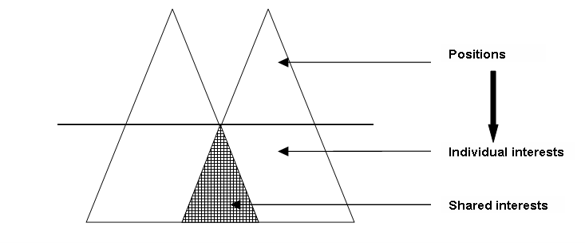
- Seek (Brainstorm) possible solutions.
- Use objective criteria to evaluate possible solutions.
- Identify solutions that all parties can accept (meet common interests).
- Agree on the best solution and to come back to the problem if the solution does not work.
- Look long-term to preserve the relationship.
Review the positions and interests of the Silk Manufacturers, the Union Leaders and the Silk Workers (Handout 7)
The Silk Manufacturers
Position:
- Will not deal with the IWW because it is a lawless organizations
- Will listen to grievances from individual employees
- Will make adjustments only when the strikers return to work.
Interests:
- Maintain a handsome profit on investment—by 1913 Paterson silk manufacturers were caught in declining profits resulting from lower prices due to an increasingly competitive industry
- Reduce labor costs and/or increase labor productivity to remain competitive
- Main managerial control over the terms and conditions of employment
- Wanted satisfied, reliable, loyal, skilled workers: high turnover and work stoppages, walkouts and strikes were costly.
The Silk Workers
Position:
- Tending four looms made one worker do the work of two. It was a physical hardship.
- The for-loom system would result in lower quality.
- Workers wanted more control over the conditions of their employment
- Workers wanted a fair system where greater profits due to increased productivity was shared with the workers.
- Technological improvements were acceptable as long as it was not used solely to reduce their wages.
Interests:
- Management should share the economic benefits of new technology and productivity with workers.
- Unskilled workers simply wanted to improve their hours, wages and working conditions.
- Skilled workers feared the downgrading of skills by the use of machines.
- The only unifying demand was for an eight-hour day.
The I.W.W.
Position:
- The industrial, capitalistic wage system exploited workers and was undemocratic.
- The solution and goal is to replace capitalism with worker management.
- Strikes are battles in the class struggle that will continue until the ultimate victory of workers.
Interests:
- Maintain and enhance the reputation of a labor organization that was tough in dealing with management and could win concessions to improve workers’ income and working conditions.
- Continue the momentum of victory from Lawrence, MA.
- Need to have manufacturers negotiate with them.
Handout and review the Wagner Act (Handout 8). The Wagner Act of 1935 legitimized the right of workers to join labor unions and to bargain collectively on “terms and conditions of employment.”
Sec. 7: Guarantees employees the right to self-organization, to form, join or assist labor organizations, to bargain collectively through representatives of their own choosing, and to engage in other concerted activities for the purpose of collective bargaining…
Sec. 8 defines as unfair labor practices, for an employer:
- to interfere with, restrain or coerce employees in the exercise of rights guaranteed in section 7;
- to interfere with the formation or administration of any labor organization…
- to discriminate in the hiring or tenure of employment or any term or condition of employment; to encourage or discourage membership in a labor organization
- to discharge or otherwise discriminate against an employee because he has filed charges or given testimony under this Act;
- to refuse to bargain collectively with the representatives of his employees.
Employers and employees are required to bargain over “wages, hours, and other terms and conditions of employment.” This has been defined over the years to include wages and fringe benefits, grievance procedures, arbitration, health and safety, nondiscrimination clauses, no-strike clauses, length of contract, management rights, discipline, seniority and union security
Directions for Mock Collective Bargaining (Handout 9)
Set up the groups of 15 around a table.
Step 1: Internal Negotiations
- The manufacturers should meet, discuss their positions and interests, try to identify options that might be acceptable to workers and manufacturers and agree on the best strategy to take to the collective bargaining session with the workers and union reps. and who will represent the manufacturers in the collective bargaining session.
- The silk workers and IWW and AFL union reps should meet, discuss their positions and interests, try to identify options that might be acceptable to workers and manufacturers, and agree on the best strategy to take to the collective bargaining session with the manufacturers and who will represent the workers in the collective bargaining session with the manufacturers
Step 2: Collective Bargaining
- The designated representatives from the workers/unions and the manufacturers will meet for a collective bargaining session
- The representatives will lay out and negotiate their views on hours, wages and conditions of employment and try to come to an agreement on these issues.
- If these negotiations lead to an offer that differs from their internal agreement, either side may ask for a recess to consider the proposal with the internal group
- The observer/recorder/reporters should watch their assigned groups and take notes on the process and the results. The observers do not participate directly in the negotiations.
The Debriefing: What were the outcomes for each negotiating group? (Handout 10)
Debriefing is critical to get your students out of their roles, especially if a student finds his or her role incompatible with his or her personal views. We are not trying to make up history but rather to engage and interest students in what really happened. Ask for comments from the observers in each group (and add your own observations) about:
The Process
- Did the participants use active listening skills?
- Were there missed opportunities for compromise?
- Did rhetoric get in the way of pursuing the interests?
- Were the roles played with historical accuracy?
The Results
- Review the results from each collective bargaining group
- Review what really happened in history
- Compare the results of the mock collective bargaining and what really happened in history
- Consider the reasons for any similarities or differences
The rubrics in the Negotiation Evaluation Form (Handout 11) might be used to evaluate each student’s involvement in the process of negotiating.
What Really Happened in Paterson in 1913? (Handout 12)
Provide oral or written information about what really happened in the Paterson Silk Strike in 1913 or, alternatively, have students research and explain.
The Paterson silk workers had forged an unprecedented united front. However, the manufacturers were equally united and for the first time, the silk manufacturers formed a united Silk Manufacturers Association. They refused to negotiate with the strikers and rejected all attempts at third-party mediation. The owners tried to separate the strikers from the IWW, to split the native-born and immigrants, to pit different ethnic groups against each other. They even invited the United Textile Workers to intervene. But these efforts just made the strikers even more determined. The owners used the power of local government, including the Paterson police, against the strikers: more than 2,200 strikers were arrested mostly for “disorderly conduct” in peaceful picketing. They filled the jails but did little to hurt the strike. The city closed the two halls in which the strikers had been meeting in Paterson, forcing the strikers to meet outside of the city, in nearby Haledon, which had a socialist mayor. The strikers met at the Botto House (now the American Labor Museum ).

Strikers meet at the Botto House in Haledon, just outside of Paterson, 1913, Passaic County Historical Society
The strikers sought to widen their support and fundraising. They staged an innovative “Pageant of the Paterson Silk Strike” in Madison Square Garden in June 1913, to obtain sympathy and support. They had articles and political cartoons supporting their efforts in labor magazines.

Advertisement for the Pageant of the Paterson Silk Strike, from The Masses, June 1913
While the Pageant contributed to the united spirit among the workers, it split the leaders: Haywood supported it but Flynn thought that it diverted the workers attention from the real issue-the strike. The strike turned into an endurance contest. The silk manufacturers had greater resources. They had silk mills in PA and other locations and the strikers were unable to close down mills outside of Paterson. The manufacturers were also supported by other industrialists and most of the newspapers were seeking to halt the growth of the radical IWW. By June 1913, the strikers had used up all personal savings and contributions and were down to one meal a day. The manufacturers ultimately starved the workers back to work after four long months (late February-mid-June, 1913).
Political Cartoon Analysis (Handout 13):

“To Hell with Your Laws,” Political cartoon from Solidarity, June 7, 1913.
Source analysis:
- What is the source? Solidarity
- What kind of publication is “Solidarity”?
- What would be its viewpoint? Pro-strikers
- When was it published? June 1913
- Why was it published? To gain support for the striking silk workers in Paterson
Content analysis:
- What is on the flag? To Hell with Your Laws! I’ll get Harwood, Elizabeth Flynn or anyone else who interferes with my profits.
- Who is the man with the flag? Paterson Silk Manufacturer
- What is the man standing on? Paterson silk manufacturer standing on ripped pages of “free speech,” “right of assembly,” and “child labor” laws.
- Who is the man watching? Uncle Sam = the country
- What is the cartoon trying to say? The Paterson Silk Manufacturers are greedy and don’t care about anything other than making money.
Do you think this is an effective political cartoon? Why or why not?
Compare what really happened with the results of the in-class negotiations and discuss why.
Go to The Paterson Silk Strike of 1913 at The Paterson Silk Strike of 1913.
Discuss the Historical Impact of the Paterson Silk Strike
The political parties responded to some extent to the grievances of organized labor with the Clayton Act in 1914. President Wilson was the first president to address an annual convention of organized labor (the AFL) in 1916. During World War I, President Wilson supported union organization and collective bargaining in industries with government contracts and union membership—almost all of it AFL which supported the war effort—grew dramatically. Debs, as well as the bulk of the Socialist Party, opposed the war. With vigilante actions and government prosecutions, the IWW and the Socialist Party were effectively crushed between 1917 and 1920, along with them the hopes of replacing capitalism with worker management. Instead, a new legal context for labor and management relations was developed, with the support of the Roosevelt administration, which required peaceful collective bargaining but only on issues related to hours, wages and other terms and conditions of employment.
Assessment: Have students respond to the following questions or have a classroom discussion (Handout 14)
- Did the Paterson silk workers and silk mill owners have any common interests? If so, what were they? Could these have been used to achieve a resolution of the workers’ grievances to everyone’s satisfaction?
- Were there ways in which the asymmetrical power relationships between workers and employers in the late 19th and early 20th centuries could have been equalized? How did the Wagner Act of 1935 help to equalize the power of employees and employers?
- Was the 1913 Paterson Silk Strike a failure for the workers? For the manufacturers? For the IWW? For the AFT? Why or why not?
- Discuss the critical role of women in the Paterson Silk Strike? Why were women so involved in the Paterson Silk Strike? Did working class women change their self-perception after taking leadership roles in the strike?
- What roles do unions and government play in regard to American workers today? Labor unions in most European countries are political parties. Here they are lobbyists. Is our system of labor relations working? What might be a better system?
Extension
Visit the American Labor Museum. The Botto House in Haledon, NJ, where the Paterson silk workers met during the 1913 strike has been turned into a museum about the labor movement with a special emphasis on immigrants. It has exhibits, educational programs and other events. For more information go to American Labor Museum.
Visit the Paterson Museum in the former Rogers Locomotive and Machine works building at 2 Market Street in Paterson. The museum aims to preserve and display the industrial history of Paterson. Founded in 1925, it is owned and run by the city of Paterson and its mission is to preserve and display the industrial history of Paterson. The museum is open daily 10 a.m. to 4 p.m. For additional information go to Paterson Museum..
Visit Lambert’s Castle, originally called Belle Vista, is located within the Garret Mountain Reservation at 3 Valley Road in Paterson. Because of its medieval architecture, size and view, it is often used for weddings, concerts, teas and other events. It is open for visits. For more information go to Passaic County Historical Society.
Handout 1
“Lambert’s Castle,” in Paterson, NJ, built by Catholina Lambert in 1892-1893, Courtesy of the Passaic County Historical Society
Handout 2 - 6,000 Weavers Quit
6,000 Weavers Quit; I.W.W. Leaders Held; Paterson Police break up Mass meeting and Arrest Elizabeth Flynn and Carlo Tresca
Under the leadership of William Haywood’s direct action branch of the “Industrial Workers of the World” the silk weavers and dyers here went out on strike today as a protest against new and improved machinery…
When the first 4,000 of the strikers left their looms this morning, they attempted to parade to the other mills in the hope of rallying supporters to their cause the Paterson police force, under command of Police Chief Bimson, bore down on the strikers, seized their leaders and sent the chief of them out of town on an Erie Railroad train.
Disconcerted in their attempt to parade, the strikers attempted to have a mass meeting in a hall they had hired for the occasion. Police Chief Bimson charged upon the meeting place and seized the three principal speakers, among them Elizabeth Gurley Flynn and Carlo Tresca, both I.W.W. leaders associated with the waiters’ strike in New York recently.
The strikers allowed their parade leader to be drummed out of town and allowed the speakers at their mass meeting to be placed under arrest without bringing on a general riot. But for many hours after the arrests the strikers moved in disorganized masses about town, threatening the police and the Mayor and denouncing the treatment accorded them…
Source: The New York Times, February 26, 1913
Handout 3: The Silk Manufacturers
Catholina Lambert began work as a ten-year old boy in a cotton mill in Yorkshire, England. At 17, he had immigrated to the United States and became an office boy in a Boston silk firm. Four years later he purchased a partnership in the firm, renamed it Dexter, Lambert & Co. and moved it to Paterson. There he made enough money from his five silk mills to build an English-style castle and to buy some 400 original paintings by European masters. He was part of the old-line manufacturing group that dominated the Silk Association and the Paterson Board of Trade. Lambert was 79 years old in 1913 and took a very hard line in the strike. He never recovered from the strike. After World War I he was forced to declare bankruptcy and to sell his famous art collection.
Samuel McCollom was another large silk manufacturer in Paterson. He believed that he had the right to hire whomever he pleased. Fed up with workers’ interference, he moved several of his larger factories to rural Pennsylvania. McCollom took a hard line against the unions and strikers in Paterson. He opposed any union. He had been responsible for the restructuring of the local city government which weakened the labor-supported Board of Alderman and created the more powerful, non-elected (and business influenced) Board of Commissioners. McCollom urged silk manufacturers to stand as a united front against the strikers.
Henry Dougherty, Jr. was a proud, independent, aging mill owner who had worked his way up. Arriving in Paterson as a young weaver from England in 1868, he soon became a shop foreman. In 1879, he started his own silk shop with a partner and one loom. Within two years, his business had expanded to 100 looms and 250 workers. In 1910, he built the largest mill in Paterson, with state-of-the-art looms. He increased the loom assignments from two to four. He sought and received prior approval from the AFL’s United Textile Workers, the recognized union of most of the weavers at the time. He was shocked to see the majority of his workers walk out of his fine new mill after they turned to the IWW Local 152 for support. As the strike spread and the months rolled by, Dougherty’s business suffered tremendously. He tried to find some point of accommodation.
Moses Strauss was a successful Jewish manager of two Paterson silk mills, one of which employed male weavers on older, slower, labor-intensive German looms and the other with female weavers on new, high-speed looms. He believed that the skilled male weavers would be replaced in 15-20 years because of technological advances. He had little sympathy for the complaints of the higher-paid male workers. He was paternalistic towards the female workers. Strauss was surprised when in early March 1913 some 200 women and girls walked out of one of the miles because they had never told him that they had any grievances.
Handout 4: The Unions
The American Federation of Labor (AFL) and John Golden. The AFL was a conservative, craft-oriented union. By 1913 it had been in existence for 30 years. At this point it had little interest in recruiting unskilled, female or immigrant workers. The AFL sought shorter working hours and better pay. The AFL and IWW had very different approaches to labor-management relations and were fiercely vying with each other for membership in the early 1900s, especially after the IWW victory for textile workers in Lawrence, MA in 1912. John Golden was president of the AFL’s United Textile Workers Union. He was appalled at the success of the IWW hotheads in the Lawrence, MA strike. To Golden, IWW leaders were anarchists and lawbreakers who urged the uneducated masses of newly arrived immigrants to sabotage businesses and all workers would lose. In April 1913, Golden opened two recruiting offices in Paterson in an effort to offer workers a less radical approach. He had little success because many weavers saw the AFL as a collaborator with Doherty’s plan to implement the four-loom speedup. Golden believed that four looms were inevitable and should be accepted.
The Industrial Workers of the World (IWW) and Bill Haywood. The Industrial Workers of the World (IWW) Founded in 1905 in Chicago and originally spearheaded by western miners and lumberjacks, the IWW became famous in the east after its 1912 victory in the Lawrence, Ma, wool textile strike. Like the Knights of Labor before it and the CIA after it in the 1930s, the IWW reached out to the workers who the AFL would not or could not organize—the unskilled new immigrants from southern and eastern Europeans, women, blacks and Hispanics. The IWW wanted to replace employer management with worker self-management and to abolish the wage system. The IWW believed that class struggle was inevitable. They were skeptical of politics and believed in the power of the strike. The IWW encouraged workers to take increasing democratic responsibilities for running their local shop and their industry until worker management extended everywhere. They saw no legitimacy in management or in conservative unions, such as the AFL which recruited only skilled workers and was narrowly focused on wages and hours. The IWW neither started nor directed the Paterson strike. Its leaders were invited as speakers and advisors. At the height of the strike, almost 10,000 Paterson silk workers joined the IWW.
William “Big Bill” Haywood was president of the IWW. He had participated in the violent labor-management battles in the western mining camps. Haywood was an imposing figure, well over six feet tall. He arrived in Paterson on March 7, 1913 after the strike had already been planned and started. His chief role was to make public speeches stressing worker equality and the need for solidarity to achieve their goals. Haywood was a bridge to New York socialists and philanthropists and helped to plan the “Paterson Pageant” on June 7, 1913.
Ewald Koettgen was the only full-time organizer of the IWW local 152. Of German descent, Koettgen had worked in Paterson as a ribbon weaver since the 1890s. He had been a member of the IWW for several years and was deeply committed to the organization’s radical goals and militant methods. At age 40, he was tall and gaunt, with deep lines in his face. As leader of the IWW silk workers local 152, Koettgen had built his membership to nearly 500. In January 1913, he was elected chairman of the IWW’s National Textile Union. Koettgen was out of town when the Doherty mill workers decided to strike in February 1913 but hurried back to help local 152 sound out its membership about a general strike.
Handout 5: The silk workers
There were several different groups of silk workers. The ribbon weavers highly skilled men and women who wove narrow silks for hat bands and ties. Most of them came from English and German background and were native-born. The broad silk weavers were semi-skilled men and women who worked the machines that wove silk cloth for dresses. Most of them were Catholics from Italy or Jews from Eastern Europe who had immigrated to Paterson within the last 10-15 years. The dyer’s helpers were unskilled men who dyed the silk yarn before it was women. Most of them were from Italy. Although the protest against four-looms only affected the ribbon weavers, the workers demand for an eight-hour day was a unifying cry for all of the silk workers.
|
|
|
Silk ribbon weaver at a Paterson Silk Mill, Passaic County Historical Society. 1906 |
Dyers in a Paterson Silk Mill, Passaic County Historical Society, 1908 |
Adolf Lessig was a broad silk weaver of German descent who had been weaving both cotton and silk since the 1880s. He moved to Paterson in 1902 and briefly joined the AFL but switched to the IWW shortly after it was founded in 1905. When Doherty mill workers decided to walk out to protest working four looms, Lessig inquired among local 152 members in other mills about supporting a general strike. Lessing called a series of mass meetings and formed the executive Strike Committee.
Louis Magnet was an experienced ribbon weaver. He was concerned that many women were moving into the craft and willing to work for less at longer hours. He was an active member in the Socialist Party but did not agree with the industrial radicalism of the IWW. He tried but failed to develop alternatives to the IWW during the strike.
Carrie Golzio was a second-generation broad silk and jacquard weaver. Her parents had been involved in labor disputes back in their native Piedmont region in Northern Italy, as well as in Paterson. Golzio was in her 20s in 1913 and was drawn into the IWW by the dynamic speaking of Elizabeth Gurley Flynn. As a skilled craftsperson, Golzio took pride in the quality of her workmanship. She feared that the four-loom system would reduce the quality of her work. She believed that the mill owners took the workers for granted and was drawn together in a cooperative spirit with eastern European Jewish female silk weavers who worked with her.
Hannah Silverman was a 17-year old skilled Jewish employee who enthusiastically took part in the picketing at the mill. The weekly women-only meetings helped to inspire young girls like Hannah Silverman to emerge as leaders in the strike. Silverman was captain of the pickets and one of the co-directors of the Paterson Strike Pageant at Madison Square Garden.
Scully Bell was an unskilled dye worker from Southern Italy. It was horrible work that often required double shifts just to stay employed. Dyer’s helpers added chemicals to the large vats of boiling water to which the silk yarns were added. The dye house was dirty and always filled with steam and fumes. The dyer’s helpers wore wooden clogs to try to protect their feet from the slop on the floor. The dyer’s helpers were the most easily replaced because the job could be learned in a week.
Handout 6: Steps in Negotiations
- Recognize emotions and avoid having them interfere—avoid “triggers”: verbal or nonverbal behaviors that result in anger or other negative emotional reactions and interfere with the communication between two (or more) people (such as finger pointing, eye rolling, name calling, etc.).
- Use active listening skills: Ask questions, paraphrase, repeat to let the other person know what you think was said.
- Identify the underlying interests: We often take positions that make it difficult to negotiate. However, if we identify the underlying interests, there is often an area of overlapping interests. Consider the following graphic organizer to help your understanding of overlapping interests:
- Seek (Brainstorm) possible solutions.
- Use objective criteria to evaluate possible solutions.
- Identify solutions that all parties can accept (meet common interests).
- Agree on the best solution and to come back to the problem if the solution does not work.
- Look at long-term interests to preserve the relationship.
Handout 7: Positions and Interests
The Silk Manufacturers
Position:
- Will not deal with the IWW because it is a lawless organizations
- Will listen to grievances from individual employees
- Will make adjustments only when the strikers return to work.
Interests:
- Maintain a handsome profit on investment—by 1913 Paterson silk manufacturers were caught in declining profits resulting from lower prices due to an increasingly competitive industry
- Reduce labor costs and/or increase labor productivity to remain competitive
- Main managerial control over the terms and conditions of employment
- Wanted satisfied, reliable, loyal, skilled workers: high turnover and work stoppages, walkouts and strikes were costly.
The Silk Workers
Position:
- Tending four looms made one worker do the work of two. It was a physical hardship.
- The for-loom system would result in lower quality.
- Workers wanted more control over the conditions of their employment
- Workers wanted a fair system where greater profits due to increased productivity was shared with the workers.
- Technological improvements were acceptable as long as they were not used to reduce thier
Interests:
- Management should share the economic benefits of new technology and productivity with workers.
- Unskilled workers simply wanted to improve their hours, wages and working conditions.
- Skilled workers feared the downgrading of skills by the use of machines.
- The only unifying demand was for an eight-hour day.
The I.W.W.
Position:
- The industrial, capitalistic wage system exploited workers and was undemocratic.
- The solution and goal is to replace capitalism with worker management.
- Strikes are battles in ongoing class struggle that ultimately lead to victory for
Interests:
- Maintain and enhance the reputation of a labor organization dealing with management and trying to win concessions to improve workers’ income and working
- Continue the momentum of victory from Lawrence, MA.
- Need to have manufacturers negotiate with them.
Handout 8: Collective Bargaining under the National Labor Relations Act, 29 U.S.C. §§ 151-169, National Labor Relations Act
Sec. 7: Guarantees employees the right to self-organization, to form, join or assist labor organizations, to bargain collectively through representatives of their own choosing, and to engage in other concerted activities for the purpose of collective bargaining…
Sec. 8: Defines as unfair labor practices, for an employer:
- to interfere with, restrain or coerce employees in the exercise of rights guaranteed in section 7;
- to interfere with the formation or administration of any labor organization…;
- to discriminate in the hiring or tenure of employment or any term or condition of employment; to encourage or discourage membership in a labor organization;
- to discharge or otherwise discriminate against an employee because he has filed charges or given testimony under this Act;
- to refuse to bargain collectively with the representatives of his employees.
Employers and employees are required to bargain over “wages, hours, and other terms and conditions of employment.” This has been defined over the years to include wages and fringe benefits, grievance procedures, arbitration, health and safety, nondiscrimination clauses, no-strike clauses, length of contract, management rights, discipline, seniority and union security.
Handout 9: Directions for the Collective Bargaining Negotiations
Step 1: Internal Negotiations
- The manufacturers should meet, discuss their positions and interests, try to identify options that might be acceptable to workers and manufacturers and agree on the best strategy to take to the collective bargaining session with the workers and union reps. and who will represent the manufacturers in the collective bargaining session.
- The silk workers and IWW and AFL union reps should meet, discuss their positions and interests, try to identify options that might be acceptable to workers and manufacturers, and agree on the best strategy to take to the collective bargaining session with the manufacturers and who will represent the workers in the collective bargaining session with the manufacturers.
Step 2: Collective Bargaining
- The designated representatives from the workers/unions and the manufacturers will meet for a collective bargaining session.
- The representatives will lay out and negotiate their views on hours, wages and conditions of employment and try to come to an agreement on these issues.
- If these negotiations lead to an offer that differs from their internal agreement, either side may ask for a recess to consider the proposal with the internal group.
- The observer/recorder/reporters should watch their assigned groups and take notes on the process and the results. The observers do not participate directly in the negotiations.
Handout 10: Debriefing:
What happened and what were the results from each negotiating group?
The Process:
- Did the participants use active listening skills?
- Were there missed opportunities for compromise?
- Did rhetoric get in the way of pursuing the interests?
- Were the roles played with historical accuracy?
The Results:
- Review the results from each collective bargaining group.
- Review what really happened in history.
- Compare the results of the mock collective bargaining and what really happened in history.
- Consider the reasons for any similarities or differences.
Handout 11: Negotiation Evaluation Form
|
Rubrics/Scores |
Excellent - 4 |
Good - 3 |
Needs improvement - 2 |
Poor – 1 |
|
Separating emotions and issues |
Emotions identified and separated from the issues; no triggers or interruptions. |
Emotions identified. Minimal triggers used and/or interruptions made. |
Emotions identified. Triggers used frequently and/or interrupts often. |
Emotions not identified. Triggers used frequently. Interrupts often. |
|
Identification of issues and interests |
Issues clearly identified. Underlying interests of both sides clearly understood. |
Issues and own interests identified but no effort to understand interests of the other side. |
Effort to identify issues. Positions repeated. Interests of self or other side not identified. |
No effort to identify issues or interests. Positions repeated or no solid position taken. |
|
Active listening—providing feedback |
Pay attention. Asks clarifying questions, paraphrases, makes his/her understanding clear, and shares relevant information. |
Pay attention. Seeks information by questioning, paraphrasing or restating and shares some relevant information. Tries to communicate understanding. |
Eye contact. Seeks but does not share information. Irrelevant comments made. Understanding of issues not clearly communicated. |
No eye contact. No effort to seek or offer additional information. Not paying attention. Understanding of issues not clearly communicated. |
|
Brainstorming possible solutions |
Seeks a wide variety of possible solutions and withholds judging them until after a full list has been developed. |
Seeks a limited number of alternative solutions and immediately eliminates some of them. |
Seeks a limited number of alternative solutions and immediately judges and discards most. |
Little or no effort to brainstorm a variety of possible solutions to the conflict. Monopolizes the discussion. |
|
Evaluating possible solutions |
Considers pros and cons of possible solutions by reference to objective criteria and interests of the parties. |
Considers the pros and cons of possible solutions with reference to the interests of the parties but no objective criteria. |
Considers the possible solutions but without reference to the interests of the parties or objective criteria. |
Little or no consideration of the merits of the possible solutions. |
|
Delivery and presentation |
The speaker uses facts, background and references to similar situations or analogies; is articulate and convincing. |
The speaker refers to facts or background; (makes analogies) is clear but unconvincing. |
The speaker includes a few references to facts or background; (analogies) is awkward or unconvincing. |
The speaker includes no reference to facts or background (no analogies); speaks in generalizations. |
|
Cooperation |
Offers suggestions; considers ideas of others; tries to find a resolution. |
Offers suggestions and considers ideas of others. |
Offers suggestions but does not cooperate with the other side. |
Makes no effort to work with others to try to find a solution. |
Handout 12: What really happened in Paterson in 1913?
The Paterson silk workers had forged an unprecedented united front. However, the manufacturers were equally united and for the first time, the silk manufacturers formed a united Silk Manufacturers Association. They refused to negotiate with the strikers and rejected all attempts at third-party mediation. The owners tried to separate the strikers from the IWW, to split the native-born and immigrants, to pit different ethnic groups against each other. They even invited the United Textile Workers to intervene. But these efforts just made the strikers even more determined. The owners used the power of local government, including the Paterson police, against the strikers: more than 2,200 strikers were arrested mostly for “disorderly conduct” in peaceful picketing. They filled the jails but did little to hurt the strike. The city closed the two halls in which the strikers had been meeting in Paterson, forcing the strikers to meet outside of the city, in nearby Haledon, which had a socialist mayor. The strikers met at the Botto House (now the American Labor Museum ).
Strikers meet at the Botto House in Haledon, just outside of Paterson, 1913. Courtesy of the Passaic County Historical Society
The strikers sought to widen their support and fundraising. They staged an innovative “Pageant of the Paterson Silk Strike” in Madison Square Garden in June 1913, to obtain sympathy and support.
Advertisement for the Pageant of the Paterson Silk Strike, from The Masses, June 1913
While the Pageant contributed to the united spirit among the workers, it split the leaders: Haywood supported it but Flynn thought that it diverted the workers attention from the real issue-the strike.
The strike turned into an endurance contest. The silk manufacturers had greater resources. They had silk mills in PA and other locations and the strikers were unable to close down mills outside of Paterson. The manufacturers were also supported by other industrialists and most of the newspapers were seeking to halt the growth of the radical IWW. By June 1913, the strikers had used up all personal savings and contributions and were down to one meal a day. The manufacturers ultimately starved the workers back to work after four long months (late February-mid-June, 1913).
Handout 13: Political Cartoon Analysis
The strikers had articles and political cartoons supporting their efforts in labor magazines. Analyze this political cartoon.
“To Hell with Your Laws,” from Solidarity, June 7, 1913.
Source analysis:
- What is the source?
- What kind of publication is “Solidarity”?
- What would be its viewpoint?
- When was it published?
- Why was it published?
Content analysis:
- What is on the flag?
- Who is the man with the flag?
- What is the man standing on?
- Who is the man watching?
- What is the cartoon trying to say?
- Do you think this is an effective political cartoon? Why or why not?
Handout 14: Questions
- Did the Paterson silk workers and silk mill owners have any common interests? If so, what were they? Could these have been used to achieve a resolution of the workers’ grievances to everyone’s satisfaction?
- Were there ways in which the asymmetrical power relationships between workers and employers in the late 19th and early 20th centuries could have been equalized? How did the Wagner Act of 1935 help to equalize the power of employees and employers?
- Was the 1913 Paterson Silk Strike a failure for the workers? For the manufacturers? For the IWW? For the AFT? Why or why not?
- Discuss the critical role of women in the Paterson Silk Strike? Why were women so involved in the Paterson Silk Strike? Did working class women change their self-perception after taking leadership roles in the strike?
- What roles do unions and government play in regard to American workers today? Labor unions in most European countries are political parties. Here they are lobbyists. Is our system of labor relations working? What might be a better system?
Standard Oil of New Jersey and the Effort to End Monopolies

Vintage Esso billboard advertisements. July 1940
Creators: MaryAnn Kopp, Orange Prep Academy, Orange, NJ and Richard Kopp, Golden Door Charter School, Jersey City, NJ
Grade level: Secondary
Objectives: Students will be able to:
- explain the concept of monopolies
- explain how Rockefeller created the Standard Oil Trust
- explain the purpose and language of the Sherman Antitrust Act (1890)
- analyze and evaluate newspaper and magazine articles about Standard Oil
- analyze political cartoons and political advertisements
- analyze the U.S. Supreme Court decision, Standard Oil Co. of NJ v. The United States (1911)
- determine the impact of predatory monopolistic behavior on consumers
- take and defend a position of whether the government should regulate private business in order to protect consumers from predatory monopolistic practices
New Jersey Student Learning Standards for Social Studies
6.1.12.EconEM.5.a: Assess the impact of governmental efforts to regulate industrial and financial systems in order to provide economic stability.
6.1.12.EconEM.5.b: Analyze the economic practices of corporations and monopolies regarding the production and marketing of goods and determine the positive or negative impact of these practices on individuals and the nation and the need for government regulations.
6.1.12.CivicsPR.6.a: Use a variety of sources from multiple perspectives to evaluate the effectiveness of Progressive reforms in preventing unfair business practices and political corruption and in promoting social justice.
6.1.12.GeoHE.6.a: Compare and contrast issues involved in the struggle between the unregulated development of natural resources and efforts to conserve and protect natural resources during the period of industrial expansion.
Compelling Questions:
- What is the impact of a monopoly on consumers?
- Should the United States government be involved in regulating privately owned businesses?
- What is more important to New Jerseyans: a successful Standard Oil, or federal laws being followed?
Supporting Questions:
- What is a monopoly?
- How does a monopoly hurt consumers?
- Who was John D. Rockefeller?
- How did he create Standard Oil?
- Why was Standard Oil a New Jersey company?
- What is the Sherman Antitrust Act?
- Who is Ida Tarbell?
- What did she do to try to bring an end to monopolies in the U.S.?
- How did Standard Oil continue to operate after it was ordered by the government to dissolve the trust in 1892?
- How did Standard Oil of NJ v United States help end the monopolies on oil that we still use today?
- Are potential monopolies still a problem today? Why?
Key Terms/People:
- John D. Rockefeller
- Monopoly
- Trusts
- Horizontal integration
- Vertical Integration
- Undercutting
- Price fixing
- Holding company
- Sherman Antitrust Act
- Ida Tarbell
- Muckrakers
1. What is a Monopoly?
Anticipatory activity: To begin this lesson, tell students that you want to purchase a pen from somebody. Ask whether any of them have a pen that they would be willing to sell. Tell them to write down on a piece of paper the price that they would charge for a pen, using the pen they wish to sell. Also ask them to help you decide which pen you should purchase by identifying what information you should think about in making your decision? (The students may suggest that you should think about which pen you want, and that you should try to purchase it for the lowest possible price. If the students do not suggest these ideas on their own, raise them for the students. Ask them to explain why these ideas make sense.)
Now tell the students to imagine that one student in the class owned all of the pens in the classroom. Also tell the students that you are able to buy a pen only from somebody in the class. Ask students to explain how this scenario might influence the price of the pen and the quality of the pen being sold. (Here you would like to hear the students state that if one person owned all of the pens, that person could charge more money for them and sell lower-quality pens. Ask the students to explain why this is true. They should recognize that since only one person was selling pens, this individual would not have to worry about either the price set by other people or the quality of the pens that other people were selling.)
When the activity is complete, explain to students that this scenario is an example of a monopoly. (From http://www.econedlink.org/teacher-lesson/686)
Definition: A monopoly is a market structure characterized by a single seller of a unique product with no close substitutes. Consequently, there is essentially no competition in the market. This is one of four basic market structures. The other three are perfect competition, oligopoly, and monopolistic competition. The demand for a monopolistic firm's output is the market demand. This gives the firm extensive market control--the ability to control the price and/or quantity of the goods sold--making a monopoly firm a price maker. However, while a monopoly can control the market price, it cannot charge more than the maximum demand price that buyers are willing to pay.
Ask the students to explain this definition in their own words. Then shift the discussion: ask the students if they think it is fair for monopolies to exist. Urge them to support their opinions. As the students share their opinions, take notes on the board. Encourage ideas that both support and oppose monopolies.
How does a monopoly hurt consumers? In the absence of government intervention, a monopoly is free to set any price it chooses, and this price is generally the one that leads to the largest possible profit. Characteristically, monopolies charge higher prices than if there was competition. They also limit the options available and limit innovation. Adam Smith, who is hailed as the father of free markets, condemned business monopolies. In this epic work, The Wealth of Nations (1776), Smith argued that monopolies hurt the public by reducing choice, efficiency, and progress while raising prices to whatever levels the monopolists deems necessary to their desired profit.
2. Who was John D. Rockefeller? How and why did he create Standard Oil of New Jersey?
John D. Rockefeller c. 1872, shortly after founding Standard Oil, Source: The History of Standard Oil Company. November 1904.
Background: (Teachers may share this background as a reading assignment)
Born into a modest working-class family in upstate New York, John D. Rockefeller entered the then-fledgling oil business in 1863 by investing in a Cleveland, Ohio refinery. Discovery of oil in Titusville, Pennsylvania just before the Civil War led to the rapid growth of a new industry based largely on the use of kerosene for lighting. Oil refining became largely concentrated in Cleveland because of its proximity to the oil fields of Western Pennsylvania, its excellent (and competitive) railroad service, its availability of cheap water transportation (on adjacent Lake Erie) and its abundant supplies of low-cost immigrant labor. In 1870, he joined three others to establish Standard Oil. At that time, the refining industry was highly decentralized, with more than 250 competitors in the U.S. By the early 1880s, Standard Oil controlled some 90 percent of U.S. refineries and pipelines.
The company was an innovator in the development of the business “trust.” In 1882, all of its properties and those of its affiliates were merged into the Standard Oil Trust,. A trust was an arrangement whereby the stockholders in a group of companies transferred their shares to a single set of trustees who controlled all of the companies. In exchange, the stockholders received certificates entitling them to a specified share of the consolidated earnings of the jointly managed companies.
In 1885, Standard Oil of Ohio moved its headquarters from Cleveland to its permanent headquarters in New York City. Concurrently, the trustees of Standard Oil of Ohio chartered the Standard Oil Co. of New Jersey (SOCNJ) to take advantage of New Jersey's more lenient corporate stock ownership laws. After enacting laws in 1888-89 that permitted one company to own another, New Jersey became the preferred state for trust incorporations.
Standard Oil had previously purchased 176 acres of land on Constable Hook in Bayonne, the site of marine transfer operations for the Port of New York and New Jersey, in 1872, and by 1885 there was a pipeline connecting it to the field of Texas. On July 4, 1900, a fire broke out in the Constable Hook Standard Oil refinery in Bayonne. It started when lightning caused a number of the large oil tanks to explode. Flaming oil spread out into New York Bay. It took three days to extinguish the fire that in the end caused nine injuries and $2.5 million in damages. In 1906, Standard Oil expanded its operations to over 300 acres at Constable Hook in Bayonne. The following year it purchased several hundred acres in Linden and Elizabeth, New Jersey, as well as on the New York harbor. Standard Oil built a large facility for processing crude oil that became Bayway, a leading research facility as well as the most northern oil refinery on the east coast of the United States.
Standard Oil dominated the oil products market initially through horizontal integration in the refining sector. Horizontal integration can be defined as the process of creating or acquiring production units that are complementary or competitive ( e.g., buying competitors in the same industry doing the same stage of development to reduce competition). Horizontal integration - Wikipedia In later years, Standard Oil engaged in vertical integration defined as the process of integrating multiple stages of production along its production path or supply chain to promote financial growth and efficiency ( e.g. growing raw materials, manufacturing, transporting, marketing, and/or retailing). Vertical integration - Wikipedia
Using these and other practices, Standard Oil trust streamlined production and logistics, lowered costs, and undercut competitors. Critics accused Rockefeller of engaging in unethical practices, such as predatory pricing and colluding with railroads to eliminate his competitors, in order to gain a monopoly in the industry.
In 1911, the U.S. Supreme Court found Standard Oil in violation of anti-trust laws and ordered it to dissolve. With the dissolution of the Standard Oil trust into 33 smaller companies, Rockefeller became the richest man in the world. During his life Rockefeller donated more than $500 million to various philanthropic causes.
Activity 2: Standard Oil business practices and the Sherman Antitrust Act
In the United States, we value competition in our market system. Competition and the self-interest of consumers are regulating forces in the US economy. They work together to keep prices low, bring new products to the marketplace, and foster innovations that can bring down the cost of doing business.
But are there times when one supplier in a market is better than a competitive market? Should the government work to protect that one supplier in a market? This lesson will explore the idea of monopolies and the actions the government uses when faced with monopolies.
Have students review Handout 1- Rockefeller's Practices, which details examples of ways that Rockefeller used the size and clout of Standard Oil to undercut competitors:
- Temporarily undercutting the prices of competitors until they either went out of business or sold out to Standard Oil.
- Buying up the components needed to make oil barrels in order to prevent competitors from getting their oil to customers.
- Using its large and growing volume of oil shipments to negotiate an alliance with the railroads that gave it secret rebates and thereby reduced its effective shipping costs to a level far below the rates charged to their competitors.
- Secretly buying up competitors and then having officials from those companies spy on and give advance warning of deals being planned by other competitors.
- Secretly buying up or creating new oil-related companies, such as pipeline and engineering firms, that appeared to be independent operators but which gave Standard Oil hidden rebates.
- Dispatching thugs who used threats and physical violence to break up the operations of competitors who could not otherwise be persuaded.
Adapted from: The Dismantling of The Standard Oil Trust
Background: What is the Sherman Antitrust Act?
Share Handout 2 - The Sherman Antitrust Act with students. Contrary to popular belief, monopolies are not illegal in the United States. What is illegal is actions taken by monopolies to limit competition. The Sherman Antitrust Act (Sherman Act, July 2, 1890, ch. 647, 26 Stat. 209, 15 U.S.C. 1–7) was the first United States Federal statute to limit cartels and monopolies.
The Act provides: "Every contract, combination in the form of trust or otherwise, or conspiracy, in restraint of trade or commerce among the several States, or with foreign nations, is declared to be illegal".
The Act also provides: "Every person who shall monopolize, or attempt to monopolize, or combine or conspire with any other person or persons, to monopolize any part of the trade or commerce among the several States, or with foreign nations, shall be deemed guilty of a felony.
The Act put responsibility upon government attorneys and district courts to pursue and investigate trusts, companies and organizations suspected of violating the Act.
Later, in 1914, the Clayton Act extended the right to sue under the antitrust laws to "any person who shall be injured in his business or property by reason of anything forbidden in the antitrust laws.". Under the Clayton Act, private parties may sue in U.S. district court and should they prevail, they may be awarded treble damages and the cost of suit, including reasonable attorney's fees.
See Sherman Anti-Trust Act (1890) | National Archives
Activity 3: Analyzing a political cartoon
Teachers share Handout 3 - King of the World with the students. Have students answer the following:
- What do you see? (Make a list)
- Who is depicted in this political cartoon?
Is the artist in support of monopolies and against monopolies? Explain.

John D. Rockefeller, "King of the World", Source: Puck Magazine. 1901
Some of what your students should identify are:
- Rockefeller is sitting on top of a platform labeled Standard Oil (Company name)
- Rockefeller is dressed in king’s attire with money signs all in his robe.
- Serious look on his face
- The huge crown atop his head.
- Four railroad companies that Rockefeller owned and used to transport his oil.
- Reading R.R (Monopoly board game)
- Jersey Central R.R
- Paul R.R
- Lehigh Valley R.R
- Dollar sign on top of his crown
- The Background is a ruined/destroyed United States.
- Dark grey skies, industry across the land.
- No trees.
Activity 4: Close Reading
Background: Who is Ida Tarbell?
Ida Minerva Tarbell was born in 1857 in northwestern Pennsylvania. She grew up amid the derricks of the oil region. Her father became an oil producer and refiner until a hidden agreement between the railroads and refiners led by John D. Rockefeller in 1872 hit the Pennsylvania oil region like a tidal wave. After graduating from Allegheny College, the sole woman in the class of 1880, Tarbell moved to Ohio to teach science, but resigned after two years and turned to writing.
The rapidly changing economic landscape and the rise of monopolistic trusts was "disturbing and confusing people," wrote Tarbell. A new generation of investigative journalists, later dubbed "muckrakers" by President Theodore Roosevelt, had set out to wage a campaign to expose corruption in business and political lawlessness. Tarbell latched onto the idea of using the story of Standard Oil to illustrate these troubling issues, persuading McClure Magazine to publish a three-part series on the oil trust. Instantly popular with readers, "The History of the Standard Oil Company" grew to be a 19-part series, published between November 1902 and October 1904.
Tarbell wrote a detailed exposé of Rockefeller's unethical tactics, sympathetically portraying the plight of Pennsylvania's independent oil workers. Still, she was careful to acknowledge Rockefeller's brilliance and the flawlessness of the business structure he had created. She did not condemn capitalism itself, but "the open disregard of decent ethical business practices by capitalists." About Standard Oil, she wrote: "They had never played fair, and that ruined their greatness for me."
Directions: Have students read Handout 4 - The Woman Who Took on the Tycoon.
- Instruct the students to closely read and annotate as they read:
- underlining and starring the important points
- putting a question mark next what is confusing
- circling any word that they do not understand
- Once the students have completed the exercise themselves, the teacher will then go through the article with the students to help their understanding
- Students will then complete the critical thinking questions about the article and Ida Tarbell. (Hand Out 5 - The Woman Who Took on the Tycoon - Worksheet)
Activity 5: Standard Oil Co. of New Jersey v. U.S. (1911)
Have students listen to Rockefeller’s two minute speech to the court from “The Men Who Built America” at Rockefeller court speech from The Men Who Built America.
Possible questions after student viewing:
- What does the judge accuse Standard Oil of doing and how? Does John D. Rockefeller address these accusations?
- John D. Rockefeller does not deny his company's actions. Instead he reminds the court of all the jobs his company provides, millions of dollars he made for the United States. Do these things outweigh his actions? Why or why not?
Homework: Invite students to read Handout 2 - The Sherman Antitrust Act and Standard Oil and the Sherman Anti‐Trust Act. Then complete the Handout 6 - Standard Oil and the Sherman Antitrust Act - Worksheet.
- What was John D. Rockefeller’s role in the Standard Oil Company?
- How did lowering prices help Standard Oil Company attract new customers?
- How did buying other oil companies help Standard Oil gain control of the oil industry?
- Why do you think that the United State Congress prohibited monopolies and trusts?
After the students have completed this work, reconvene the class. Call on students to share their answers with one another. (Possible answer in italics)
- What was John Rockefeller’s role in the Standard Oil Company? John Rockefeller invested in the Standard Oil Company so that the company could afford to expand its operations.
- How did lowering prices help Standard Oil Company attract new customers? Standard Oil Company had more money than its competitors. Therefore, they were able to survive on less income. Standard Oil could afford to cut their prices. Other companies that lacked financial infrastructure could not afford to reduce their prices. Consequently, when Standard Oil cut their prices other companies’ customers purchased Standard Oil.
- How did buying other oil companies help Standard Oil gain control of the oil industry? Standard Oil Company not only bought the other companies’ oil, they also bought the other companies’ customers. As Standard Oil added to its customer base it increased its control of the oil industry. 4. Why do you think that the United States Congress prohibited monopolies and trusts?
Invite students to read Handout 7: Excerpts from the U.S. Supreme Court decision, Standard Oil Co. of New Jersey v. United States, 221 U.S. 1 (1911) before discussing question 4
- Compare and discuss question 4: Why do you think that the United State Congress prohibited monopolies and trusts?.
Activity 6: Standard Oil Today
Following U.S. Supreme Court decisions in 1911, Standard Oil was broken into 33 separate companies as Rockefeller became the richest man in the world. In 1926, Jersey Standard marketed a new blend of fuel under the trade name Esso., based on the phonetic rendition of the initials ‘S’ and ‘O,’ In 1972, the name was officially changed to Exxon, and in 1999, Exxon and Mobile joined to become the Exxon Mobil Corporation. The company evolved from a domestic refiner and distributor of kerosene to a large multinational corporation, involving every level of oil and gas exploration, production, refining and marketing, and petrochemicals manufacturing.
Cartoon Analysis: Provide students Handout 8 - Standard Has Everything.

Handout 8: This 1932 Standard Oil Company (New Jersey) advertisement is among those preserved by the Dr. Seuss Collection of the Mandeville Special Collections Library at the University of California, San Diego. Source: http://aoghs.org/editors-picks/seuss-the-oilman/
Ask students to consider the following questions
- What do you see?
- What is this?
- Who do you think was the artist?
- Does it look like the break-up of Standard Oil hurt the company?
Environmental Clean-up. Share the following background with students: In 2004, the state of New Jersey filed a lawsuit against Exxon Mobil, claiming that it had polluted 1500 acres of wetlands and surrounding natural environment where it had run its petrochemical operations for decades. Exxon Mobil was found to be responsible for cleaning up the environmental damage at its Constable Hook facilities in Bayonne and its Bayway facility in Linden, NJ, as well as at 16 other facilities and roughly 1700 gas stations across the state. The clean-up at Constable Hook included excavation, stabilization, capping, and the capturing of ground water contamination and installation of steel wall containment systems. The state originally requested $8.9 billion for the clean-up. However, Governor Christie agreed to a $225 million settlement.
Critical Thinking Exercise: Do you think that corporations should be held liable to clean up any damage they cause to the environment by their operations? Or should the public pay to clean-up environmental damage because it has benefitted from the products produced and such corporate liability might inhibit economic progress and jobs? Support your answer.
Activity 7: Assessment
Have students write a short essay answering one of the following questions:
- Do you think that Standard Oil should have been broken up? Support your conclusion with reasoning and facts.
- Do you think that the U.S. government should be less or more involved in regulating big businesses? Support your conclusion with specific examples and balancing of the potentially positive and negative effects of monopolies.
- Select one of the examples below (telephones, computer operating systems or airlines)) and discuss whether you think monopolistic behavior was/is involved and whether a merger should be allowed or a break-up required. Support your conclusion with evidence.
- Telephones: AT&T and the Department of Justice settled the antitrust case against AT&T when AT&T agreed to break itself up into several firms in 1984. One firm, AT&T, would provide long-distance service, and seven other firms ("Baby Bells") would provide local telephone service in different regions. The Department of Justice found that a vertically integrated telephone company, one that provided local and long-distance service, was not required for productive efficiency, or that there were other offsetting gains from the divestiture. According to the Department of Justice, the vertical structure of the company provided an opportunity for unfair competition against other providers of long-distance service. Since 1984, the technology and industry structure have changed rapidly. The AT&T break-up probably helped upstart fiber-optic long-distance firms Sprint and MCI, who did not own local lines and had to compete with the integrated AT&T network. Severing AT&T’s local networks put all three on the same footing. But in other ways, the break up was more ceremony than substance. Each of the seven “Baby Bells” still controlled the local communications network in its region. All that changed for most consumers of local phone services was the name at the top of the bill. Meanwhile, rival networks from outside the traditional telecom world were just beginning to bubble, and they would not only moot the local-long-distance distinctions at the heart of the AT&T split but also transform communications in more fundamental ways.
- Computer operating systems: The court concluded in 2002 that Microsoft maintained its monopoly power by anticompetitive means and attempted to monopolize the Web browser market.
- Airlines: As the world has become more global, many large U.S. corporation have been growing and fighting off international competition through mergers and the U.S. Justice Department has been allowing them. For example, the recent merger of Continental and United Airlines was allowed and has resulted in reduced competition and higher prices at Newark and JFK airports.
Additional Resources for Teachers:
- The Dismantling of The Standard Oil Trust
- Standard Oil Co. of New Jersey v. United States at STANDARD OIL COMPANY OF NEW JERSEY et al., Appts., v. UNITED STATES. | Supreme Court
- Supreme Court Orders Standard Oil to be Broken Up, at https://archive.nytimes.com/learning.blogs.nytimes.com/2012/05/15/may-15-1911-supreme-court-orders-standard-oil-to-be-broken-up/?_r=0
- Monopoly, by George J. Stigler at Monopoly - Econlib
Handout 1 - Rockefeller’s Practices
Examples of ways that Rockefeller used the size and clout of Standard Oil to undercut competitors:
- Temporarily undercutting the prices of competitors until they either went out of business or sold out to Standard Oil.
- Buying up the components needed to make oil barrels in order to prevent competitors from getting their oil to customers.
- Using its large and growing volume of oil shipments to negotiate an alliance with the railroads that gave it secret rebates and thereby reduced its effective shipping costs to a level far below the rates charged to its competitors.
- Secretly buying up competitors and then having officials from those companies spy on and give advance warning of deals being planned by other competitors.
- Secretly buying up or creating new oil-related companies, such as pipeline and engineering firms, that appeared be independent operators but which gave Standard Oil hidden rebates.
- Dispatching thugs who used threats and physical violence to break up the operations of competitors who could not otherwise be persuaded.
Adapted from: The Dismantling of The Standard Oil Trust
Handout 2: The Sherman Antitrust Act, 1890
The Sherman Antitrust Act (Sherman Act, July 2, 1890, ch. 647, 26 Stat. 209, 15 U.S.C. 1–7) was the first United States Federal statute to limit cartels and monopolies.
The Act provides: "Every contract, combination in the form of trust or otherwise, or conspiracy, in restraint of trade or commerce among the several States, or with foreign nations, is declared to be illegal".
The Act also provides: "Every person who shall monopolize, or attempt to monopolize, or combine or conspire with any other person or persons, to monopolize any part of the trade or commerce among the several States, or with foreign nations, shall be deemed guilty of a felony.
The Act put responsibility upon government attorneys and district courts to pursue and investigate trusts, companies and organizations suspected of violating the Act.
Later, in 1914, the Clayton Act extended the right to sue under the antitrust laws to "any person who shall be injured in his business or property by reason of anything forbidden in the antitrust laws.". Under the Clayton Act, private parties may sue in U.S. district court and should they prevail, they may be awarded treble damages and the cost of suit, including reasonable attorney's fees.
Adapted from: Sherman Anti-Trust Act (1890) | National Archives
Handout 3 - King of the World
John D. Rockefeller, "King of the World,", Source: Puck Magazine. 1901.
- What do you see in this cartoon? (make a list)
- Who is depicted in this political cartoon?
- Is the artist in support of monopolies and against monopolies?
Handout 4 - The Woman Who Took on the Tycoon
 By Gilbert King , smithsonian.com (2012), The Woman Who Took on the Tycoon
At the age of 14, Ida Tarbell witnessed the Cleveland Massacre (History of Standard Oil: The Cleveland Massacre) in which dozens of small oil producers in Ohio and Western Pennsylvania, including her father, were faced with a daunting choice that seemed to come out of nowhere: sell their businesses to the shrewd, confident 32 year-old John D. Rockefeller, Sr. and his newly incorporated Standard Oil Company, or attempt to compete and face ruin. She didn’t understand it at the time, not all of it, anyway, but she would never forget the wretched effects of “the oil war” of 1872, which enabled Rockefeller to leave Cleveland owning 85 percent of the city’s oil refineries.
Tarbell was, in effect, a young woman betrayed, not by a straying lover but by Standard Oil’s secret deals with the major railroads—a collusive scheme that allowed the company to crush not only her father’s business, but all of its competitors. Almost 30 years later, Tarbell would redefine investigative journalism with a 19-part series in McClure’s magazine, a masterpiece of journalism and an unrelenting indictment that brought down one of history’s greatest tycoons and effectively broke up Standard Oil’s monopoly. By dint of what she termed “steady, painstaking work,” Tarbell unearthed damaging internal documents, supported by interviews with employees, lawyers and—with the help of Mark Twain—candid conversations with Standard Oil’s most powerful senior executive at the time, Henry H. Rogers, which sealed the company’s fate.
She became one of the most influential muckrakers of the Gilded Age, helping to usher in that age of political, economic and industrial reform known as the Progressive Era. “They had never played fair,” Tarbell wrote of Standard Oil, “and that ruined their greatness for me.
Ida Minerva Tarbell was born in 1857, in a log cabin in Hatch Hollow, in Western Pennsylvania’s oil region. Her father, Frank Tarbell, spent years building oil storage tanks but began to prosper once he switched to oil production and refining. “There was ease such as we had never known; luxuries we had never heard of,” she later wrote. Her town of Titusville and surrounding areas in the Oil Creek Valley “had been developed into an organized industry which was now believed to have a splendid future. Then suddenly this gay, prosperous town received a blow between the eyes.”
That blow came in the form of the South Improvement Company, a corporation established in 1871 and widely viewed as an effort by Rockefeller and Standard Oil in Ohio to control the oil and gas industries in the region. In a secret alliance with Rockefeller, the three major railroads that ran through Cleveland—the Pennsylvania, the Erie and the New York Central—agreed to raise their shipping fees while paying “rebates” and “drawbacks” to him.
 Word of the South Improvement Company’s scheme leaked to newspapers, and independent oilmen in the region were outraged. “A wonderful row followed,” Tarbell wrote. “There were nightly anti-monopoly meetings, violent speeches, processions; trains of oil cars loaded for members of the offending corporation were raided, the oil run on the ground, their buyers turned out of the oil exchanges.
Tarbell recalled her father coming home grim-faced, his good humor gone and his contempt directed no longer at the South Improvement Company but at a “new name, that of the Standard Oil company.” Franklin Tarbell and the other small oil refiners pleaded with state and federal officials to crack down on the business practices that were destined to ruin them, and by April of 1872 the Pennsylvania legislature repealed the South Improvement Company’s charter before a single transaction was made. But the damage had already been done. In just six weeks, the threat of an impending alliance allowed Rockefeller to buy 22 of his 26 competitors in Cleveland. “Take Standard Oil Stock,” Rockefeller told them, “and your family will never know want.” Most who accepted the buyouts did indeed become rich. Franklin Tarbell resisted and continued to produce independently, but struggled to earn a decent living. His daughter wrote that she was devastated by the “hate, suspicion and fear that engulfed the community” after the Standard Oil ruckus. Franklin Tarbell’s partner, “ruined by the complex situation,” killed himself, and Tarbell was forced to mortgage the family home to meet his company’s debts.
Rockefeller denied any conspiracy at the time, but years later, he admitted in an interview that “rebates and drawbacks were a common practice for years preceding and following this history. So much of the clamor against rebates and drawbacks came from people who knew nothing about business. Who can buy beef the cheaper—the housewife for her family, the steward for a club or hotel, or the quartermaster or commissary for an army? Who is entitled to better rebates from a railroad, those who give it for transportation 5,000 barrels a day, or those who give 500 barrels—or 50 barrels?”
Presumably, with Rockefeller’s plan uncovered in Cleveland, his efforts to corner the market would be stopped. But in fact, Rockefeller had already accomplished what he had set out to do. As his biographer Ron Chernow wrote, “Once he had a monopoly over the Cleveland refineries, he then marched on and did the same thing in Pittsburgh, Philadelphia, Baltimore, New York and the other refining centers. So that was really the major turning point in his career, and it was really one of the most shameful episodes in his career.”
Still a teenager, Ida Tarbell was deeply impressed by Rockefeller’s machinations. “There was born in me a hatred of privilege, privilege of any sort,” she later wrote. “It was all pretty hazy, to be sure, but it still was well, at 15, to have one definite plan based on things seen and heard, ready for a future platform of social and economic justice if I should ever awake to my need of one.”
At age 19, she went to Allegheny College in Meadville, Pennsylvania. But after studying biology, Tarbell came to realize that she preferred writing. She took an editing job for a teaching publication and eventually worked her way up to managing editor before moving to Paris in 1890 to write. It was there that she met Samuel McClure, who offered her a position at McClure’s magazine. There, Tarbell wrote a long and well-received series on Napoleon Bonaparte, which led to an immensely popular 20-part series on Abraham Lincoln. It doubled the magazine’s circulation, made her a leading authority on the early life of the former president, and landed her a book deal.
In 1900, nearly three decades after the Cleveland Massacre, Tarbell set her sights on what would become “The History of the Standard Oil Company,” a 19-part series (and book) that, as one writer described, “fed the antitrust frenzy by verifying what many had suspected for years: the pattern of deceit, secrecy and unregulated concentration of power that characterized Gilded Age business practice with its ‘commercial Machiavellianism.’ ”
Ironically, Tarbell began her research by interviewing one of her father’s former fellow independents back in Pennsylvania—Henry H. Rogers. After the Cleveland Massacre, Rogers spent 25 years working alongside Rockefeller, building Standard Oil into one of the first and largest multinational corporations in the world. Rogers, it seems, may have been under the impression, after McClure's series on Lincoln, that Tarbell was writing a flattering piece on him; he reached out to her through his good friend Mark Twain. Meeting her in his home, Rogers was remarkably candid in some regards, even going to far as to provide her with internal documents and explaining the use of drawbacks in Standard Oil’s history.
Tarbell recalled that Rogers also arranged for her to interview another of Rockefeller’s partners, Henry Flagler, who refused to give specifics about the origins of the South Improvement Company. Instead, she sat “listening to the story of how the Lord had prospered him,” she wrote. “I was never happier to leave a room, but I was no happier than Mr. Flagler was to have me go.”
Franklin Tarbell warned Ida that Rockefeller and Standard Oil were capable of crushing her, just as they’d crushed her home town of Titusville. But his daughter was relentless. As the articles began to appear in McClure’s in 1902, Rogers continued to speak with Tarbell, much to her surprise. And after he went on record defending the efficiency of current Standard Oil business practices, “his face went white with rage” to find that Tarbell had uncovered documents that showed the company was still colluding with the railroads to snuff out its competition.
“Where did you get that stuff?” Rogers said angrily, pointing to the magazine. Tarbell informed him that his claims of “legitimate competition” were false. “You know this bookkeeping record is true,” she told him.
Tarbell never considered herself a writer of talent. “I was not a writer, and I knew it,” she said. But she believed her diligent research and commitment (she spent years examining hundreds of thousands of documents across the country, revealing strong-arm tactics, espionage and collusion) “ought to count for something. And perhaps I could learn to write.”
In The History of the Standard Oil Company, she managed to combine a thorough understanding of the inner workings of Rockefeller’s trust and his interest in the oil business, with simple, dramatic and elegant prose. While avoiding a condemnation of capitalism itself and acknowledging Rockefeller’s brilliance, she did not hesitate to criticize the man for stooping to unethical business practices in pursuit of his many conquests:
It takes time to crush men who are pursuing legitimate trade. But one of Mr. Rockefeller’s most impressive characteristics is patience. There never was a more patient man, or one who could dare more while he waited. The folly of hurrying, the folly of discouragement, for one who would succeed, went hand in hand. Everything must be ready before he acted, but while you wait you must prepare, must think, work. “You must put in, if you would take out.” His instinct for the money opportunity in things was amazing, his perception of the value of seizing this or that particular invention, plant, market, was unerring. He was like a general who, besieging a city surrounded by fortified hills, views from a balloon the whole great field, and sees how, this point taken, that must fall; this hill reached, that fort is commanded. And nothing was too small: the corner grocery in Browntown, the humble refining still on Oil Creek, the shortest private pipe line. Nothing, for little things grow.
Ida Tarbell concluded her series with a two-part character study of Rockefeller, where she described him as a “living mummy,” adding, “our national life is on every side distinctly poorer, uglier, meaner, for the kind of influence he exercises.” Public fury over the exposé is credited with the eventual breakup of Standard Oil, which came after the U.S. Supreme Court ruled in 1911 that the company was violating the Sherman Anti-Trust Act (1890) | National Archives. Tarbell ultimately forced Americans to consider that the nation’s best-known tycoon was using nefarious tactics to crush legitimate competitors, driving honest men from business. Ultimately, Standard Oil was broken into “baby Standards,” which include ExxonMobil and Chevron today. Rockefeller, a great philanthropist, was deeply stung by Tarbell’s investigation. He referred to her as “that poisonous woman,” but told advisers not to comment on the series or any of the allegations. “Not a word,” Rockefeller told them. “Not a word about that misguided woman.”
Almost 40 years after the Cleveland Massacre cast a pall over Titusville, Ida Tarbell, in her own way, was able to hold the conglomerate accountable. She died in Connecticut in 1944, at the age of 86. New York University placed her book, The History of the Standard Oil Company, at No. 5 on a list of the top 100 works of 20th-century American journalism.
Sources
Books: Ida M. Tarbell, All in the Day’s Work, Macmillan, 1939. Ida M. Tarbell, The History of the Standard Oil Company, The Macmillan Company, 1904. Ron Chernow, Titan: The Life of John D. Rockefeller, Sr., Random House, 1998. Steve Weinbert, Taking on the Trust: The Epic Battle of Ida Tarbell and John D. Rockefeller, W.W. Norton & Company, 2008. Clarice Stasz, The Rockefeller Women: Dynasty of Piety, Privacy, and Service, iUniverse, 2000.
Articles: “The Rockefellers,” American Experience, PBS.org, American Experience | Official Site | PBS; “The Lessons of Ida Tarbell, by Steve Weinberg, the Alicia Patterson Foundation, The Lessons of Ida Tarbell 1 - Steve Weinberg 1997; “Ida Tarbell and the Standard Oil Company: Her Attack on the Standard Oil Company and the Influence it had Throughout Society,” by Lee Hee Yoon.
Handout 5: The Woman Who Took on the Tycoon - Worksheet
Directions: Read “The Woman Who Took on the Tycoon” and answer the following questions in complete sentences citing evidence from the text.
- Why would some oil producers in Ohio and Western Pennsylvania choose to sell to the Standard Oil Company and others choose to fight?
- How did the South Improvement Company work with Standard Oil in Pennsylvania?
- Why did the repeal of South Improvement Companies charter not change the lives of the oil refiners in Western Pennsylvania?
- Explain what Ron Chernow meant when he said “Once he has a monopoly over the Cleveland refineries, he then marched on and did the same thing in Pittsburgh, Philadelphia, Baltimore, New York, and the other refining centers. So that was really the major turning point in his career, and it was really one of the most shameful episodes of his career,” when speaking about John D. Rockefeller.
- Why did Henry Rogers give information and internal documents to Tarbell regarding Standard Oil?
- How did Tarbell’s 19-part series on “The History of Standard Oil” lead to its ultimate downfall?
Handout 6: Standard Oil and the Sherman Anti-Trust Act - Worksheet
- What was John D. Rockefeller’s role in the Standard Oil Company?
- How did lowering prices help Standard Oil Company attract new customers?
- How did buying other oil companies help Standard Oil gain control of the oil industry?
- Why do you think that the United State Congress prohibited monopolies and trusts?
Handout 7: Standard Oil Co. of New Jersey v. United States, 221 U.S. 1 (1911)
Excerpted from Syllabus by Cornell Legal Information Institute
The Anti-Trust Act of July 2, 1890, c. 647, 26 Stat. 209, should be construed in the light of reason; and, as so construed, it prohibits all contracts and combination which amount to an unreasonable or undue restraint of trade in interstate commerce.
The combination of the defendants in this case is an unreasonable and undue restraint of trade in petroleum and its products moving in interstate commerce, and falls within the prohibitions of the act as so construed.
…The debates in Congress on the Anti-Trust Act of 1890 show that one of the influences leading to the enactment of the statute was doubt as to whether there is a common law of the United States governing the making of contracts in restraint of trade and the creation and maintenance of monopolies in the absence of legislation.
…The terms "restraint of trade," and "attempts to monopolize," as used in the Anti-Trust Act, took their origin in the common law, and were familiar in the law of this country prior to and at the time of the adoption of the act, and their meaning should be sought from the conceptions of both English and American law prior to the passage of the act.
The original doctrine that all contracts in restraint of trade were illegal was long since so modified in the interest of freedom of individuals to contract that the contract was valid if the resulting restraint was only partial in its operation, and was otherwise reasonable.
The early struggle in England against the power to create monopolies resulted in establishing that those institutions were incompatible with the English Constitution.
At common law, monopolies were unlawful because of their restriction upon individual freedom of contract and their injury to the public and at common law, and contracts creating the same evils were brought within the prohibition as impeding the due course of, or being in restraint of, trade.
At the time of the passage of the Anti-Trust Act, the English rule was that the individual was free to contract and to abstain from contracting and to exercise every reasonable right in regard thereto, except only as he was restricted from voluntarily and unreasonably or for wrongful purposes restraining his right to carry on his trade. Mogul Steamship Co. v. McGregor, 1892, A.C. 25.
A decision of the House of Lords, although announced after an event, may serve reflexively to show the state of the law in England at the time of such event.
This country has followed the line of development of the law of England, and the public policy has been to prohibit, or treat as illegal, contracts, or acts entered into with intent to wrong the public and which unreasonably restrict competitive conditions, limit the right of individuals, restrain the free flow of commerce, or bring about public evils such as the enhancement of prices.
The Anti-Trust Act of 1890 was enacted in the light of the then existing practical conception of the law against restraint of trade, and the intent of Congress was not to restrain the right to make and enforce contracts, whether resulting from combinations or otherwise, which do not unduly restrain interstate or foreign commerce, but to protect that commerce from contracts or combinations by methods, whether old or new, which would constitute an interference with, or an undue restraint upon, it.
The Anti-Trust Act contemplated and required a standard of interpretation, and it was intended that the standard of reason which had been applied at the common law should be applied in determining whether particular acts were within its prohibitions.
The word "person" in § 2 of the Anti-Trust Act, as construed by reference to § 8 thereof, implies a corporation as well as an individual.
The commerce referred to by the words "any part" in § 2 of the Antitrust Act, as construed in the light of the manifest purpose of that act, includes geographically any part of the United States and also any of the classes of things forming a part of interstate or foreign commerce.
The words "to monopolize" and "monopolize" as used in § 2 of the Anti-Trust Act reach every act bringing about the prohibited result.
Freedom to contract is the essence of freedom from undue restraint on the right to contract.
In prior cases where general language has been used, to the effect that reason could not be resorted to in determining whether a particular case was within the prohibitions of the Anti-Trust Act, the unreasonableness of the acts under consideration was pointed out, and those cases are only authoritative by the certitude that the rule of reason was applied; United States v. Trans-Missouri Freight Association, 166 U.S. 290, and United States v. Joint Traffic Association, 171 U.S. 505, limited and qualified so far as they conflict with the construction now given to the Anti-Trust Act of 1890.
…The Anti-Trust Act generically enumerates the character of the acts prohibited and the wrongs which it intends to prevent, and is susceptible of being enforced without any judicial exertion of legislative power.
The unification of power and control over a commodity such as petroleum and its products by combining in one corporation the stocks of many other corporations aggregating a vast capital gives rise, of itself, to the prima facie presumption of an intent and purpose to dominate the industry connected with, and gain perpetual control of the movement of, that commodity and its products in the channels of interstate commerce in violation of the Anti-Trust Act of 1890, and that presumption is made conclusive by proof of specific acts such as those in the record of this case.
The fact that a combination over the products of a commodity such as petroleum does not include the crude article itself does not take the combination outside of the Anti-Trust Act when it appears that the monopolization of the manufactured products necessarily controls the crude article.
…The remedy to be administered in case of a combination violating the Anti-Trust Act is two-fold: first, to forbid the continuance of the prohibited act, and second, to so dissolve the combination as to neutralize the force of the unlawful power.
The constituents of an unlawful combination under the Anti-Trust Act should not be deprived of power to make normal and lawful contracts, but should be restrained from continuing or recreating the unlawful combination by any means whatever, and a dissolution of the offending combination should not deprive the constituents of the right to live under the law, but should compel them to obey it.
In determining the remedy against an unlawful combination, the court must consider the result, and not inflict serious injury on the public by causing a cessation of interstate commerce in a necessary commodity.
Handout 8 - Standard Has Everything
This 1932 Standard Oil Company (New Jersey) advertisement is among those preserved by the Dr. Seuss Collection of the Mandeville Special Collections Library at the University of California, San Diego. Source: http://aoghs.org/editors-picks/seuss-the-oilman/
- What do you see?
- What is it about?
- Who do you think is the artist?
- Does it look like the break-up of Standard Oil hurt the company?